Practise 30 exam-style questions on Scale factors, scale drawings and maps for AQA GCSE Maths (Higher non-calculator). Write your answer as you would in the exam and get it marked in seconds against the mark scheme, point by point, with the Study Helper on hand if you get stuck.
30 questions
1–5 marks each
Instant marking
No sign-up needed
20 questions, marked as you go
Sample questions with model answers
Here are 4 of the questions in this topic, each with a model answer, an explanation of why it earns the marks and the mark scheme an examiner would use.
Question 1
1 mark
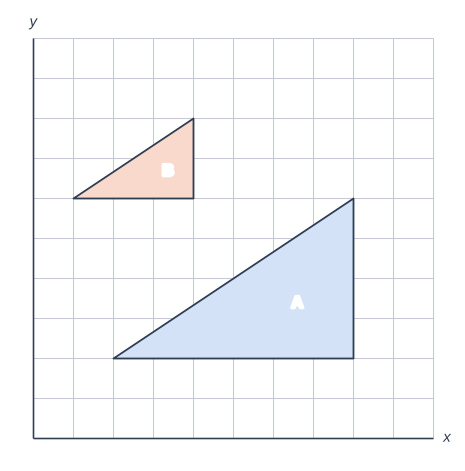
The grid shows shape A and shape B. Shape B is an enlargement of shape A.
Write down the scale factor of the enlargement.
Model answer
The base of A is 6 squares long and the base of B is 3 squares long. Scale factor \(= \dfrac{3}{6} = \dfrac{1}{2}\)
Explanation
The scale factor is new length ÷ original length, using a pair of corresponding sides. Shape B is smaller than shape A, so the scale factor is less than 1. A common mistake is to divide the wrong way round and give 2.
Mark scheme
1 mark
B1 for \(\dfrac{1}{2}\)
oe, e.g. 0.5; do not accept 2 or −2
Question 2
2 marks
Leo has a photo that is 6 cm long and 4 cm wide. He wants to enlarge the photo so that it fits exactly into a frame that is 20 cm long and 15 cm wide.
Can Leo do this? Give a reason for your answer.
Model answer
Length scale factor \(= 20 \div 6 = 3\frac{1}{3}\) Width scale factor \(= 15 \div 4 = 3.75\) The scale factors are different, so No, the photo cannot be enlarged to fit exactly.
Explanation
An enlargement multiplies every length by the same scale factor, so the length and the width must be multiplied by the same number. Here they would need different multipliers. Equivalently, the photo has ratio 3 : 2 but the frame has ratio 4 : 3, so their shapes are different.
Mark scheme
1 mark
M1 for comparing the scale factors 20 ÷ 6 and 15 ÷ 4 or the ratios of length to width
e.g. \(3\frac{1}{3}\) and 3.75, or 6 : 4 = 3 : 2 and 20 : 15 = 4 : 3, or 4 × \(\dfrac{20}{6}\) = \(13\frac{1}{3}\) (not 15)
1 mark
A1 for No with correct supporting values
must have correct values for both
Question 3
3 marks
On a map with a scale of 1 : 500 000, town B is 6 cm due east of town A. Town C is due south of town B. The real distance from town A to town C is 50 km.
Work out the distance from town B to town C on the map.
Model answer
1 cm represents 500 000 cm = 5 km AC on the map = 50 ÷ 5 = 10 cm Angle ABC = 90° (east and south are at right angles) BC \(= \sqrt{10^2 - 6^2} = \sqrt{64} = 8\) cm
Explanation
Due east and due south are at right angles, so triangle ABC has a right angle at B and AC is the hypotenuse. Work entirely on the map (change 50 km to 10 cm) or entirely in real life (change 6 cm to 30 km, find BC = 40 km, then change back to 8 cm).
Mark scheme
1 mark
M1 for a correct use of the scale, e.g. AB = 30 km or AC = 10 cm on the map
1 cm represents 5 km
1 mark
M1 for Pythagoras, e.g. \(\sqrt{50^2 - 30^2}\) or \(\sqrt{10^2 - 6^2}\)
ft their 30 or their 10
1 mark
A1 for 8 (cm)
correct answer with no working scores full marks
Question 4
4 marks
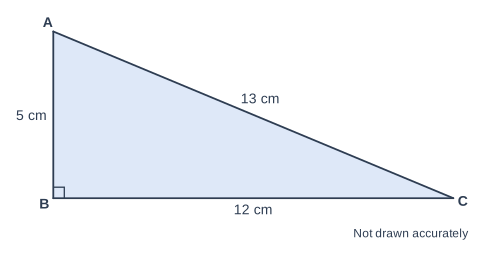
The diagram shows a plan of a triangular field ABC. The plan is drawn using a scale of 1 : 400
One bag of fertiliser covers 150 m² of the field. Work out the number of bags needed to cover the whole field.
Model answer
1 cm on the plan represents 400 cm = 4 m AB = 5 × 4 = 20 m BC = 12 × 4 = 48 m Area \(= \dfrac{1}{2} \times 20 \times 48 = 480\) m² 480 ÷ 150 = 3.2 So 4 bags are needed.
Explanation
Convert the two sides that meet at the right angle into real lengths, then use area = ½ × base × height (the 13 cm side is not needed). 3.2 bags is not enough to buy, so round up to 4. Squaring the scale (400² = 160 000) and multiplying the plan area of 30 cm² also works.
Mark scheme
1 mark
M1 for a correct conversion of a length, e.g. 5 × 400 = 2000 cm or 20 m, or 12 × 400 = 4800 cm or 48 m
or area scale factor 400² = 160 000
1 mark
M1 for \(\dfrac{1}{2} \times 20 \times 48\) or \(\dfrac{1}{2} \times 5 \times 12 \times 160\,000\)
ft their real lengths; must use the two perpendicular sides
1 mark
A1 for 480 (m²)
oe, e.g. 4 800 000 cm²
1 mark
B1ft for 4 (bags)
ft their area ÷ 150 rounded up to a whole number; correct answer with no working scores full marks
Ready to try the rest? Every answer you write is marked against the mark scheme, so you can see exactly where the marks are.
Ctrl + Enter to check
Study HelperHints first, answers after you try
Stuck on this one? Ask for a hint and I’ll point you in the right direction, without giving the answer away. Once you’ve checked your answer, I’ll show you how the marks are awarded.