Practise 36 exam-style questions on Vector arithmetic and proof for AQA GCSE Maths (Higher non-calculator). Write your answer as you would in the exam and get it marked in seconds against the mark scheme, point by point, with the Study Helper on hand if you get stuck.
36 questions
1–5 marks each
Instant marking
No sign-up needed
20 questions, marked as you go
Sample questions with model answers
Here are 4 of the questions in this topic, each with a model answer, an explanation of why it earns the marks and the mark scheme an examiner would use.
Multiplying a vector by a number multiplies both components. Then add the matching components. A zero component is fine - this vector points straight down.
Mark scheme
1 mark
M1 for \(3\mathbf{a} = \begin{pmatrix} 6 \\ -15 \end{pmatrix}\) or \(2\mathbf{b} = \begin{pmatrix} -6 \\ 2 \end{pmatrix}\)
or one correct component in the answer
1 mark
A1 for \(\begin{pmatrix} 0 \\ -13 \end{pmatrix}\)
correct answer with no working scores full marks
Question 2
2 marks
\(\overrightarrow{AB} = 3\mathbf{a} - 2\mathbf{b}\) and \(\overrightarrow{CD} = k\mathbf{a} + 6\mathbf{b}\) AB is parallel to CD.
Work out the value of k.
Model answer
CD is a multiple of AB. The b terms give 6 = −3 × (−2), so the multiplier is −3. \(\overrightarrow{CD} = -3(3\mathbf{a} - 2\mathbf{b}) = -9\mathbf{a} + 6\mathbf{b}\) k = −9
Explanation
Parallel vectors are multiples of each other, so the a and b coefficients are multiplied by the same number. Use the b terms, where both coefficients are known, to find the multiplier, then apply it to the a term.
Mark scheme
1 mark
M1 for the multiplier −3, e.g. \(6\mathbf{b} = -3 \times (-2\mathbf{b})\)
oe, e.g. \(\overrightarrow{CD} = -3\overrightarrow{AB}\) or \(\dfrac{k}{3} = \dfrac{6}{-2}\)
1 mark
A1 for k = −9
correct answer with no working scores full marks
Question 3
3 marks
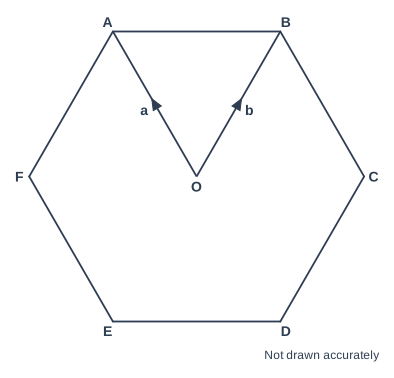
The diagram shows a regular hexagon ABCDEF with centre O. \(\overrightarrow{OA} = \mathbf{a}\) and \(\overrightarrow{OB} = \mathbf{b}\)
Write \(\overrightarrow{CE}\) in terms of \(\mathbf{a}\) and \(\mathbf{b}\). Give your answer in its simplest form.
Model answer
OABC is a rhombus, so \(\overrightarrow{BC} = \overrightarrow{AO} = -\mathbf{a}\) and \(\overrightarrow{OC} = \mathbf{b} - \mathbf{a}\). E is opposite B through the centre, so \(\overrightarrow{OE} = -\mathbf{b}\). \(\overrightarrow{CE} = \overrightarrow{CO} + \overrightarrow{OE} = -(\mathbf{b} - \mathbf{a}) - \mathbf{b} = \mathbf{a} - 2\mathbf{b}\)
Explanation
A regular hexagon is made of six equilateral triangles meeting at the centre, so many of its edges and radii are equal vectors: \(\overrightarrow{BC} = \overrightarrow{AO}\), \(\overrightarrow{OE} = -\overrightarrow{OB}\). Build the route from C to E out of vectors you know and simplify.
Mark scheme
1 mark
B1 for \(\overrightarrow{OC} = \mathbf{b} - \mathbf{a}\) or \(\overrightarrow{OE} = -\mathbf{b}\) or \(\overrightarrow{CD} = -\mathbf{b}\) or \(\overrightarrow{DE} = \mathbf{a} - \mathbf{b}\)
any one correct vector on a route from C to E
1 mark
M1 for a correct route from C to E, e.g. \(\overrightarrow{CE} = \overrightarrow{CO} + \overrightarrow{OE}\) or \(\overrightarrow{CD} + \overrightarrow{DE}\), with at least one correct vector
1 mark
A1 for \(\mathbf{a} - 2\mathbf{b}\)
oe; correct answer with no working scores full marks
Question 4
4 marks
\(\overrightarrow{OA} = \mathbf{a}\) and \(\overrightarrow{OB} = \mathbf{b}\) C is the point with \(\overrightarrow{OC} = 2\mathbf{a} + \mathbf{b}\) D is the point on OB extended such that \(\overrightarrow{OD} = k\mathbf{b}\) CD is parallel to AB.
Work out the value of k.
Model answer
\(\overrightarrow{AB} = -\mathbf{a} + \mathbf{b}\) \(\overrightarrow{CD} = \overrightarrow{OD} - \overrightarrow{OC} = k\mathbf{b} - 2\mathbf{a} - \mathbf{b} = -2\mathbf{a} + (k - 1)\mathbf{b}\) CD is parallel to AB, so \(\overrightarrow{CD} = \lambda(-\mathbf{a} + \mathbf{b})\). Comparing a terms: λ = 2 Comparing b terms: k − 1 = 2, so k = 3
Explanation
Parallel means one vector is a multiple of the other. Write \(\overrightarrow{CD}\) in terms of a, b and k, then match the coefficients: the a terms fix the multiplier, and the b terms then give k.
Mark scheme
1 mark
M1 for \(\overrightarrow{AB} = \mathbf{b} - \mathbf{a}\)
oe
1 mark
M1 for \(\overrightarrow{CD} = k\mathbf{b} - 2\mathbf{a} - \mathbf{b}\)
oe, e.g. \(-2\mathbf{a} + (k - 1)\mathbf{b}\)
1 mark
M1dep for \(\overrightarrow{CD} = 2\overrightarrow{AB}\) from comparing the a terms, or \(-2\mathbf{a} + (k - 1)\mathbf{b} = \lambda(-\mathbf{a} + \mathbf{b})\) with λ = 2
oe
1 mark
A1 for k = 3
correct answer with no working scores full marks
Ready to try the rest? Every answer you write is marked against the mark scheme, so you can see exactly where the marks are.
Ctrl + Enter to check
Study HelperHints first, answers after you try
Stuck on this one? Ask for a hint and I’ll point you in the right direction, without giving the answer away. Once you’ve checked your answer, I’ll show you how the marks are awarded.