Practise 18 exam-style questions on Geometric notation, polygons and symmetry for AQA GCSE Maths (Higher non-calculator). Write your answer as you would in the exam and get it marked in seconds against the mark scheme, point by point, with the Study Helper on hand if you get stuck.
18 questions
1–5 marks each
Instant marking
No sign-up needed
18 questions, marked as you go
Sample questions with model answers
Here are 4 of the questions in this topic, each with a model answer, an explanation of why it earns the marks and the mark scheme an examiner would use.
Question 1
1 mark
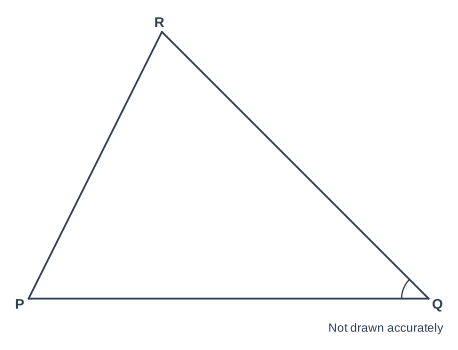
The diagram shows triangle PQR. One angle is marked.
Which of these is the correct way to write the marked angle?
Choose your answer.
\(\angle QPR\)
\(\angle PQR\)
\(\angle PRQ\)
\(\angle QRP\)
Model answer
\(\angle PQR\): the angle is at vertex Q, between the sides QP and QR.
Explanation
In three-letter angle notation, the middle letter is the vertex where the angle is, and the other two letters are on the two arms. The marked angle is at Q, so Q goes in the middle: \(\angle PQR\) (or \(\angle RQP\)). \(\angle QPR\) is the angle at P, and both \(\angle PRQ\) and \(\angle QRP\) are the angle at R.
Mark scheme
1 mark
B1 for \(\angle PQR\)
accept \(\angle RQP\) or \(\angle Q\) if written instead
Question 2
2 marks
Tom says, "Any polygon with rotational symmetry of order 8 must be a regular octagon."
Is Tom correct? Give a reason for your answer.
Model answer
No. An 8-pointed star, with 8 outer points and 8 inner corners, is a polygon with 16 sides. It looks the same after every turn of 45°, so it has rotational symmetry of order 8, but it is not a regular octagon.
Explanation
One counter-example is enough to show a general statement is false. An octagon with rotational symmetry of order 8 would have to be regular, but a polygon with more sides can also have order 8, for example a star shape. Order of rotational symmetry counts the positions in one full turn where the shape looks the same.
Mark scheme
1 mark
B1 for a correct counter-example, e.g. an 8-pointed star (a polygon with 16 sides) has rotational symmetry of order 8
oe, any polygon with order 8 that is not a regular octagon; a regular 16-sided polygon is not a counter-example (its order is 16)
1 mark
B1dep for No with a correct counter-example
No alone scores 0
Question 3
3 marks
A(1, 2), B(4, 3) and C(3, 6) are three vertices of a square ABCD.
Work out the coordinates of D.
Model answer
The vertices go round the square in order A, B, C, D. From B to C: 1 left and 3 up. AD is parallel and equal to BC, so from A go 1 left and 3 up: D = (1 − 1, 2 + 3) = (0, 5) Check: from D to C is 3 right and 1 up, the same as from A to B.
Explanation
The letters of a polygon are written in order round the shape, so D is next to both C and A, and BD is a diagonal. In a square, opposite sides are equal and parallel, so the step from A to D is the same as the step from B to C. Drawing a quick sketch on squared paper helps you see this.
Mark scheme
1 mark
M1 for the movement from A to B (3 right, 1 up) or from B to C (1 left, 3 up)
oe, e.g. column vectors \(\begin{pmatrix}3\\1\end{pmatrix}\) or \(\begin{pmatrix}-1\\3\end{pmatrix}\)
1 mark
M1dep for applying the movement B to C to point A, or the reverse of A to B to point C
or using the midpoint of AC, (2, 4), as the midpoint of BD
1 mark
A1 for (0, 5)
correct answer with no working scores full marks
Question 4
4 marks
ABCD is a rectangle with AB = 12 cm and BC = 8 cm. E is the point on DC such that AE = BE.
Work out the perimeter of triangle ABE.
Model answer
AE = BE, so E is on the perpendicular bisector of AB, which is the line of symmetry of the rectangle. So E is the midpoint of DC and DE = 6 cm. Triangle ADE has a right angle at D, with AD = BC = 8 cm. \(AE^2 = 6^2 + 8^2 = 36 + 64 = 100\), so AE = 10 cm BE = AE = 10 cm Perimeter of ABE \(= 12 + 10 + 10 = 32\) cm
Explanation
Sketch the rectangle from the description, with the vertices in order round the shape. Points that are the same distance from A and B lie on the line of symmetry of the rectangle, so E is halfway along DC. Then Pythagoras' theorem in the right-angled triangle ADE gives AE.
Mark scheme
1 mark
B1 for E is the midpoint of DC, or DE = 6 cm
e.g. E lies on the line of symmetry of the rectangle
1 mark
M1 for \(AE^2 = 6^2 + 8^2\)
oe, ft their DE
1 mark
A1 for AE = 10 (cm)
1 mark
A1 for 32 (cm)
correct answer with no working scores full marks
Ready to try the rest? Every answer you write is marked against the mark scheme, so you can see exactly where the marks are.
Ctrl + Enter to check
Study HelperHints first, answers after you try
Stuck on this one? Ask for a hint and I’ll point you in the right direction, without giving the answer away. Once you’ve checked your answer, I’ll show you how the marks are awarded.