Practise 28 exam-style questions on Direct and inverse proportion problems for AQA GCSE Maths (Higher non-calculator). Write your answer as you would in the exam and get it marked in seconds against the mark scheme, point by point, with the Study Helper on hand if you get stuck.
28 questions
1–5 marks each
Instant marking
No sign-up needed
20 questions, marked as you go
Sample questions with model answers
Here are 4 of the questions in this topic, each with a model answer, an explanation of why it earns the marks and the mark scheme an examiner would use.
Question 1
2 marks
A recipe for 6 people uses 450 g of flour.
How much flour is needed to make the recipe for 10 people?
Model answer
Flour for 1 person = \(450 \div 6 = 75\) g Flour for 10 people = \(75 \times 10 = 750\) g
Explanation
The amount of flour is directly proportional to the number of people, so find the amount for one person (the unitary method) and multiply up. You could also use 2 people: 450 ÷ 3 = 150 g, then 150 × 5 = 750 g.
Mark scheme
1 mark
M1 for \(450 \div 6\) (= 75) or \(450 \times \dfrac{10}{6}\) oe
e.g. 450 ÷ 3 = 150 (for 2 people) then × 5
1 mark
A1 for 750 (g)
correct answer with no working scores full marks
Question 2
2 marks
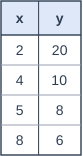
The table shows some values of \(x\) and \(y\).
Aisha says, "\(y\) is inversely proportional to \(x\)."
Is Aisha correct? You must show your working.
Model answer
If \(y\) is inversely proportional to \(x\), then \(xy\) is the same for every pair. \(2 \times 20 = 40\), \(4 \times 10 = 40\), \(5 \times 8 = 40\), but \(8 \times 6 = 48\) 48 ≠ 40, so Aisha is not correct.
Explanation
In inverse proportion \(y = \dfrac{k}{x}\), so \(xy = k\) for every pair of values. Testing every pair is important: the first three pairs fit, but the last one does not (for inverse proportion, \(y\) would be 5 when \(x = 8\)). One pair that does not fit is enough to show the statement is wrong.
Mark scheme
1 mark
M1 for finding \(xy\) for at least three pairs, e.g. 40, 40, 40, 48
or another correct test, e.g. x doubles from 4 to 8 but y does not halve (10 to 6)
1 mark
A1 for No with \(8 \times 6 = 48\) and 40 (or 6 ≠ 5) oe
must have correct values with the conclusion; answer only scores 0
Question 3
3 marks
The time taken to empty a tank is inversely proportional to the number of pumps used. With \(n\) pumps it takes 18 hours to empty the tank. With \((n + 3)\) pumps it takes 12 hours to empty the tank.
Work out the value of \(n\).
Model answer
In inverse proportion, number of pumps × time is constant. \(18n = 12(n + 3)\) \(18n = 12n + 36\) \(6n = 36\) \(n = 6\) (Check: \(6 \times 18 = 108\) and \(9 \times 12 = 108\))
Explanation
When two quantities are inversely proportional, their product is constant. Here the product is the total number of pump-hours needed to empty the tank, so the two products must be equal. This gives a linear equation in \(n\).
Mark scheme
1 mark
M1 for \(18n\) or \(12(n + 3)\) as the total work (pump-hours)
or \(T = \dfrac{k}{n}\) with \(k = 18n\)
1 mark
M1dep for \(18n = 12(n + 3)\) oe
1 mark
A1 for 6
a correct trial, e.g. \(18 \times 6 = 108 = 12 \times 9\), scores full marks; correct answer with no working scores full marks
Question 4
4 marks
A group of friends rent a holiday cottage. They share the total cost equally. If 6 friends share the cost, each pays £140 more than if 10 friends share the cost.
Work out the total cost of renting the cottage.
Model answer
Let the total cost be £\(C\). \(\dfrac{C}{6} - \dfrac{C}{10} = 140\) Multiply by 30: \(5C - 3C = 4200\) \(2C = 4200\) \(C = 2100\) Total cost = £2100 (Check: £350 each for 6 friends, £210 each for 10 friends, difference £140)
Explanation
The cost per person is inversely proportional to the number of friends: cost per person = total ÷ number of people. Writing both shares in terms of the total cost gives an equation; multiplying by 30, the lowest common multiple of 6 and 10, clears the fractions.
Mark scheme
1 mark
M1 for \(\dfrac{C}{6}\) and \(\dfrac{C}{10}\), or each of 10 pays \(p\) and each of 6 pays \(p + 140\)
oe
1 mark
M1dep for \(\dfrac{C}{6} - \dfrac{C}{10} = 140\) or \(6(p + 140) = 10p\) oe
1 mark
M1dep for \(\dfrac{C}{15} = 140\) or \(10C - 6C = 8400\), or \(p = 210\)
oe
1 mark
A1 for 2100
a correct trial, e.g. £2100 ÷ 6 = £350 and £2100 ÷ 10 = £210 with a difference of £140, scores full marks; correct answer with no working scores full marks
Ready to try the rest? Every answer you write is marked against the mark scheme, so you can see exactly where the marks are.
Ctrl + Enter to check
Study HelperHints first, answers after you try
Stuck on this one? Ask for a hint and I’ll point you in the right direction, without giving the answer away. Once you’ve checked your answer, I’ll show you how the marks are awarded.