Practise 37 exam-style questions on Pythagoras' theorem and trigonometry for AQA GCSE Maths (Higher non-calculator). Write your answer as you would in the exam and get it marked in seconds against the mark scheme, point by point, with the Study Helper on hand if you get stuck.
37 questions
1–5 marks each
Instant marking
No sign-up needed
20 questions, marked as you go
Sample questions with model answers
Here are 4 of the questions in this topic, each with a model answer, an explanation of why it earns the marks and the mark scheme an examiner would use.
Question 1
2 marks
A rectangular garden is 9 m long and 12 m wide. A straight path goes diagonally across the garden from one corner to the opposite corner.
The diagonal of a rectangle is the hypotenuse of a right-angled triangle whose shorter sides are the length and width. Square, add, then square root.
Mark scheme
1 mark
M1 for \(9^2 + 12^2\)
oe, e.g. 81 + 144 or 225
1 mark
A1 for 15 m
correct answer with no working scores full marks; condone missing units
Question 2
2 marks
Triangle PQR has a right angle at Q. PQ = 15 cm, QR = 8 cm and PR = 17 cm. Angle QPR = \(x\).
Write down the value of \(\cos x\) and the value of \(\tan x\).
Model answer
From angle P: the opposite side is QR = 8, the adjacent side is PQ = 15 and the hypotenuse is PR = 17. \(\cos x = \dfrac{15}{17}\) \(\tan x = \dfrac{8}{15}\)
Explanation
Identify the sides from the angle at P. The hypotenuse PR is opposite the right angle, QR is opposite P and PQ is next to P. Then cos = adjacent ÷ hypotenuse and tan = opposite ÷ adjacent.
Mark scheme
1 mark
B1 for \(\cos x = \dfrac{15}{17}\)
oe
1 mark
B1 for \(\tan x = \dfrac{8}{15}\)
oe
Question 3
3 marks
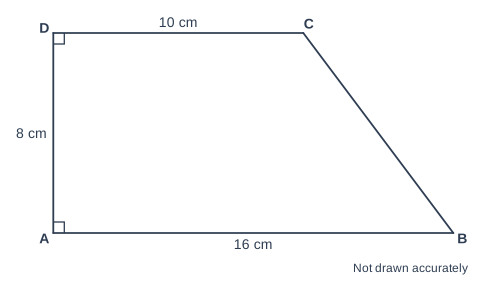
The diagram shows a trapezium ABCD. AB is parallel to DC. Angle DAB = angle ADC = 90°. AB = 16 cm, DC = 10 cm and AD = 8 cm.
Work out the perimeter of the trapezium.
Model answer
Draw a perpendicular from C to AB. It has length 8 cm and meets AB 10 cm from A, leaving 16 − 10 = 6 cm. \(BC^2 = 6^2 + 8^2 = 36 + 64 = 100\), so BC = 10 cm Perimeter = 16 + 10 + 10 + 8 = 44 cm
Explanation
The slanting side BC is the hypotenuse of a right-angled triangle made by dropping a perpendicular from C to AB. Its height is AD = 8 cm and its base is the difference of the parallel sides, 6 cm. Then add all four sides.
Mark scheme
1 mark
M1 for 16 − 10 (= 6)
the horizontal distance between C and B
1 mark
M1 for \(BC^2 = 6^2 + 8^2\)
oe; ft their 6; BC = 10 implies M1 M1
1 mark
A1 for 44 cm
correct answer with no working scores full marks; condone missing units
Question 4
4 marks
A boat sails 15 km due east from a port P to a point Q. It then sails 8 km due north from Q to a point R. The boat sails at a constant speed of 10 km/h.
How many minutes would the boat have saved if it had sailed in a straight line from P to R at the same speed?
East and north are at right angles, so the direct route is the hypotenuse of a right-angled triangle. Find the distance saved, then use time = distance ÷ speed. Remember to convert hours to minutes: 0.6 hours is 36 minutes, not 60 minutes or 6 minutes.
Mark scheme
1 mark
M1 for \(15^2 + 8^2\) (= 289)
oe
1 mark
A1 for PR = 17 km
1 mark
M1 for (15 + 8 − their 17) ÷ 10
oe, e.g. 6 ÷ 10 = 0.6 hours, or 2.3 h − 1.7 h
1 mark
A1 for 36 (minutes)
correct answer with no working scores full marks; 0.6 with no conversion scores M1 A1 M1 A0
Ready to try the rest? Every answer you write is marked against the mark scheme, so you can see exactly where the marks are.
Ctrl + Enter to check
Study HelperHints first, answers after you try
Stuck on this one? Ask for a hint and I’ll point you in the right direction, without giving the answer away. Once you’ve checked your answer, I’ll show you how the marks are awarded.