Practise 29 exam-style questions on Vector arithmetic and proof for AQA GCSE Maths (Higher calculator). Write your answer as you would in the exam and get it marked in seconds against the mark scheme, point by point, with the Study Helper on hand if you get stuck.
29 questions
1–5 marks each
Instant marking
No sign-up needed
20 questions, marked as you go
Sample questions with model answers
Here are 4 of the questions in this topic, each with a model answer, an explanation of why it earns the marks and the mark scheme an examiner would use.
Question 1
1 mark
\(\overrightarrow{OA} = \mathbf{a}\) and \(\overrightarrow{OB} = \mathbf{b}\)
Zara writes
\(\overrightarrow{AB} = \mathbf{a} - \mathbf{b}\)
What mistake has Zara made?
Model answer
\(\overrightarrow{AB} = \overrightarrow{AO} + \overrightarrow{OB} = -\mathbf{a} + \mathbf{b} = \mathbf{b} - \mathbf{a}\) Zara's answer, \(\mathbf{a} - \mathbf{b}\), is the vector \(\overrightarrow{BA}\): she has the direction reversed.
Explanation
The vector from A to B is 'end minus start': \(\overrightarrow{OB} - \overrightarrow{OA}\). Going against an arrow changes its sign, so A to O is \(-\mathbf{a}\). Zara's vector has the right length but points the opposite way.
Mark scheme
1 mark
B1 for a correct description, e.g. she has found \(\overrightarrow{BA}\) instead of \(\overrightarrow{AB}\); \(\overrightarrow{AB}\) should be \(\mathbf{b} - \mathbf{a}\)
oe, e.g. 'she subtracted the wrong way round', 'she went from B to A', 'AB = −a + b'
Question 2
2 marks
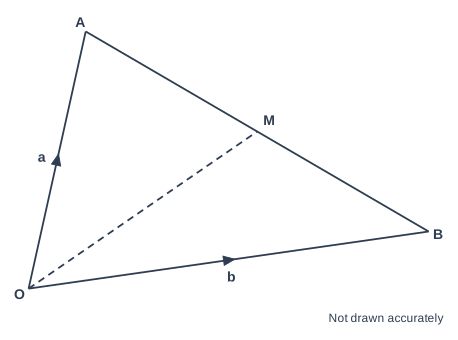
The diagram shows triangle OAB. \(\overrightarrow{OA} = \mathbf{a}\) and \(\overrightarrow{OB} = \mathbf{b}\) M is the midpoint of AB.
Work out \(\overrightarrow{OM}\) in terms of \(\mathbf{a}\) and \(\mathbf{b}\). Give your answer in its simplest form.
Go from O to A, then half way along AB. Expanding the bracket and collecting terms gives \(\frac{1}{2}(\mathbf{a} + \mathbf{b})\): the position of a midpoint is the average of the two end vectors. A common error is to write \(\frac{1}{2}\overrightarrow{AB}\) as the answer, which only gets you from A to M.
Mark scheme
1 mark
M1 for \(\overrightarrow{AB} = \mathbf{b} - \mathbf{a}\) or \(\overrightarrow{OM} = \mathbf{a} + \frac{1}{2}(\mathbf{b} - \mathbf{a})\)
oe, e.g. \(\mathbf{b} + \frac{1}{2}(\mathbf{a} - \mathbf{b})\)
1 mark
A1 for \(\frac{1}{2}\mathbf{a} + \frac{1}{2}\mathbf{b}\)
oe, e.g. \(\frac{1}{2}(\mathbf{a} + \mathbf{b})\)
Question 3
3 marks
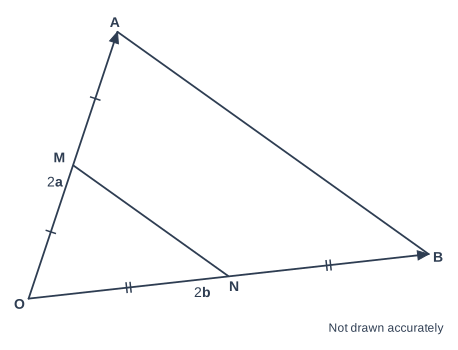
The diagram shows triangle OAB. \(\overrightarrow{OA} = 2\mathbf{a}\) and \(\overrightarrow{OB} = 2\mathbf{b}\) M is the midpoint of OA and N is the midpoint of OB.
Prove that MN is parallel to AB and half the length of AB.
Model answer
\(\overrightarrow{OM} = \mathbf{a}\) and \(\overrightarrow{ON} = \mathbf{b}\) \(\overrightarrow{MN} = \overrightarrow{MO} + \overrightarrow{ON} = -\mathbf{a} + \mathbf{b} = \mathbf{b} - \mathbf{a}\) \(\overrightarrow{AB} = \overrightarrow{AO} + \overrightarrow{OB} = -2\mathbf{a} + 2\mathbf{b} = 2(\mathbf{b} - \mathbf{a})\) So \(\overrightarrow{AB} = 2\overrightarrow{MN}\). \(\overrightarrow{AB}\) is a multiple of \(\overrightarrow{MN}\), so MN is parallel to AB, and MN is half the length of AB.
Explanation
Write both vectors in terms of \(\mathbf{a}\) and \(\mathbf{b}\) and compare them. If one vector is a scalar multiple of another they are parallel, and the scalar tells you the ratio of their lengths. Factorising \(-2\mathbf{a} + 2\mathbf{b}\) as \(2(\mathbf{b} - \mathbf{a})\) makes the multiple easy to see.
Mark scheme
1 mark
M1 for \(\overrightarrow{MN} = -\mathbf{a} + \mathbf{b}\)
oe, e.g. \(\mathbf{b} - \mathbf{a}\)
1 mark
M1 for \(\overrightarrow{AB} = -2\mathbf{a} + 2\mathbf{b}\)
oe
1 mark
A1 for \(\overrightarrow{AB} = 2\overrightarrow{MN}\) (or \(\overrightarrow{MN} = \frac{1}{2}\overrightarrow{AB}\)) with a conclusion that MN is parallel to AB and half its length
must state both parallel and half the length
Question 4
4 marks
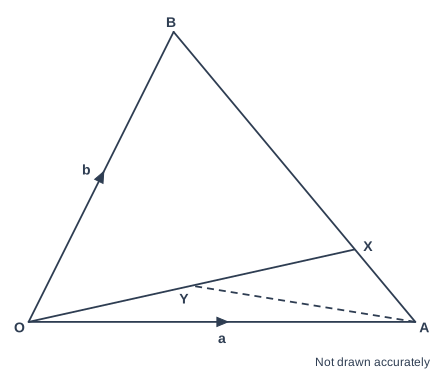
The diagram shows triangle OAB. \(\overrightarrow{OA} = \mathbf{a}\) and \(\overrightarrow{OB} = \mathbf{b}\) X is the point on AB such that AX : XB = 1 : 3 Y is the midpoint of OX.
Work out \(\overrightarrow{AY}\) in terms of \(\mathbf{a}\) and \(\mathbf{b}\). Give your answer in its simplest form.
Build up the answer one step at a time: the ratio 1 : 3 means AX is \(\frac{1}{4}\) of AB, which gives \(\overrightarrow{OX}\); halving that gives \(\overrightarrow{OY}\); then go from A back to O and on to Y. Collect the \(\mathbf{a}\) terms carefully: \(-1 + \frac{3}{8} = -\frac{5}{8}\).
Mark scheme
1 mark
M1 for \(\overrightarrow{AX} = \frac{1}{4}(\mathbf{b} - \mathbf{a})\)
oe
1 mark
A1 for \(\overrightarrow{OX} = \frac{3}{4}\mathbf{a} + \frac{1}{4}\mathbf{b}\)
oe
1 mark
M1 for \(\overrightarrow{OY} = \frac{1}{2}\overrightarrow{OX}\) and \(\overrightarrow{AY} = -\mathbf{a} + \overrightarrow{OY}\)
ft their \(\overrightarrow{OX}\); or \(\overrightarrow{AY} = \overrightarrow{AX} + \frac{1}{2}\overrightarrow{XO}\)
1 mark
A1 for \(-\frac{5}{8}\mathbf{a} + \frac{1}{8}\mathbf{b}\)
oe, e.g. \(\frac{1}{8}(\mathbf{b} - 5\mathbf{a})\)
Ready to try the rest? Every answer you write is marked against the mark scheme, so you can see exactly where the marks are.
Ctrl + Enter to check
Study HelperHints first, answers after you try
Stuck on this one? Ask for a hint and I’ll point you in the right direction, without giving the answer away. Once you’ve checked your answer, I’ll show you how the marks are awarded.