
Level:
Correct: 0
Incorrect: 0
Marks: 0/0
Exam Practice
Course:
Topics:
AQA GCSE Maths (Higher calculator) Smart practice A mixed round aimed at your weak spots
Unit 1
Number
Unit 2
Algebra
Unit 3
Ratio, proportion and rates of change
Unit 4
Geometry and measures
Unit 5
Probability
Unit 6
Statistics
Avg
score:
–
Topics
done:
0/97

Direct and inverse proportion problems

Practise 29 exam-style questions on Direct and inverse proportion problems for AQA GCSE Maths (Higher calculator). Write your answer as you would in the exam and get it marked in seconds against the mark scheme, point by point, with the Study Helper on hand if you get stuck.

  • 29 questions
  • 1–5 marks each
  • Instant marking
  • No sign-up needed
20 questions, marked as you go

Sample questions with model answers

Here are 4 of the questions in this topic, each with a model answer, an explanation of why it earns the marks and the mark scheme an examiner would use.

Question 1

1 mark

The graph shows the cost of hiring a van for one day for different distances driven.

Amy says,
"The cost is directly proportional to the distance driven."

Is Amy correct?
Give a reason for your answer.
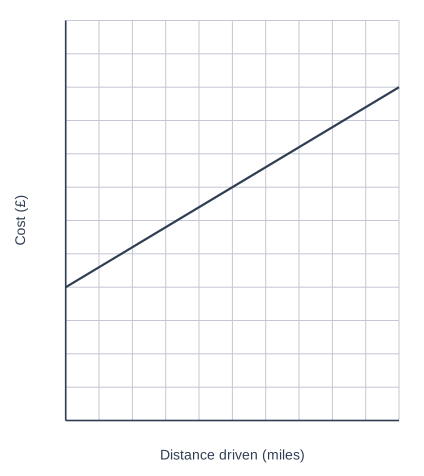
A graph of Cost (£) (vertical axis, 0 to 120, marked every 10) against Distance driven (miles) (horizontal axis, 0 to 200, marked every 20), on a grid. The graph is a straight line joining (0, 40) and (200, 100).

Model answer

No. The graph is a straight line but it does not pass through the origin: the cost is £40 even for 0 miles. Doubling the distance from 100 to 200 miles does not double the cost (£70 to £100).

Explanation

A graph of direct proportion is a straight line through the origin, because zero distance must give zero cost. This line starts at £40, a fixed charge, so the cost is not directly proportional to the distance even though the graph is a straight line.

Mark scheme
  1. 1 mark

    B1 for No with a correct reason, e.g. the line does not pass through the origin

    accept 'it costs £40 to drive 0 miles', or a correct numerical reason, e.g. 100 miles costs £70 but 200 miles costs £100, not £140; do not accept 'No' with no reason or with an incorrect reason
Question 2

2 marks

Here are three pairs of values of x and y.

x = 12, y = 30
x = 18, y = 45
x = 28, y = 70

Show that y could be directly proportional to x.

Model answer

\(30 \div 12 = 2.5\)
\(45 \div 18 = 2.5\)
\(70 \div 28 = 2.5\)
\(y \div x\) is the same for every pair, so \(y = 2.5x\) fits all three pairs. So y could be directly proportional to x.

Explanation

If y is directly proportional to x then \(y = kx\), so \(y \div x\) must give the same value k for every pair. You must check all three pairs: two pairs on their own would fit a direct proportion whatever they were. Saying 'y goes up when x goes up' is not enough.

Mark scheme
  1. 1 mark

    M1 for working out \(y \div x\) (or \(x \div y\)) for at least two pairs, e.g. \(30 \div 12 = 2.5\) and \(45 \div 18 = 2.5\)

    or finding k = 2.5 from one pair and using it to check another pair, e.g. \(2.5 \times 18 = 45\)

  2. 1 mark

    A1 for showing all three pairs give 2.5 (or 0.4) with a conclusion, e.g. y = 2.5x for every pair

    answer only scores 0

Question 3

3 marks

A coach completes a journey in 2 hours 15 minutes at an average speed of 64 km/h.

On the return journey along the same route, the coach travels at an average speed of 80 km/h.

How long does the return journey take?
Give your answer in hours and minutes.

Model answer

2 hours 15 minutes = 2.25 hours
Distance: \(64 \times 2.25 = 144\) km
Return time: \(144 \div 80 = 1.8\) hours
\(0.8 \times 60 = 48\) minutes
1 hour 48 minutes

Explanation

For a fixed distance, the time is inversely proportional to the speed, so speed × time stays the same (it is the distance, 144 km). The common mistakes are writing 2 hours 15 minutes as 2.15 hours and reading 1.8 hours as 1 hour 80 minutes; 15 minutes is 0.25 hours and 0.8 hours is 48 minutes.

Mark scheme
  1. 1 mark

    M1 for 2.25 hours or 135 minutes

    or \(64 \times 2.25\) (= 144 km) seen

  2. 1 mark

    M1 for \(64 \times 2.25 \div 80\) (= 1.8) or \(135 \times 64 \div 80\) (= 108)

    oe, e.g. \(144 \div 80\); condone \(64 \times 2.15 \div 80\) for this mark only

  3. 1 mark

    A1 for 1 hour 48 minutes

    do not accept 1 hour 80 minutes or 1.8 hours on its own; correct answer with no working scores full marks

Question 4

4 marks

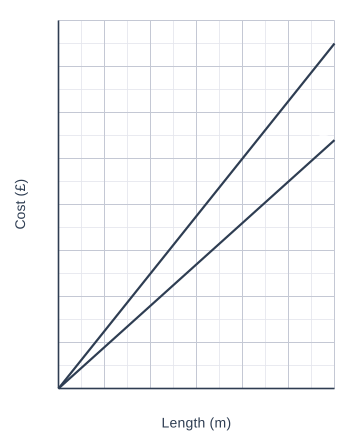
The graph shows the cost of two types of cable, A and B.
For each type, the cost is directly proportional to the length.

Kim needs 35 m of cable.

How much more would 35 m of cable A cost than 35 m of cable B?

A graph of Cost (£) (vertical axis, 0 to 80, marked every 10) against Length (m) (horizontal axis, 0 to 30, marked every 5), on a grid with 2 small squares to each large square. Graph A is a straight line; its values can be read from the grid. Graph B is a straight line; its values can be read from the grid. Graph A and graph B cross at one point, which can be read from the grid.

Model answer

From the graph, 20 m of cable A costs £50, so A costs \(50 \div 20 = 2.5\), £2.50 per metre
From the graph, 25 m of cable B costs £45, so B costs \(45 \div 25 = 1.8\), £1.80 per metre
35 m of A: \(35 \times 2.50 = 87.50\)
35 m of B: \(35 \times 1.80 = 63.00\)
\(87.50 - 63.00 = 24.50\)
£24.50

Explanation

35 m is beyond the graph, so read a pair of values from each line where it crosses grid lines exactly, find the cost per metre, and scale up. You could also find the difference per metre, £0.70, and multiply by 35. Choose points where the line is exactly on a grid line, so your readings are accurate.

Mark scheme
  1. 1 mark

    M1 for a correct pair read from line A used to find the cost of 1 m or to scale, e.g. \(50 \div 20\) (= 2.5)

    or 75 at 30 m; oe, e.g. cost of 35 m of A = 87.50

  2. 1 mark

    M1 for a correct pair read from line B used to find the cost of 1 m or to scale, e.g. \(45 \div 25\) (= 1.8)

    oe, e.g. cost of 35 m of B = 63

  3. 1 mark

    M1dep for \(35 \times 2.5 - 35 \times 1.8\) or \(35 \times 0.7\)

    dependent on at least one previous M1; ft their costs per metre

  4. 1 mark

    A1 for £24.50

    accept £24.5; correct answer with no working scores full marks

Ready to try the rest? Every answer you write is marked against the mark scheme, so you can see exactly where the marks are.

Study Helper Hints first, answers after you try

Stuck on this one? Ask for a hint and I’ll point you in the right direction, without giving the answer away. Once you’ve checked your answer, I’ll show you how the marks are awarded.