Practise 36 exam-style questions on Areas and volumes of prisms for AQA GCSE Maths (Higher calculator). Write your answer as you would in the exam and get it marked in seconds against the mark scheme, point by point, with the Study Helper on hand if you get stuck.
36 questions
1–5 marks each
Instant marking
No sign-up needed
20 questions, marked as you go
Sample questions with model answers
Here are 4 of the questions in this topic, each with a model answer, an explanation of why it earns the marks and the mark scheme an examiner would use.
Question 1
2 marks
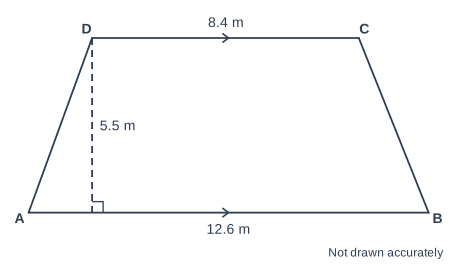
The diagram shows a patio in the shape of a trapezium.
Work out the area of the patio.
Model answer
Area of a trapezium = \(\frac{1}{2}(a + b)h\) Area = \(\frac{1}{2} \times (12.6 + 8.4) \times 5.5\) = \(\frac{1}{2} \times 21 \times 5.5 = 57.75\) m²
Explanation
Add the two parallel sides, halve the total (this is the average width) and multiply by the perpendicular distance between them. Forgetting to add the parallel sides before halving is a common error.
Mark scheme
1 mark
M1 for \(\frac{1}{2} \times (12.6 + 8.4) \times 5.5\)
oe, e.g. splitting into a rectangle and two triangles
1 mark
A1 for 57.75 m²
exact value; correct answer with no working scores full marks
Question 2
2 marks
A parallelogram has a base of 7.5 cm and a perpendicular height of 4 cm. A triangle has the same area as the parallelogram. The base of the triangle is 6 cm.
Work out the perpendicular height of the triangle.
Model answer
Area of parallelogram = 7.5 × 4 = 30 cm² \(\frac{1}{2} \times 6 \times h = 30\) \(3h = 30\) \(h = 10\) cm
Explanation
Work out the parallelogram's area (base × height), then use the triangle formula backwards. Because a triangle's area includes a half, its height must be larger: dividing 30 by 6 and getting 5 forgets the half.
Mark scheme
1 mark
M1 for \(7.5 \times 4\) (= 30) and \(\frac{1}{2} \times 6 \times h = 30\)
oe, e.g. 30 × 2 ÷ 6
1 mark
A1 for 10 cm
correct answer with no working scores full marks
Question 3
3 marks
A solid metal cuboid measures 20 cm by 15 cm by 8 cm. It is melted down and the metal is used to make solid cylinders. Each cylinder has a radius of 2 cm and a height of 5 cm.
Work out the greatest number of complete cylinders that can be made.
Model answer
Volume of the cuboid = 20 × 15 × 8 = 2400 cm³ Volume of one cylinder = \(\pi \times 2^2 \times 5 = 20\pi = 62.83...\) cm³ 2400 ÷ 62.83... = 38.19... The greatest number of complete cylinders is 38.
Explanation
The volume of metal does not change when it is melted. Divide the total volume by the volume of one cylinder and round down, because only complete cylinders count. Rounding to 39 is wrong: there is not enough metal for a 39th cylinder.
Mark scheme
1 mark
M1 for \(20 \times 15 \times 8\) (= 2400)
1 mark
M1 for their 2400 \(\div (\pi \times 2^2 \times 5)\)
oe, e.g. 2400 ÷ 62.83... = 38.19...
1 mark
A1 for 38
do not accept 38.2 or 39; correct answer with no working scores full marks
Question 4
4 marks
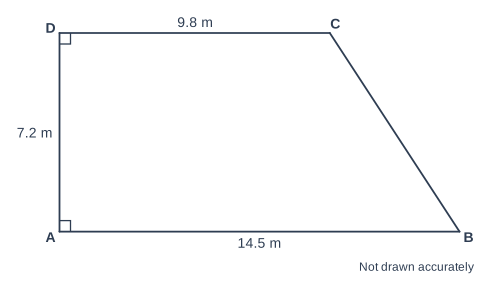
The diagram shows a lawn in the shape of a trapezium.
Fertiliser is spread on the lawn at a rate of 35 g per m². Fertiliser is sold in 1.5 kg boxes costing £8.99 each.
Work out the cost of the fertiliser needed for the lawn.
Model answer
Area = \(\frac{1}{2} \times (14.5 + 9.8) \times 7.2 = 87.48\) m² Fertiliser = 87.48 × 35 = 3061.8 g = 3.0618 kg 3.0618 ÷ 1.5 = 2.04..., so 3 boxes are needed Cost = 3 × 8.99 = £26.97
Explanation
Find the area of the trapezium, then the mass of fertiliser, and change grams to kilograms to compare with the box size. Two boxes (3 kg) are not quite enough, so 3 boxes must be bought.
Mark scheme
1 mark
M1 for \(\frac{1}{2} \times (14.5 + 9.8) \times 7.2\)
oe, e.g. 9.8 × 7.2 + ½ × 4.7 × 7.2
1 mark
A1 for 87.48 m²
exact value
1 mark
M1 for their \(87.48 \times 35\) (= 3061.8 g) and dividing by 1500 or comparing with whole boxes
oe, e.g. 3.0618 kg ÷ 1.5 = 2.04...
1 mark
A1 for £26.97
correct answer with no working scores full marks
Ready to try the rest? Every answer you write is marked against the mark scheme, so you can see exactly where the marks are.
Ctrl + Enter to check
Study HelperHints first, answers after you try
Stuck on this one? Ask for a hint and I’ll point you in the right direction, without giving the answer away. Once you’ve checked your answer, I’ll show you how the marks are awarded.