
Level:
Correct: 0
Incorrect: 0
Marks: 0/0
Exam Practice
Course:
Topics:
AQA GCSE Maths (Higher calculator) Smart practice A mixed round aimed at your weak spots
Unit 1
Number
Unit 2
Algebra
Unit 3
Ratio, proportion and rates of change
Unit 4
Geometry and measures
Unit 5
Probability
Unit 6
Statistics
Avg
score:
–
Topics
done:
0/97

Linear equations

Practise 28 exam-style questions on Linear equations for AQA GCSE Maths (Higher calculator). Write your answer as you would in the exam and get it marked in seconds against the mark scheme, point by point, with the Study Helper on hand if you get stuck.

  • 28 questions
  • 1–5 marks each
  • Instant marking
  • No sign-up needed
20 questions, marked as you go

Sample questions with model answers

Here are 4 of the questions in this topic, each with a model answer, an explanation of why it earns the marks and the mark scheme an examiner would use.

Question 1

2 marks

Solve 3.6x + 1.9 = 12.7

Model answer

3.6x + 1.9 = 12.7
3.6x = 12.7 − 1.9 = 10.8
x = 10.8 ÷ 3.6
x = 3

Explanation

Undo the operations in reverse order: subtract 1.9 from both sides first, then divide both sides by 3.6. Dividing by 3.6 before subtracting 1.9 is a common mistake, because the 1.9 would also need dividing.

Mark scheme
  1. 1 mark

    M1 for 3.6x = 10.8

    oe, e.g. 3.6x = 12.7 − 1.9

  2. 1 mark

    A1 for x = 3

    correct answer with no working scores full marks
Question 2

2 marks

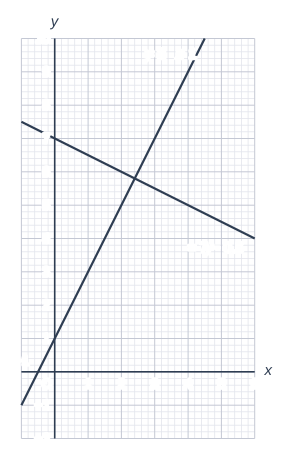
The diagram shows the graphs of y = 2x + 1 and y = 7 − 0.5x

Use the graph to find an approximate solution to the equation 2x + 1 = 7 − 0.5x

A coordinate grid with x from −1 to 6 and y from −2 to 10; each grid square is 1 unit across (with 5 small squares along each side of a large square), and the axes cross at the origin O. The line labelled "y = 2x + 1" is a straight line sloping upwards from left to right crossing the y-axis at (0, 1) and crossing the x-axis at (−0.5, 0). The line labelled "y = 7 − 0.5x" is a straight line sloping downwards from left to right crossing the y-axis at (0, 7) and passing through (2, 6). The line labelled "y = 2x + 1" and the line labelled "y = 7 − 0.5x" cross at one point, which can be read from the grid.

Model answer

The two sides of the equation are the two lines, so the solution is where they cross.
The lines intersect at about (2.4, 5.8)
x ≈ 2.4

Explanation

The left-hand side of the equation is the line y = 2x + 1 and the right-hand side is y = 7 − 0.5x, so they are equal where the lines meet. The solution is the x-coordinate of that point, not the y-coordinate. Algebra confirms it: 2.5x = 6, so x = 2.4.

Mark scheme
  1. 1 mark

    M1 for using the point of intersection of the two lines

    may be implied by an answer in range; reading only the y-coordinate (5.8) scores M1 only

  2. 1 mark

    A1 for x = 2.4

    accept [2.3, 2.5]

Question 3

3 marks

Water drains out of a tank.
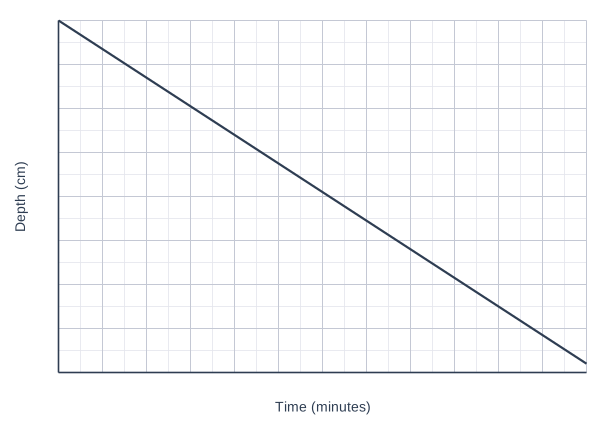
The depth of water in the tank, d cm, t minutes after it starts to drain is given by d = 80 − 6.5t
The graph of d against t is shown.

Use the graph to estimate the time when the depth is 30 cm.
Then solve an equation to find this time to 1 decimal place.

A graph of Depth (cm) (vertical axis, 0 to 80, marked every 10) against Time (minutes) (horizontal axis, 0 to 12, marked every 1), on a grid with 2 small squares to each large square. The graph is a straight line joining (0, 80) and (12, 2).

Model answer

From the graph: go across from 30 on the depth axis to the line, then down. t ≈ 7.7 minutes
Algebra:
80 − 6.5t = 30
50 = 6.5t
t = 50 ÷ 6.5 = 7.692...
t = 7.7 minutes (1 d.p.)

Explanation

On the graph, the time when the depth is 30 cm is the t-coordinate of the point on the line at height 30. Algebraically, substitute d = 30 and solve the linear equation. The graph gives a quick estimate; the equation gives the accurate answer, and the two should agree.

Mark scheme
  1. 1 mark

    B1 for an estimate from the graph in the range [7.4, 8] minutes

  2. 1 mark

    M1 for 80 − 6.5t = 30

    oe, e.g. 6.5t = 50

  3. 1 mark

    A1 for 7.7 minutes

    accept [7.69, 7.7] (7.692...)

Question 4

4 marks

A car travels for x hours at an average speed of 48 km/h.
It then travels for (x + 0.5) hours at an average speed of 64 km/h.
The total distance travelled is 172 km.

Work out the total time of the journey.

Model answer

Distance = speed × time
48x + 64(x + 0.5) = 172
48x + 64x + 32 = 172
112x = 140
x = 1.25
Total time = x + (x + 0.5) = 1.25 + 1.75 = 3 hours

Explanation

Each part of the journey gives a distance of speed × time, and the two distances add up to 172 km. Solve for x, then answer the question that was asked: the total time is x + x + 0.5. Check: 48 × 1.25 = 60 km and 64 × 1.75 = 112 km, which add to 172 km.

Mark scheme
  1. 1 mark

    M1 for 48x or 64(x + 0.5) as a distance

  2. 1 mark

    M1dep for 48x + 64(x + 0.5) = 172

    oe

  3. 1 mark

    M1dep for 112x = 140 or x = 1.25

    oe

  4. 1 mark

    A1 for 3 hours

    1.25 (x) only scores M3; correct answer with no working scores full marks
Ready to try the rest? Every answer you write is marked against the mark scheme, so you can see exactly where the marks are.

Study Helper Hints first, answers after you try

Stuck on this one? Ask for a hint and I’ll point you in the right direction, without giving the answer away. Once you’ve checked your answer, I’ll show you how the marks are awarded.