Practise 18 exam-style questions on Parts of a circle for AQA GCSE Maths (Higher calculator). Write your answer as you would in the exam and get it marked in seconds against the mark scheme, point by point, with the Study Helper on hand if you get stuck.
18 questions
1–5 marks each
Instant marking
No sign-up needed
18 questions, marked as you go
Sample questions with model answers
Here are 4 of the questions in this topic, each with a model answer, an explanation of why it earns the marks and the mark scheme an examiner would use.
Question 1
1 mark
Which one of these statements is always true?
Choose your answer.
Every chord is a diameter.
A diameter is a chord.
A tangent passes through the centre.
A radius is a chord.
Model answer
A diameter joins two points on the circle, so it is a chord (the one that passes through the centre). A diameter is a chord.
Explanation
A chord is any straight line joining two points on a circle, so a diameter is a chord - the longest one - but most chords do not pass through the centre, so not every chord is a diameter. A radius has one end at the centre, not on the circle, and a tangent touches the circle without passing through the centre.
Mark scheme
1 mark
B1 for A diameter is a chord.
Question 2
2 marks
Ella says,
"A tangent to a circle is a straight line that cuts the circle at two points."
What mistake has Ella made?
Model answer
A straight line that cuts the circle at two points is not a tangent - the part of it inside the circle is a chord. A tangent touches the circle at exactly one point and does not cross into the circle.
Explanation
A tangent just touches a circle at a single point, and at that point it is perpendicular to the radius. A line that crosses the circle meets it twice, and the piece between the two points is a chord. Learn the exact definitions, because AQA often asks you to name or define parts of a circle.
Mark scheme
1 mark
B1 for a line that cuts the circle at two points is not a tangent
accept the part of it inside the circle is a chord, or it is a secant
1 mark
B1 for a tangent touches the circle at exactly one point
accept 'meets the circle at only one point' oe; do not accept 'touches the edge' without 'one point'
Question 3
3 marks
Two radii divide a circle into a major sector and a minor sector. The area of the major sector is 3.5 times the area of the minor sector.
Work out the angle of the minor sector.
Model answer
The area of a sector is proportional to its angle, so the major sector's angle is 3.5 times the minor sector's angle. Let the minor sector's angle be \(x\). \(x + 3.5x = 360\) \(4.5x = 360\) \(x = 80°\)
Explanation
Sectors of the same circle have areas in the same ratio as their angles, and the two angles at the centre add up to 360°. So split 360° in the ratio 1 : 3.5. A common mistake is to divide 360 by 3.5, which forgets the minor sector's own share.
Mark scheme
1 mark
M1 for \(x + 3.5x = 360\) oe
e.g. the angles are in the ratio 1 : 3.5, so 4.5 parts = 360°
1 mark
M1dep for \(360 \div 4.5\)
1 mark
A1 for 80°
correct answer with no working scores full marks; SC1 for 102.9 (from 360 ÷ 3.5) if no other marks are awarded
Question 4
4 marks
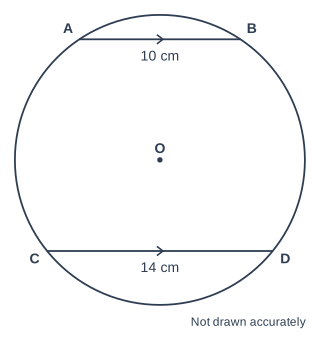
The diagram shows a circle, centre O, with radius 9 cm. AB and CD are parallel chords on opposite sides of O.
AB = 10 cm CD = 14 cm
Work out the distance between the chords AB and CD. Give your answer to 3 significant figures.
Model answer
The perpendicular from O to each chord cuts the chord in half. Distance from O to AB: \(\sqrt{9^2 - 5^2} = \sqrt{56} = 7.483...\) cm Distance from O to CD: \(\sqrt{9^2 - 7^2} = \sqrt{32} = 5.656...\) cm The chords are on opposite sides of O, so the distance between them is 7.483... + 5.656... = 13.140... Distance = 13.1 cm (3 s.f.)
Explanation
For each chord, join O to one end (a radius of 9 cm) and drop a perpendicular from O to the chord, which bisects it; Pythagoras then gives the distance from the centre. Because the chords are on opposite sides of the centre, add the two distances. Notice the longer chord is closer to the centre.
Mark scheme
1 mark
M1 for \(9^2 - 5^2\) or \(\sqrt{56}\) or 7.48...
distance from O to AB
1 mark
M1 for \(9^2 - 7^2\) or \(\sqrt{32}\) or 5.65...
distance from O to CD
1 mark
M1dep for adding their two distances
dependent on at least one of the previous M marks; M0 for subtracting
1 mark
A1 for 13.1 cm
accept [13.1, 13.15] (13.140...); correct answer with no working scores full marks
Ready to try the rest? Every answer you write is marked against the mark scheme, so you can see exactly where the marks are.
Ctrl + Enter to check
Study HelperHints first, answers after you try
Stuck on this one? Ask for a hint and I’ll point you in the right direction, without giving the answer away. Once you’ve checked your answer, I’ll show you how the marks are awarded.