
Question 1
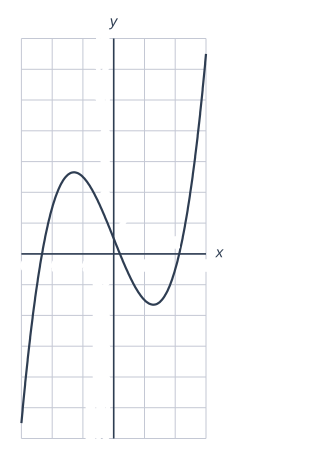
1 markHere is the graph of \(y = x^3 - 5x + 1\)
Ali uses the iterative formula \(x_{n+1} = \dfrac{x_n^3 + 1}{5}\) with \(x_1 = 0\)
The values get closer and closer to 0.2016
Ali says,
"0.2016 is the only solution of the equation \(x^3 - 5x + 1 = 0\)"
Is Ali correct?
Give a reason for your answer.
Model answer
No.
The solutions of \(x^3 - 5x + 1 = 0\) are where the graph crosses the x-axis.
The graph crosses the x-axis three times (at about −2.3, 0.2 and 2.1), so there are three solutions.
Explanation
An iterative formula finds one solution - usually the one nearest the starting value - so it does not tell you how many solutions there are. The graph of \(y = x^3 - 5x + 1\) shows them all: each crossing of the x-axis is a solution. A cubic equation can have up to three solutions.
Mark scheme
-
1 mark
B1 for No, with a reason, e.g. the graph crosses the x-axis three times, so there are three solutions
accept 'there are other solutions near −2.3 and 2.1' oe; 'No' alone scores 0