
Level:
Correct: 0
Incorrect: 0
Marks: 0/0
Exam Practice
Course:
Topics:
AQA GCSE Maths (Higher calculator) Smart practice A mixed round aimed at your weak spots
Unit 1
Number
Unit 2
Algebra
Unit 3
Ratio, proportion and rates of change
Unit 4
Geometry and measures
Unit 5
Probability
Unit 6
Statistics
Avg
score:
–
Topics
done:
0/97

Circle theorems

Practise 28 exam-style questions on Circle theorems for AQA GCSE Maths (Higher calculator). Write your answer as you would in the exam and get it marked in seconds against the mark scheme, point by point, with the Study Helper on hand if you get stuck.

  • 28 questions
  • 1–5 marks each
  • Instant marking
  • No sign-up needed
20 questions, marked as you go

Sample questions with model answers

Here are 4 of the questions in this topic, each with a model answer, an explanation of why it earns the marks and the mark scheme an examiner would use.

Question 1

2 marks

In the diagram, A, B, C and D are points on a circle.
Angle ADB = 38°

Work out the size of angle \(x\).
Give a reason for your answer.
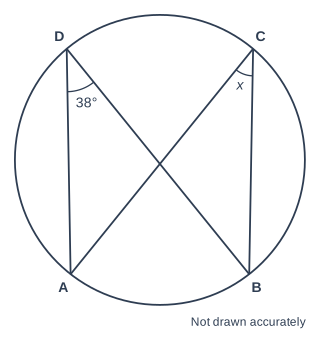
Geometry diagram, marked "Not drawn accurately". A circle; A, B, C and D lie on it, in that order going anticlockwise. Line segments DA, DB, CA and CB are drawn. Angle ADB is marked 38°. Angle ACB is marked x.

Model answer

Angles ADB and ACB both stand on the chord AB and are in the same segment.
Angles in the same segment are equal.
\(x = 38°\)

Explanation

Angles at the circumference standing on the same arc AB, on the same side of the chord, are equal. The 'bow-tie' shape made by the two angles is a sign to use this theorem. Your reason must name the theorem in full, using the words 'same segment'.

Mark scheme
  1. 1 mark

    B1 for \(x = 38°\)

  2. 1 mark

    B1 for angles in the same segment are equal

    accept 'angles subtended by the same arc (or chord) are equal'; do not accept 'they are the same angle' or 'opposite angles'
Question 2

2 marks

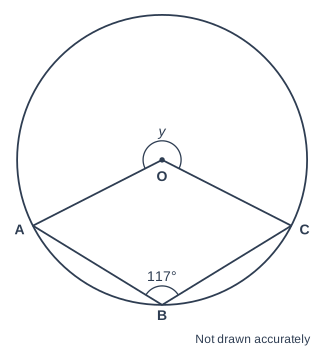
In the diagram, A, B and C are points on a circle, centre O.
B is on the minor arc AC.

Angle ABC = 117°

Work out the size of the reflex angle \(y\).
Give a reason for your answer.

Geometry diagram, marked "Not drawn accurately". A circle with centre O; A, B and C lie on it, in that order going anticlockwise. Line segments OA, OC, BA and BC are drawn. Angle ABC is marked 117°. Reflex angle AOC is marked y.

Model answer

Angle ABC and the reflex angle AOC both stand on the major arc AC.
The angle at the centre is twice the angle at the circumference.
\(y = 2 \times 117 = 234°\)

Explanation

The theorem works for any arc: the obtuse angle at B stands on the major arc AC, and the angle at the centre on that same arc is the reflex angle AOC. So the reflex angle is twice 117°. A common mistake is to find the non-reflex angle (126°) instead.

Mark scheme
  1. 1 mark

    B1 for \(y = 234°\)

  2. 1 mark

    B1 for the angle at the centre is twice the angle at the circumference

    do not accept 'the angle at the centre is double' without reference to the circumference

Question 3

3 marks

AB is a chord of a circle with centre O and radius 9 cm.
AB = 14 cm

Work out the size of angle AOB.
Give your answer to 1 decimal place.

Model answer

Let M be the midpoint of AB. The perpendicular from the centre to a chord bisects the chord, so OM is perpendicular to AB and AM = 7 cm.
In the right-angled triangle OMA, OA = 9 cm.
\(\sin AOM = \frac{7}{9}\), so angle AOM = 51.057...°
Angle AOB = \(2 \times 51.057... = 102.115...\)
Angle AOB = 102.1° (1 d.p.)

Explanation

Triangle OAB is isosceles because OA and OB are radii, and the line from O perpendicular to AB cuts it into two congruent right-angled triangles with AM = 7 cm. Use sine in one of them and double. You could also use the cosine rule in triangle OAB directly.

Mark scheme
  1. 1 mark

    M1 for \(\sin AOM = \frac{7}{9}\) where M is the midpoint of AB, or for \(\cos AOB = \frac{9^2 + 9^2 - 14^2}{2 \times 9 \times 9}\)

    uses the perpendicular from the centre bisects the chord (AM = 7), or the cosine rule

  2. 1 mark

    M1dep for \(2 \times \sin^{-1}\left(\frac{7}{9}\right)\) or \(\cos^{-1}\left(-\frac{34}{162}\right)\)

    angle AOM = 51.05...°

  3. 1 mark

    A1 for 102.1°

    accept [102.1, 102.2] (102.115...); correct answer with no working scores full marks

Question 4

4 marks

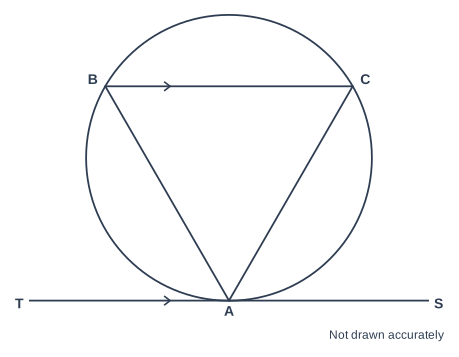
In the diagram, A, B and C are points on a circle.
TS is a tangent to the circle at A.
BC is parallel to TS.

Prove that triangle ABC is isosceles.

Geometry diagram, marked "Not drawn accurately". A circle; A, C and B lie on it, in that order going anticlockwise. Line segment TS is drawn. Triangle ACB. A lies on TS. TS touches the circle at A (it is a tangent). TA and BC are each marked with an arrowhead (parallel lines).

Model answer

Alternate segment theorem: angle TAB = angle ACB.
BC is parallel to TA, so alternate angles are equal: angle TAB = angle ABC.
So angle ABC = angle ACB.
Triangle ABC has two equal angles, so it is isosceles (with AB = AC).

Explanation

Angle TAB is equal to two different angles: to angle ACB by the alternate segment theorem, and to angle ABC as alternate angles between the parallel lines. Two angles equal to the same angle are equal to each other, so the base angles at B and C are equal. Use the correct terms - AQA does not accept 'Z angles'.

Mark scheme
  1. 1 mark

    B1 for angle TAB = angle ACB because of the alternate segment theorem

  2. 1 mark

    B1 for angle TAB = angle ABC because alternate angles are equal (BC parallel to TA)

    do not accept 'Z angles'

  3. 1 mark

    M1 for angle ABC = angle ACB

    from their two equalities

  4. 1 mark

    A1 for so triangle ABC has two equal angles and is isosceles (AB = AC), with a complete argument and both reasons

Ready to try the rest? Every answer you write is marked against the mark scheme, so you can see exactly where the marks are.

Study Helper Hints first, answers after you try

Stuck on this one? Ask for a hint and I’ll point you in the right direction, without giving the answer away. Once you’ve checked your answer, I’ll show you how the marks are awarded.