Practise 28 exam-style questions on Angles, parallel lines and polygons for AQA GCSE Maths (Higher calculator). Write your answer as you would in the exam and get it marked in seconds against the mark scheme, point by point, with the Study Helper on hand if you get stuck.
28 questions
1–5 marks each
Instant marking
No sign-up needed
20 questions, marked as you go
Sample questions with model answers
Here are 4 of the questions in this topic, each with a model answer, an explanation of why it earns the marks and the mark scheme an examiner would use.
Question 1
2 marks
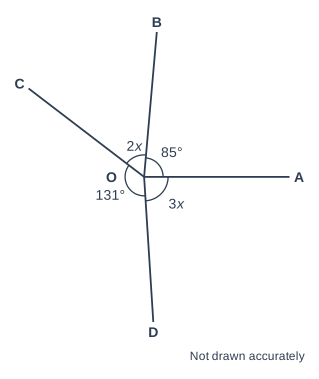
The diagram shows four angles at the point O.
Work out the value of x.
Model answer
Angles around a point add up to 360° \(2x + 3x + 85 + 131 = 360\) \(5x + 216 = 360\) \(5x = 144\) \(x = 28.8\)
Explanation
The four angles fill the whole turn around O, so they add up to 360°. Collect the x terms (2x + 3x = 5x), subtract the known angles from 360 and divide by 5. A common mistake is to use 180° (angles on a straight line) instead of 360°.
Mark scheme
1 mark
M1 for \(2x + 3x + 85 + 131 = 360\) oe
oe, e.g. \(5x = 144\) or \(360 - 216 = 144\)
1 mark
A1 for \(x = 28.8\)
correct answer with no working scores full marks
Question 2
2 marks
Leah says,
"If you double the number of sides of a regular polygon, the size of each interior angle also doubles."
Is Leah correct? You must show working to support your answer.
Model answer
Square: each interior angle = 90° Regular octagon (double the sides): exterior angle = 360 ÷ 8 = 45°, so interior angle = 180 − 45 = 135° 2 × 90 = 180, but the interior angle is 135° No, Leah is not correct.
Explanation
To show a statement is false you only need one counterexample: a square has 90° angles but a regular octagon has 135°, not 180°. Be careful: it happens to work for a triangle (60°) and a hexagon (120°), but one example that works never proves a general statement. In fact, an interior angle of 90° or more cannot double, because every interior angle of a polygon like this is less than 180°.
Mark scheme
1 mark
M1 for working out the interior angle of a regular polygon and of the regular polygon with twice as many sides, e.g. square 90° and octagon 135°, or hexagon 120° and 12 sides 150°
any correct pair other than the triangle and hexagon (60° and 120°, which does double); or a general argument, e.g. doubling an interior angle of 90° or more gives 180° or more, which is impossible
1 mark
A1 for No with correct supporting values, e.g. 135 is not 2 × 90 = 180
must have correct values for both polygons; 'No' with a triangle and hexagon only scores 0
Question 3
3 marks
Each interior angle of a regular polygon is 11 times the size of each exterior angle.
Work out the number of sides of the polygon.
Model answer
Let each exterior angle be e. The interior angle is 11e. Interior and exterior angles add up to 180°: \(e + 11e = 180\) \(12e = 180\) \(e = 15^\circ\) Number of sides = 360 ÷ 15 = 24
Explanation
At each vertex the interior and exterior angles lie on a straight line, so they add up to 180°: this splits 180° in the ratio 11 : 1. Once you have the exterior angle, 360 ÷ exterior angle gives the number of sides. Check: interior angle = 165° = 11 × 15°.
Mark scheme
1 mark
M1 for \(e + 11e = 180\) oe
where e is the exterior angle; oe, e.g. 180 ÷ 12
1 mark
M1dep for exterior angle = 15° and 360 ÷ 15
1 mark
A1 for 24
correct answer with no working scores full marks
Question 4
4 marks
A, B and C are three consecutive vertices of a regular polygon. Angle BAC = 12°
Work out the number of sides of the polygon.
Model answer
AB = BC (sides of a regular polygon), so triangle ABC is isosceles and angle BCA = 12° Angle ABC = 180 − 12 − 12 = 156° Angle ABC is an interior angle of the polygon. Exterior angle = 180 − 156 = 24° Number of sides = 360 ÷ 24 = 15
Explanation
Joining A to C makes a triangle with two equal sides (two sides of the polygon), so its base angles are equal. The angle at B is an interior angle of the polygon, and from it the exterior angle gives the number of sides. Notice that the base angle (12°) is always half the exterior angle (24°).
Mark scheme
1 mark
M1 for angle BCA = 12° (triangle ABC is isosceles because AB = BC)
may be implied by 180 − 2 × 12
1 mark
M1dep for angle ABC = 180 − 2 × 12 (= 156)
1 mark
M1dep for 360 ÷ (180 − 156) or \((n - 2) \times 180 = 156n\)
1 mark
A1 for 15
correct answer with no working scores full marks
Ready to try the rest? Every answer you write is marked against the mark scheme, so you can see exactly where the marks are.
Ctrl + Enter to check
Study HelperHints first, answers after you try
Stuck on this one? Ask for a hint and I’ll point you in the right direction, without giving the answer away. Once you’ve checked your answer, I’ll show you how the marks are awarded.