Practise 19 exam-style questions on One quantity as a fraction of another for AQA GCSE Maths (Higher calculator). Write your answer as you would in the exam and get it marked in seconds against the mark scheme, point by point, with the Study Helper on hand if you get stuck.
19 questions
1–5 marks each
Instant marking
No sign-up needed
19 questions, marked as you go
Sample questions with model answers
Here are 4 of the questions in this topic, each with a model answer, an explanation of why it earns the marks and the mark scheme an examiner would use.
Question 1
2 marks
Write 84 cm as a fraction of 3.5 m. Give your answer in its simplest form.
Model answer
3.5 m = 350 cm \(\dfrac{84}{350} = \dfrac{12}{50} = \dfrac{6}{25}\)
Explanation
Change the metres to centimetres so both quantities are in the same unit, then write the first over the second and simplify (here divide by 7 and then by 2). A fraction calculator key can do the simplifying, but the units must be sorted out first.
Mark scheme
1 mark
M1 for \(\dfrac{84}{350}\) or \(\dfrac{0.84}{3.5}\)
oe, both quantities in the same units
1 mark
A1 for \(\dfrac{6}{25}\)
correct answer with no working scores full marks; 0.24 scores M1 A0
Question 2
2 marks
Write 3x cm as a fraction of 2y m. Give your answer in its simplest form.
Model answer
2y m = 2y × 100 = 200y cm \(\dfrac{3x}{200y}\)
Explanation
Algebra does not change the rule: write both quantities in the same unit first. Converting metres to centimetres multiplies by 100, so 2y m becomes 200y cm. Check with numbers: if x = 10 and y = 1, 30 cm out of 2 m is \(\frac{30}{200}\).
Mark scheme
1 mark
M1 for 2y m = 200y cm, or 3x cm = 0.03x m
or for a correct unsimplified fraction such as \(\dfrac{0.03x}{2y}\)
1 mark
A1 for \(\dfrac{3x}{200y}\)
\(\dfrac{3x}{2y}\) scores 0
Question 3
3 marks
Ella's pay increased from £18 400 a year to £20 700 a year. Ben's pay increased from £21 600 a year to £24 000 a year.
Whose pay increased by the greater fraction of their original pay? You must show your working.
Ben's pay went up by more money, but the question asks about the increase as a fraction of the original pay. Divide each increase by the original amount (not the new amount). \(\frac{1}{8}\) is bigger than \(\frac{1}{9}\).
Mark scheme
1 mark
M1 for \(\dfrac{2300}{18\,400}\) (Ella's increase as a fraction of her original pay)
oe, e.g. \(\frac{1}{8}\), 0.125 or 12.5%; or \(\frac{20\,700}{18\,400} = \frac{9}{8}\)
1 mark
M1 for \(\dfrac{2400}{21\,600}\) (Ben's increase as a fraction of his original pay)
oe, e.g. \(\frac{1}{9}\), 0.111... or 11.1%; or \(\frac{24\,000}{21\,600} = \frac{10}{9}\)
1 mark
A1 for Ella, with correct comparable values
e.g. \(\frac{1}{8}\) and \(\frac{1}{9}\); answer only scores 0
Question 4
4 marks
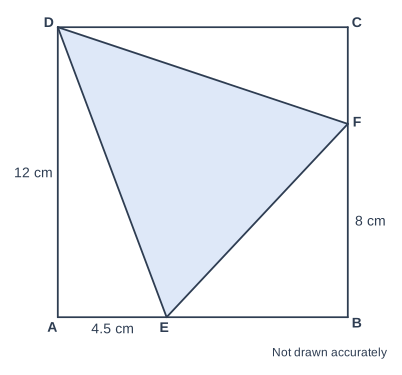
ABCD is a square of side 12 cm. E is the point on AB such that AE = 4.5 cm. F is the point on BC such that BF = 8 cm.
The diagram shows triangle DEF shaded.
Write the area of triangle DEF as a fraction of the area of the square. Give your answer in its simplest form.
Model answer
Area of square = 12 × 12 = 144 cm² EB = 12 − 4.5 = 7.5 cm and FC = 12 − 8 = 4 cm Triangle ADE = \(\frac{1}{2} \times 4.5 \times 12 = 27\) cm² Triangle EBF = \(\frac{1}{2} \times 7.5 \times 8 = 30\) cm² Triangle FCD = \(\frac{1}{2} \times 4 \times 12 = 24\) cm² Area of DEF = 144 − 27 − 30 − 24 = 63 cm² \(\dfrac{63}{144} = \dfrac{7}{16}\)
Explanation
Triangle DEF has no convenient base and height, so subtract the three right-angled triangles around it from the square. Find the missing lengths EB and FC first. Then write the shaded area over the area of the square and simplify (divide by 9).
Mark scheme
1 mark
M1 for the area of one unshaded triangle, e.g. triangle ADE = \(\frac{1}{2} \times 4.5 \times 12\) (= 27), triangle EBF = \(\frac{1}{2} \times 7.5 \times 8\) (= 30) or triangle FCD = \(\frac{1}{2} \times 4 \times 12\) (= 24)
1 mark
M1 for the areas of all three unshaded triangles
1 mark
M1dep for \(144 - (27 + 30 + 24)\) (= 63)
ft their triangle areas
1 mark
A1 for \(\dfrac{7}{16}\)
\(\frac{63}{144}\) unsimplified scores M3 A0; correct answer with no working scores full marks
Ready to try the rest? Every answer you write is marked against the mark scheme, so you can see exactly where the marks are.
Ctrl + Enter to check
Study HelperHints first, answers after you try
Stuck on this one? Ask for a hint and I’ll point you in the right direction, without giving the answer away. Once you’ve checked your answer, I’ll show you how the marks are awarded.