
Level:
Correct: 0
Incorrect: 0
Marks: 0/0
Exam Practice
Course:
Topics:
AQA GCSE Maths (Higher calculator) Smart practice A mixed round aimed at your weak spots
Unit 1
Number
Unit 2
Algebra
Unit 3
Ratio, proportion and rates of change
Unit 4
Geometry and measures
Unit 5
Probability
Unit 6
Statistics
Avg
score:
–
Topics
done:
0/97

Roots and turning points of quadratics

Practise 30 exam-style questions on Roots and turning points of quadratics for AQA GCSE Maths (Higher calculator). Write your answer as you would in the exam and get it marked in seconds against the mark scheme, point by point, with the Study Helper on hand if you get stuck.

  • 30 questions
  • 1–5 marks each
  • Instant marking
  • No sign-up needed
20 questions, marked as you go

Sample questions with model answers

Here are 4 of the questions in this topic, each with a model answer, an explanation of why it earns the marks and the mark scheme an examiner would use.

Question 1

1 mark

Leah says,

"The graph of \(y = (x + 5)^2 - 3\) has its turning point at (5, −3)."

Is Leah correct?
Give a reason for your answer.

Model answer

No.
\((x + 5)^2\) is smallest (0) when \(x = -5\), so the turning point is (−5, −3), not (5, −3).

Explanation

The turning point of \(y = (x + a)^2 + b\) is \((-a, b)\): the x-coordinate is the value that makes the bracket zero. Leah has used the number in the bracket without changing its sign.

Mark scheme
  1. 1 mark

    B1 for No, with a correct reason, e.g. the turning point is at (−5, −3) or \((x + 5)^2 = 0\) when \(x = -5\), not 5

    oe, e.g. when \(x = 5\), \(y = 97\), which is not −3
Question 2

2 marks

Ali says,

"The graph of \(y = x^2 - 8x + 16\) crosses the x-axis at two different points."

Is Ali correct?
You must show your working.

Model answer

\(x^2 - 8x + 16 = (x - 4)^2\)
\((x - 4)^2 = 0\) only when \(x = 4\)
The graph touches the x-axis at (4, 0) only (its turning point is on the x-axis).
Ali is not correct.

Explanation

Factorising (or completing the square) shows the expression is a perfect square, so the equation has one repeated root and the turning point (4, 0) sits on the x-axis. The graph touches the axis there instead of crossing it at two points.

Mark scheme
  1. 1 mark

    M1 for \((x - 4)^2\) or \((x - 4)(x - 4)\), or for \(b^2 - 4ac = 64 - 64 = 0\)

    oe, e.g. \((x - 4)^2 + 0\)

  2. 1 mark

    A1 for No, with a correct conclusion, e.g. the graph only touches the x-axis, at (4, 0)

    oe, e.g. there is only one (repeated) root, x = 4; answer only scores 0

Question 3

3 marks

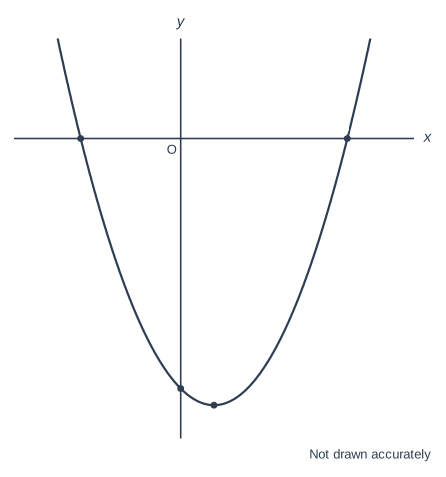
The diagram shows a quadratic curve.

The curve crosses the x-axis at A(−3, 0) and B(5, 0).
It crosses the y-axis at D(0, −15).
C is the turning point of the curve.

Work out the coordinates of C.

A sketch on a pair of axes (x across, y up) with no scale marked, the axes crossing at the origin O. It is marked "Not drawn accurately". The curve is a U-shaped parabola: it meets the x-axis twice; these points cannot be read off, as the sketch has no scale; it crosses the y-axis at a point that cannot be read off, as the sketch has no scale; it has a minimum point, which cannot be read off, as the sketch has no scale. Point A is marked with a dot at (−3, 0), labelled "A(−3, 0)". Point B is marked with a dot at (5, 0), labelled "B(5, 0)". Point D is marked with a dot at (0, −15), labelled "D(0, −15)". Point C is marked with a dot; its coordinates cannot be read off, as the sketch has no scale.

Model answer

The roots are −3 and 5, so the curve is \(y = a(x + 3)(x - 5)\)
At D, \(-15 = a \times 3 \times (-5)\), so \(a = 1\) and \(y = (x + 3)(x - 5)\)
The line of symmetry is halfway between the roots: \(x = \dfrac{-3 + 5}{2} = 1\)
When \(x = 1\), \(y = (1 + 3)(1 - 5) = -16\)
C is (1, −16)

Explanation

The turning point of a quadratic graph lies on its line of symmetry, halfway between the roots, so its x-coordinate is the mean of −3 and 5. The roots give the brackets of the equation, and the y-intercept −15 confirms the \(x^2\) coefficient is 1. Then substitute \(x = 1\) into the equation to find the y-coordinate.

Mark scheme
  1. 1 mark

    B1 for x-coordinate 1

    e.g. \(\frac{-3 + 5}{2} = 1\)

  2. 1 mark

    M1 for \(y = (x + 3)(x - 5)\) or \(y = x^2 - 2x - 15\)

    oe; must be consistent with D(0, −15)

  3. 1 mark

    A1 for (1, −16)

    correct answer with no working scores full marks

Question 4

4 marks

The curve \(y = ax^2 + bx + c\) crosses the y-axis at (0, 7).
The turning point of the curve is (2, −5).

Work out the values of a, b and c.

Model answer

The turning point is (2, −5), so \(y = a(x - 2)^2 - 5\)
At (0, 7): \(7 = a(0 - 2)^2 - 5\)
\(4a = 12\), so \(a = 3\)
\(y = 3(x - 2)^2 - 5 = 3(x^2 - 4x + 4) - 5 = 3x^2 - 12x + 7\)
\(a = 3\), \(b = -12\), \(c = 7\)

Explanation

A quadratic with turning point \((p, q)\) can be written \(y = a(x - p)^2 + q\); the point (0, 7) then fixes a. Expanding gives b and c. Check: c must equal the y-intercept, 7.

Mark scheme
  1. 1 mark

    M1 for \(y = a(x - 2)^2 - 5\)

    oe; or B1 for \(c = 7\) with \(-\frac{b}{2a} = 2\) (i.e. \(b = -4a\))

  2. 1 mark

    M1dep for \(4a - 5 = 7\)

    oe, e.g. \(4a + 2b + 7 = -5\) with \(b = -4a\)

  3. 1 mark

    A1 for \(a = 3\)

  4. 1 mark

    A1 for \(b = -12\) and \(c = 7\)

    correct answers with no working score full marks

Ready to try the rest? Every answer you write is marked against the mark scheme, so you can see exactly where the marks are.

Study Helper Hints first, answers after you try

Stuck on this one? Ask for a hint and I’ll point you in the right direction, without giving the answer away. Once you’ve checked your answer, I’ll show you how the marks are awarded.