
Level:
Correct: 0
Incorrect: 0
Marks: 0/0
Exam Practice
Course:
Topics:
AQA GCSE Maths (Higher calculator) Smart practice A mixed round aimed at your weak spots
Unit 1
Number
Unit 2
Algebra
Unit 3
Ratio, proportion and rates of change
Unit 4
Geometry and measures
Unit 5
Probability
Unit 6
Statistics
Avg
score:
–
Topics
done:
0/97

Standard form

Practise 36 exam-style questions on Standard form for AQA GCSE Maths (Higher calculator). Write your answer as you would in the exam and get it marked in seconds against the mark scheme, point by point, with the Study Helper on hand if you get stuck.

  • 36 questions
  • 1–5 marks each
  • Instant marking
  • No sign-up needed
20 questions, marked as you go

Sample questions with model answers

Here are 4 of the questions in this topic, each with a model answer, an explanation of why it earns the marks and the mark scheme an examiner would use.

Question 1

2 marks

Write \(0.0035 \times 10^{7}\) in standard form.

Model answer

\(0.0035 = 3.5 \times 10^{-3}\)
\(3.5 \times 10^{-3} \times 10^{7} = 3.5 \times 10^{4}\)

Explanation

The number in front, 0.0035, is not between 1 and 10, so write it in standard form first and then combine the powers of 10 by adding the indices: \(-3 + 7 = 4\). Check: \(0.0035 \times 10\,000\,000 = 35\,000\).

Mark scheme
  1. 1 mark

    M1 for 35 000 or \(3.5 \times 10^{-3} \times 10^{7}\)

    oe

  2. 1 mark

    A1 for \(3.5 \times 10^{4}\)

    correct answer with no working scores full marks
Question 2

2 marks

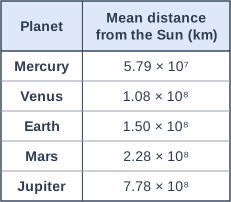
The table shows the mean distances of five planets from the Sun.

Work out the difference between the mean distance of Mars from the Sun and the mean distance of Mercury from the Sun.
Give your answer in standard form.

Table with columns "Planet", "Mean distance from the Sun (km)". Planet: Mercury; Mean distance from the Sun (km): 5.79 × 10⁷ | Planet: Venus; Mean distance from the Sun (km): 1.08 × 10⁸ | Planet: Earth; Mean distance from the Sun (km): 1.50 × 10⁸ | Planet: Mars; Mean distance from the Sun (km): 2.28 × 10⁸ | Planet: Jupiter; Mean distance from the Sun (km): 7.78 × 10⁸.

Model answer

\(2.28 \times 10^{8} = 228\,000\,000\)
\(5.79 \times 10^{7} = 57\,900\,000\)
\(228\,000\,000 - 57\,900\,000 = 170\,100\,000\)
\(= 1.701 \times 10^{8}\) km

Explanation

You cannot subtract numbers in standard form with different powers of 10 by just subtracting the front numbers. Write both as ordinary numbers (or both with \(10^8\): \(2.28 - 0.579 = 1.701\)), subtract, then write the answer back in standard form.

Mark scheme
  1. 1 mark

    M1 for \(2.28 \times 10^{8} - 5.79 \times 10^{7}\) with both written in the same form, e.g. 228 000 000 − 57 900 000

    or 170 100 000 seen

  2. 1 mark

    A1 for \(1.701 \times 10^{8}\) km

    correct answer with no working scores full marks

Question 3

3 marks

A prize fund of \(£3.6 \times 10^{9}\) is shared between two charities, A and B, in the ratio 4 : 5

How much more does charity B receive than charity A?
Give your answer in standard form.

Model answer

Total shares = 4 + 5 = 9
One share = \(3.6 \times 10^{9} \div 9 = 4 \times 10^{8}\)
B gets 5 shares and A gets 4 shares, so B gets 1 share more.
B receives \(£4 \times 10^{8}\) more.

Explanation

Divide the total by the number of shares, 9, to find one share. The difference between 5 shares and 4 shares is exactly one share. Check: A gets \(£1.6 \times 10^{9}\), B gets \(£2 \times 10^{9}\), and together that is \(£3.6 \times 10^{9}\).

Mark scheme
  1. 1 mark

    M1 for \(3.6 \times 10^{9} \div 9\) or \(4 \times 10^{8}\) as one share

    oe

  2. 1 mark

    M1dep for 5 shares − 4 shares, e.g. \(2 \times 10^{9} - 1.6 \times 10^{9}\), or for recognising the difference is 1 share

  3. 1 mark

    A1 for \(£4 \times 10^{8}\)

    correct answer with no working scores full marks

Question 4

4 marks

The mass of the Sun is \(1.99 \times 10^{30}\) kg.
The volume of the Sun is \(1.41 \times 10^{27}\) m³.

The mass of the Earth is \(5.97 \times 10^{24}\) kg.
The volume of the Earth is \(1.08 \times 10^{21}\) m³.

How many times greater is the density of the Earth than the density of the Sun?
Give your answer to 3 significant figures.

Model answer

Density of the Sun = \(\dfrac{1.99 \times 10^{30}}{1.41 \times 10^{27}} = 1411.34...\) kg/m³
Density of the Earth = \(\dfrac{5.97 \times 10^{24}}{1.08 \times 10^{21}} = 5527.77...\) kg/m³
\(5527.77... \div 1411.34... = 3.9166...\)
= 3.92 (3 s.f.)

Explanation

Density = mass ÷ volume, so work out each density, then divide to compare. The Sun is far more massive, but its volume is so large that its density is less than the Earth's. Keep the full calculator values for the densities so the final answer is accurate.

Mark scheme
  1. 1 mark

    M1 for density of the Sun = \(\frac{1.99 \times 10^{30}}{1.41 \times 10^{27}}\) or 1411.3...

    oe

  2. 1 mark

    M1 for density of the Earth = \(\frac{5.97 \times 10^{24}}{1.08 \times 10^{21}}\) or 5527.7...

    oe

  3. 1 mark

    M1dep for their Earth density ÷ their Sun density

  4. 1 mark

    A1 for 3.92

    accept [3.91, 3.92] (3.9166...); correct answer with no working scores full marks

Ready to try the rest? Every answer you write is marked against the mark scheme, so you can see exactly where the marks are.

Study Helper Hints first, answers after you try

Stuck on this one? Ask for a hint and I’ll point you in the right direction, without giving the answer away. Once you’ve checked your answer, I’ll show you how the marks are awarded.