Practise 37 exam-style questions on Area of a triangle: ½ab sin C for AQA GCSE Maths (Higher calculator). Write your answer as you would in the exam and get it marked in seconds against the mark scheme, point by point, with the Study Helper on hand if you get stuck.
37 questions
1–5 marks each
Instant marking
No sign-up needed
20 questions, marked as you go
Sample questions with model answers
Here are 4 of the questions in this topic, each with a model answer, an explanation of why it earns the marks and the mark scheme an examiner would use.
Question 1
2 marks
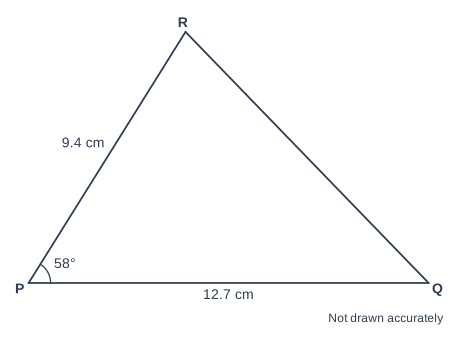
The diagram shows triangle PQR.
Work out the area of triangle PQR. Give your answer to 3 significant figures.
Model answer
Area = \(\frac{1}{2} \times 9.4 \times 12.7 \times \sin 58^\circ\) Area = \(59.69 \times 0.84804... = 50.619...\) Area = 50.6 cm² (3 s.f.)
Explanation
The 58° angle is between the two given sides, so use Area = \(\frac{1}{2}ab \sin C\) directly. Make sure your calculator is in degree mode, and do not forget the half.
Mark scheme
1 mark
M1 for \(\frac{1}{2} \times 9.4 \times 12.7 \times \sin 58^\circ\)
oe
1 mark
A1 for 50.6 cm²
accept [50.6, 50.62] (50.619...); correct answer with no working scores full marks
Question 2
3 marks
Triangle PQR has area 30 m². PQ = 8.5 m and PR = 9.2 m Angle QPR is acute.
Work out the size of angle QPR. Give your answer to 1 decimal place.
Model answer
Angle QPR is between PQ and PR. \(\frac{1}{2} \times 8.5 \times 9.2 \times \sin P = 30\) \(39.1 \sin P = 30\) \(\sin P = 0.76726...\) \(P = \sin^{-1}(0.76726...) = 50.108...\) Angle QPR = 50.1° (1 d.p.)
Explanation
Substitute the area and the two sides into Area = \(\frac{1}{2}ab \sin C\), rearrange to find \(\sin P\), then use inverse sine. The question says the angle is acute; otherwise 180° − 50.1° = 129.9° would also give an area of 30 m².
Mark scheme
1 mark
M1 for \(\frac{1}{2} \times 8.5 \times 9.2 \times \sin P = 30\)
oe
1 mark
M1dep for \(\sin P = \dfrac{30}{39.1}\) (= 0.7672...)
oe, e.g. \(\sin P = \dfrac{60}{78.2}\)
1 mark
A1 for 50.1°
accept [50.1, 50.11] (50.108...); correct answer with no working scores full marks
Question 3
3 marks
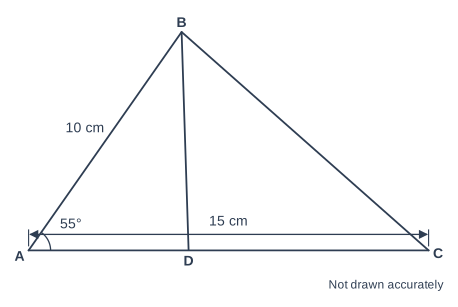
The diagram shows triangle ABC. D is the point on AC such that AD : DC = 2 : 3
Work out the area of triangle BDC. Give your answer to 3 significant figures.
Model answer
AD = \(\frac{2}{5} \times 15 = 6\) cm, DC = 9 cm Area of ABC = \(\frac{1}{2} \times 10 \times 15 \times \sin 55^\circ = 61.436...\) Area of ABD = \(\frac{1}{2} \times 10 \times 6 \times \sin 55^\circ = 24.574...\) Area of BDC = 61.436... − 24.574... = 36.861... Area = 36.9 cm² (3 s.f.)
Explanation
Triangles ABD and BDC have the same perpendicular height from B, so their areas are in the ratio of their bases, 2 : 3. You can find the whole area with \(\frac{1}{2}ab \sin C\) and take \(\frac{3}{5}\) of it, or subtract the area of ABD. You cannot use the 55° angle directly in triangle BDC, because it is not an angle of that triangle.
Mark scheme
1 mark
M1 for AD = 6 cm or DC = 9 cm
or the area of triangle BDC is \(\frac{3}{5}\) of the area of triangle ABC
1 mark
M1 for a complete method for the area of BDC, e.g. \(\frac{1}{2} \times 10 \times 15 \times \sin 55^\circ - \frac{1}{2} \times 10 \times 6 \times \sin 55^\circ\)
oe, e.g. \(\frac{3}{5} \times \frac{1}{2} \times 10 \times 15 \times \sin 55^\circ\) or \(\frac{1}{2} \times 9 \times 10\sin 55^\circ\)
1 mark
A1 for 36.9 cm²
accept [36.85, 36.9] (36.861...); correct answer with no working scores full marks
Question 4
4 marks
The area of triangle ABC is 24 cm². AB = 8 cm and BC = 7.5 cm Angle ABC is acute.
Work out the length of AC. Give your answer to 3 significant figures.
Model answer
\(\frac{1}{2} \times 8 \times 7.5 \times \sin B = 24\) \(30 \sin B = 24\), so \(\sin B = 0.8\) Angle ABC = \(\sin^{-1}(0.8) = 53.130...^\circ\) (acute) \(AC^2 = 8^2 + 7.5^2 - 2 \times 8 \times 7.5 \times \cos 53.130...^\circ = 64 + 56.25 - 72 = 48.25\) \(AC = \sqrt{48.25} = 6.946...\) AC = 6.95 cm (3 s.f.)
Explanation
Use the area to find the included angle B, then the cosine rule to find the third side. The question says angle ABC is acute, so use the calculator's value of 53.13°; the obtuse angle 126.87° would give the same area but a different AC. Keep the angle unrounded in the cosine rule.
Mark scheme
1 mark
M1 for \(\frac{1}{2} \times 8 \times 7.5 \times \sin B = 24\)
oe
1 mark
A1 for angle ABC = 53.1...°
accept [53.1, 53.2]; or \(\sin B = 0.8\) (\(\cos B = 0.6\))
accept [6.94, 6.95] (6.946...); correct answer with no working scores full marks
Ready to try the rest? Every answer you write is marked against the mark scheme, so you can see exactly where the marks are.
Ctrl + Enter to check
Study HelperHints first, answers after you try
Stuck on this one? Ask for a hint and I’ll point you in the right direction, without giving the answer away. Once you’ve checked your answer, I’ll show you how the marks are awarded.