Practise 36 exam-style questions on Quadratic equations for AQA GCSE Maths (Higher calculator). Write your answer as you would in the exam and get it marked in seconds against the mark scheme, point by point, with the Study Helper on hand if you get stuck.
36 questions
1–5 marks each
Instant marking
No sign-up needed
20 questions, marked as you go
Sample questions with model answers
Here are 4 of the questions in this topic, each with a model answer, an explanation of why it earns the marks and the mark scheme an examiner would use.
Question 1
2 marks
Solve \(25x^2 - 49 = 0\)
Model answer
\(25x^2 = 49\) \(x^2 = \dfrac{49}{25} = 1.96\) \(x = \pm\sqrt{1.96} = \pm 1.4\) x = 1.4 or x = −1.4
Explanation
With no x term, you can rearrange to \(x^2 = 1.96\) and square root, or factorise as a difference of two squares, (5x − 7)(5x + 7). Either way there are two solutions: the square root has a positive and a negative value.
Mark scheme
1 mark
M1 for \(x^2 = \dfrac{49}{25}\) or (5x − 7)(5x + 7) = 0
oe, e.g. \(x^2 = 1.96\)
1 mark
A1 for x = 1.4 and x = −1.4
oe, e.g. \(\pm\frac{7}{5}\); 1.4 only scores M1; correct answers with no working score full marks
Question 2
2 marks
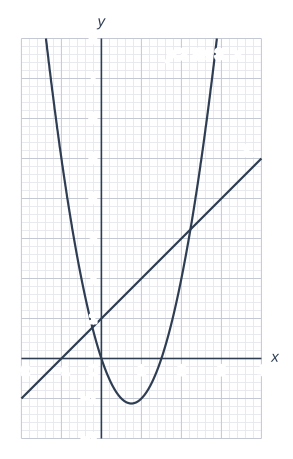
The diagram shows the graph of \(y = 2x^2 - 3x\) and a straight line L. The x-coordinates of the points where the curve and L intersect are the solutions of the equation \(2x^2 - 4x - 1 = 0\)
Work out the equation of L.
Model answer
\(2x^2 - 4x - 1 = 0\) Add x + 1 to both sides: \(2x^2 - 3x = x + 1\) The left-hand side is the curve, so the line is y = x + 1
Explanation
Rearrange the equation so that one side is exactly the curve's expression, \(2x^2 - 3x\); the other side is then the line. Where the curve and the line meet, \(2x^2 - 3x = x + 1\), which is the same as \(2x^2 - 4x - 1 = 0\). You can check from the graph: L passes through (0, 1) and (1, 2).
Mark scheme
1 mark
M1 for rearranging \(2x^2 - 4x - 1 = 0\) so that \(2x^2 - 3x\) is on one side, e.g. \(2x^2 - 3x = x + 1\)
oe, e.g. \((2x^2 - 3x) - (2x^2 - 4x - 1)\)
1 mark
A1 for y = x + 1
correct answer with no working scores full marks
Question 3
3 marks
Solve \(5x^2 + 2x - 1 = 0\) Give your answers in the form \(\dfrac{a \pm \sqrt{b}}{c}\), where a, b and c are integers and b is as small as possible.
Use the quadratic formula and keep the square root exact. Simplify \(\sqrt{24}\) to \(2\sqrt{6}\), then divide every term of the numerator and the denominator by 2. Your calculator can check the answers: 0.289... and −0.689....
accept \(\frac{-2 \pm 2\sqrt{6}}{10}\) for this mark only if \(\sqrt{6}\) is seen; decimal answers only (0.290 and −0.690) score M1 A0 A0
Question 4
4 marks
The sum of a positive number and its reciprocal is 2.9
Work out the two possible values of the number.
Model answer
\(x + \dfrac{1}{x} = 2.9\) Multiply by x: \(x^2 + 1 = 2.9x\) \(x^2 - 2.9x + 1 = 0\) Multiply by 10: \(10x^2 - 29x + 10 = 0\) (5x − 2)(2x − 5) = 0 x = 0.4 or x = 2.5
Explanation
The reciprocal of x is \(\frac{1}{x}\). Multiplying every term by x clears the fraction and gives a quadratic. The two answers are reciprocals of each other, which makes sense: if x works, so does \(\frac{1}{x}\). Check: 2.5 + 0.4 = 2.9.
Mark scheme
1 mark
M1 for \(x + \dfrac{1}{x} = 2.9\)
oe
1 mark
M1dep for \(x^2 - 2.9x + 1 = 0\)
oe, e.g. \(10x^2 - 29x + 10 = 0\)
1 mark
M1 for (5x − 2)(2x − 5) = 0, or a correct substitution into the quadratic formula
ft their three-term quadratic
1 mark
A1 for 2.5 and 0.4
oe, e.g. \(\frac{5}{2}\) and \(\frac{2}{5}\); correct answers with no working score full marks
Ready to try the rest? Every answer you write is marked against the mark scheme, so you can see exactly where the marks are.
Ctrl + Enter to check
Study HelperHints first, answers after you try
Stuck on this one? Ask for a hint and I’ll point you in the right direction, without giving the answer away. Once you’ve checked your answer, I’ll show you how the marks are awarded.