Practise 29 exam-style questions on Ratio notation and simplifying ratios for AQA GCSE Maths (Higher calculator). Write your answer as you would in the exam and get it marked in seconds against the mark scheme, point by point, with the Study Helper on hand if you get stuck.
29 questions
1–5 marks each
Instant marking
No sign-up needed
20 questions, marked as you go
Sample questions with model answers
Here are 4 of the questions in this topic, each with a model answer, an explanation of why it earns the marks and the mark scheme an examiner would use.
Question 1
1 mark
Write the ratio 8 : 5 in the form n : 1
Model answer
Divide both parts by 5: 8 ÷ 5 = 1.6 and 5 ÷ 5 = 1 8 : 5 = 1.6 : 1
Explanation
To make the second part 1, divide both parts by the second part (5). The first part can then be a decimal. The form n : 1 is useful for comparing ratios, for example screen shapes or mixtures.
Mark scheme
1 mark
B1 for 1.6 : 1
accept \(\frac{8}{5} : 1\)
Question 2
2 marks
In a club there are 12 boys and 18 girls.
Ben says, "The ratio of girls to boys is 2 : 3"
Is Ben correct? Give a reason for your answer.
Model answer
girls : boys = 18 : 12 = 3 : 2 No, Ben is not correct. He has written the ratio of boys to girls (2 : 3). The ratio of girls to boys is 3 : 2.
Explanation
The order in a ratio matters: 'girls to boys' means the number of girls first. There are more girls than boys, so the first part must be the bigger one. 2 : 3 is the correct ratio of boys to girls.
Mark scheme
1 mark
B1 for 18 : 12 or 3 : 2
1 mark
B1 for No, with a correct reason, e.g. girls : boys = 3 : 2, or 2 : 3 is boys to girls
accept there are more girls than boys so the first number should be bigger
Question 3
3 marks
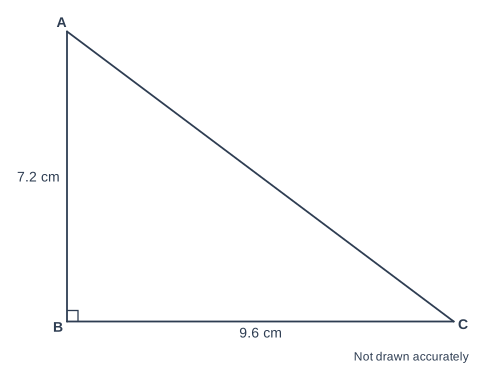
The diagram shows a right-angled triangle ABC. AB = 7.2 cm, BC = 9.6 cm and angle ABC = 90°
Write the ratio AB : BC : CA in its simplest form.
Model answer
\(CA^2 = 7.2^2 + 9.6^2 = 51.84 + 92.16 = 144\) \(CA = 12\) cm AB : BC : CA = 7.2 : 9.6 : 12 Multiply by 10: 72 : 96 : 120 Divide by 24: 3 : 4 : 5
Explanation
Use Pythagoras' theorem to find the hypotenuse CA, then simplify the three lengths as a ratio: clear the decimals and divide by the highest common factor. The answer shows this triangle is an enlargement of the 3, 4, 5 right-angled triangle.
Mark scheme
1 mark
M1 for \(\sqrt{7.2^2 + 9.6^2}\)
oe
1 mark
A1 for CA = 12 cm
1 mark
A1 for 3 : 4 : 5
correct answer with no working scores full marks
Question 4
4 marks
A cube has edges of length 2a cm. A cuboid measures a cm by 3a cm by 4a cm.
Write the ratio surface area of the cube : surface area of the cuboid in its simplest form.
Model answer
Cube: each face has area \((2a)^2 = 4a^2\), so surface area = \(6 \times 4a^2 = 24a^2\) Cuboid: surface area = \(2(3a^2 + 4a^2 + 12a^2) = 2 \times 19a^2 = 38a^2\) Ratio = \(24a^2 : 38a^2 = 24 : 38 = 12 : 19\)
Explanation
Find each surface area in terms of a, then the \(a^2\) cancels and you simplify the numbers. Take care that \((2a)^2 = 4a^2\), not \(2a^2\), and that a cuboid has three pairs of different faces.
Mark scheme
1 mark
M1 for the surface area of the cube, \(6 \times (2a)^2\) (= \(24a^2\))
\(6 \times 2a^2\) scores M0
1 mark
M1 for a correct method for the surface area of the cuboid, \(2(a \times 3a + a \times 4a + 3a \times 4a)\)
1 mark
A1 for \(38a^2\)
1 mark
A1 for 12 : 19
correct answer with no working scores full marks
Ready to try the rest? Every answer you write is marked against the mark scheme, so you can see exactly where the marks are.
Ctrl + Enter to check
Study HelperHints first, answers after you try
Stuck on this one? Ask for a hint and I’ll point you in the right direction, without giving the answer away. Once you’ve checked your answer, I’ll show you how the marks are awarded.