
Level:
Correct: 0
Incorrect: 0
Marks: 0/0
Exam Practice
Course:
Topics:
AQA GCSE Maths (Higher calculator) Smart practice A mixed round aimed at your weak spots
Unit 1
Number
Unit 2
Algebra
Unit 3
Ratio, proportion and rates of change
Unit 4
Geometry and measures
Unit 5
Probability
Unit 6
Statistics
Avg
score:
–
Topics
done:
0/97

Upper and lower bounds

Practise 37 exam-style questions on Upper and lower bounds for AQA GCSE Maths (Higher calculator). Write your answer as you would in the exam and get it marked in seconds against the mark scheme, point by point, with the Study Helper on hand if you get stuck.

  • 37 questions
  • 1–5 marks each
  • Instant marking
  • No sign-up needed
20 questions, marked as you go

Sample questions with model answers

Here are 4 of the questions in this topic, each with a model answer, an explanation of why it earns the marks and the mark scheme an examiner would use.

Question 1

2 marks

The mass of a parcel is 3.65 kg, correct to 2 decimal places.

Write down the lower bound and the upper bound of the mass of the parcel.

Model answer

To 2 decimal places, the mass is within half of 0.01 = 0.005 kg of 3.65 kg.
Lower bound = 3.65 − 0.005 = 3.645 kg
Upper bound = 3.65 + 0.005 = 3.655 kg

Explanation

Rounding to 2 decimal places means rounding to the nearest 0.01, so the bounds are 0.005 either side. The upper bound is written as 3.655 kg, even though 3.655 itself would round up to 3.66.

Mark scheme
  1. 1 mark

    B1 for lower bound 3.645 kg

    cao

  2. 1 mark

    B1 for upper bound 3.655 kg

    cao; do not accept 3.654 or 3.6549
Question 2

2 marks

The price of a bike was £240, correct to the nearest £10
The price is then increased by exactly 15%

Work out the lower bound of the new price.

Model answer

Lower bound of the original price = 240 − 5 = £235
Lower bound of the new price = 235 × 1.15 = £270.25

Explanation

Find the lower bound of the original price (half of £10 below £240) and then apply the multiplier 1.15. The 15% is exact, so it has no bounds of its own. A common mistake is to use £239.50, which is the bound for the nearest pound.

Mark scheme
  1. 1 mark

    M1 for 235 × 1.15

    oe, e.g. 235 + 0.15 × 235

  2. 1 mark

    A1 for £270.25

    cao; correct answer with no working scores full marks

Question 3

3 marks

The formula \(v = u + at\) gives the final velocity, \(v\) m/s, of an object with initial velocity \(u\) m/s and acceleration \(a\) m/s², after \(t\) seconds.

\(u = 12.4\), correct to 1 decimal place
\(a = 2.5\), correct to 2 significant figures
\(t = 6\), correct to the nearest whole number

Work out the lower bound of \(v\).
Give your answer to 3 significant figures.

Model answer

Lower bounds: \(u = 12.35\), \(a = 2.45\), \(t = 5.5\)
\(v = 12.35 + 2.45 \times 5.5 = 12.35 + 13.475 = 25.825\)
Lower bound of \(v\) = 25.8 m/s (3 s.f.)

Explanation

Every term in \(u + at\) is added and every value is positive, so the smallest \(v\) comes from the lower bound of each of \(u\), \(a\) and \(t\). Take care with the bounds: 2.5 to 2 significant figures has bounds 2.45 and 2.55, and 6 to the nearest whole number has bounds 5.5 and 6.5.

Mark scheme
  1. 1 mark

    B1 for at least two of 12.35, 2.45 and 5.5 seen

  2. 1 mark

    M1 for 12.35 + 2.45 × 5.5

  3. 1 mark

    A1 for 25.8 m/s

    accept [25.8, 25.83]; correct answer with no working scores full marks

Question 4

4 marks

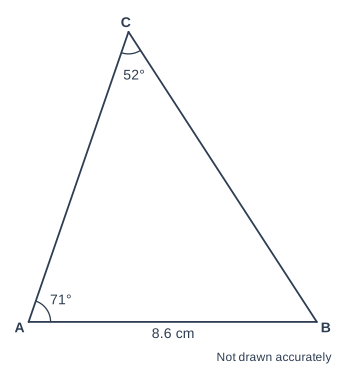
The diagram shows triangle ABC.

AB = 8.6 cm, correct to 1 decimal place.
Angle BAC = 71° and angle ACB = 52°, both correct to the nearest degree.

Work out the upper bound of the length of BC.
Give your answer to 3 significant figures.

Geometry diagram, marked "Not drawn accurately". Triangle ABC. Side AB is labelled 8.6 cm. Angle BAC is marked 71°. Angle ACB is marked 52°.

Model answer

By the sine rule, \(\dfrac{BC}{\sin A} = \dfrac{AB}{\sin C}\), so \(BC = \dfrac{AB \times \sin A}{\sin C}\)
For the largest BC: AB as large as possible (8.65), sin A as large as possible (A = 71.5°) and sin C as small as possible (C = 51.5°).
\(BC = \dfrac{8.65 \times \sin 71.5^\circ}{\sin 51.5^\circ} = 10.4816...\)
Upper bound of BC = 10.5 cm (3 s.f.)

Explanation

Rearrange the sine rule to get BC on its own, then decide which bound makes each part largest: the top of the fraction is biggest with the upper bounds of AB and angle A, and the bottom is smallest with the lower bound of angle C. For acute angles, a bigger angle has a bigger sine.

Mark scheme
  1. 1 mark

    B1 for 8.65 seen

    cao

  2. 1 mark

    B1 for 71.5 and 51.5 seen

  3. 1 mark

    M1 for \(\dfrac{BC}{\sin 71.5^\circ} = \dfrac{8.65}{\sin 51.5^\circ}\)

    oe; allow M1 for a correct sine rule using at least one correct bound

  4. 1 mark

    A1 for 10.5 cm

    accept [10.48, 10.5] (10.4816...); correct answer with no working scores full marks

Ready to try the rest? Every answer you write is marked against the mark scheme, so you can see exactly where the marks are.

Study Helper Hints first, answers after you try

Stuck on this one? Ask for a hint and I’ll point you in the right direction, without giving the answer away. Once you’ve checked your answer, I’ll show you how the marks are awarded.