Level:
Correct: 0
Incorrect: 0
Marks: 0/0
Exam Practice
Course:
Topics:
AQA GCSE Maths (Higher calculator) Smart practice A mixed round aimed at your weak spots
Unit 1
Number
Unit 2
Algebra
Unit 3
Ratio, proportion and rates of change
Unit 4
Geometry and measures
Unit 5
Probability
Unit 6
Statistics
Avg
score:
–
Topics
done:
0/97

Geometric notation, polygons and symmetry

Practise 18 exam-style questions on Geometric notation, polygons and symmetry for AQA GCSE Maths (Higher calculator). Write your answer as you would in the exam and get it marked in seconds against the mark scheme, point by point, with the Study Helper on hand if you get stuck.

  • 18 questions
  • 1–5 marks each
  • Instant marking
  • No sign-up needed
18 questions, marked as you go

Sample questions with model answers

Here are 4 of the questions in this topic, each with a model answer, an explanation of why it earns the marks and the mark scheme an examiner would use.

Question 1

1 mark

In triangle ABC the sides are labelled in the standard way, so that side a is opposite angle A, side b is opposite angle B and side c is opposite angle C.

a = 7 cm, b = 9 cm and c = 12 cm

Which angle of the triangle is the largest?

Choose your answer.

  • angle A
  • angle B
  • angle C
  • they are all equal

Model answer

angle C
The largest angle is opposite the longest side, and c = 12 cm is the longest side.

Explanation

In the standard labelling, the lower-case letter for a side matches the capital letter of the angle opposite it. In any triangle the largest angle is opposite the longest side, so it is angle C, opposite c = 12 cm. This labelling is the one used in the sine and cosine rules.

Mark scheme
  1. 1 mark

    B1 for angle C

Question 2

2 marks

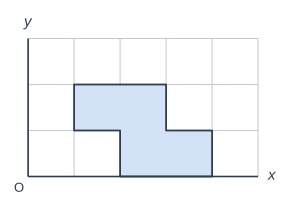
The diagram shows a shape made from four squares.

Write down the number of lines of symmetry of the shape.
Write down the order of rotational symmetry of the shape.

A sketch on a pair of axes (x across, y up) with no scale marked, the axes crossing at the origin O. A shaded octagon with vertices (1, 2), (3, 2), (3, 1), (4, 1), (4, 0), (2, 0), (2, 1) and (1, 1).

Model answer

Number of lines of symmetry: 0
Order of rotational symmetry: 2 (it looks the same after a half turn about its centre)

Explanation

No fold line makes the two halves of this shape match, so it has no lines of symmetry. A half turn (180°) about its centre maps it onto itself, so the order of rotational symmetry is 2. Every shape has order at least 1, so the order is never 0.

Mark scheme
  1. 1 mark

    B1 for 0 lines of symmetry

  2. 1 mark

    B1 for order 2

    do not accept 0 for the order

Question 3

3 marks

In triangle ABC the sides are labelled in the standard way, so that side a is opposite angle A, side b is opposite angle B and side c is opposite angle C.

a = 8 cm, b = 11 cm and angle C = 47°

Work out the length of side c.
Give your answer to 3 significant figures.

Model answer

Angle C is between sides a and b, so use the cosine rule:
\(c^2 = a^2 + b^2 - 2ab\cos C\)
\(c^2 = 64 + 121 - 176 \times \cos 47^\circ = 185 - 120.03... = 64.968...\)
\(c = 8.0602...\)
c = 8.06 cm (3 s.f.)

Explanation

With standard labelling, angle C is the angle between sides a and b, and c is the side opposite it, so this is exactly the cosine rule \(c^2 = a^2 + b^2 - 2ab\cos C\). Drawing a quick sketch from the description helps you see which sides and angle you have. Remember to take the square root at the end.

Mark scheme
  1. 1 mark

    M1 for \(c^2 = 8^2 + 11^2 - 2 \times 8 \times 11 \times \cos 47^\circ\)

  2. 1 mark

    M1dep for \(c^2 = 64.96...\) or \(\sqrt{64.96...}\)

    accept [64.9, 65] for \(c^2\)

  3. 1 mark

    A1 for 8.06 cm

    accept [8.06, 8.061]; correct answer with no working scores full marks

Question 4

4 marks

ABCD is a quadrilateral.
AB is parallel to DC.
AB = 6 cm and DC = 10 cm
AD = BC
Angle ADC = 60°

Write down the mathematical name of quadrilateral ABCD.
Work out the perimeter of ABCD.

Model answer

ABCD is an isosceles trapezium.
Drop perpendiculars from A and B to DC. The parts of DC outside them are each (10 − 6) ÷ 2 = 2 cm.
\(\cos 60^\circ = \dfrac{2}{AD}\), so \(AD = \dfrac{2}{\cos 60^\circ} = 4\) cm, and BC = 4 cm
Perimeter = 6 + 10 + 4 + 4 = 24 cm

Explanation

Sketch the shape from the description: one pair of parallel sides with the other two sides equal makes an isosceles trapezium, which is symmetrical about the perpendicular bisector of its parallel sides. That symmetry splits the extra 4 cm of DC equally between the two ends, giving right-angled triangles with base 2 cm and angle 60°. Then use cosine to find the sloping sides.

Mark scheme
  1. 1 mark

    B1 for isosceles trapezium

    do not accept 'trapezium' alone

  2. 1 mark

    M1 for (10 − 6) ÷ 2 (= 2)

    the horizontal distance from D to the foot of the perpendicular from A

  3. 1 mark

    M1dep for AD = 2 ÷ cos 60° (= 4)

    oe

  4. 1 mark

    A1 for 24 cm

    correct answer with no working scores full marks

Ready to try the rest? Every answer you write is marked against the mark scheme, so you can see exactly where the marks are.

Study Helper Hints first, answers after you try

Stuck on this one? Ask for a hint and I’ll point you in the right direction, without giving the answer away. Once you’ve checked your answer, I’ll show you how the marks are awarded.