Level:
Correct: 0
Incorrect: 0
Marks: 0/0
Exam Practice
Course:
Topics:
AQA GCSE Maths (Higher calculator) Smart practice A mixed round aimed at your weak spots
Unit 1
Number
Unit 2
Algebra
Unit 3
Ratio, proportion and rates of change
Unit 4
Geometry and measures
Unit 5
Probability
Unit 6
Statistics
Avg
score:
–
Topics
done:
0/97

Plans and elevations

Practise 18 exam-style questions on Plans and elevations for AQA GCSE Maths (Higher calculator). Write your answer as you would in the exam and get it marked in seconds against the mark scheme, point by point, with the Study Helper on hand if you get stuck.

  • 18 questions
  • 1–5 marks each
  • Instant marking
  • No sign-up needed
18 questions, marked as you go

Sample questions with model answers

Here are 4 of the questions in this topic, each with a model answer, an explanation of why it earns the marks and the mark scheme an examiner would use.

Question 1

1 mark

A cylinder is lying on its curved surface on a horizontal table.

What shape is the plan of the cylinder?

Choose your answer.

  • circle
  • rectangle
  • triangle
  • semicircle

Model answer

Looking down on a cylinder lying on its side, you see its length and its diameter: a rectangle.
rectangle

Explanation

The plan is the view from directly above, so it depends on how the solid is placed. A cylinder standing on a circular end has a circular plan, but lying on its side it looks like a rectangle from above (its length by its diameter); the circle is then seen in one of the elevations.

Mark scheme
  1. 1 mark

    B1 for rectangle

Question 2

2 marks

The plan of a solid is a regular pentagon with a line from each vertex to the centre.
The front elevation of the solid is a triangle.

Name the solid and write down the number of edges it has.

Model answer

The pentagon is the base, and the lines from each vertex to the centre are the sloping edges meeting at the apex above the centre.
The solid is a pentagonal pyramid.
Edges: 5 round the base + 5 sloping edges = 10

Explanation

From above, a pyramid shows its base with the sloping edges running to the apex, which is directly above the centre. From the front it looks like a triangle. A pyramid with an \(n\)-sided base has \(2n\) edges.

Mark scheme
  1. 1 mark

    B1 for pentagonal pyramid

    accept pyramid with a pentagonal base

  2. 1 mark

    B1 for 10 edges

    ft 2 × number of sides of the base for another pyramid named

Question 3

3 marks

A cone has base diameter 9 cm and slant height 8 cm.
Its front elevation is an isosceles triangle.

Work out the area of the front elevation.
Give your answer to 3 significant figures.

Model answer

The front elevation is a triangle with base 9 cm (the diameter) and two sloping sides of 8 cm (the slant height).
Half the base is 4.5 cm, so the height is \(\sqrt{8^2 - 4.5^2} = \sqrt{43.75} = 6.614...\) cm
Area = \(\frac{1}{2} \times 9 \times 6.614... = 29.76...\)
Area = 29.8 cm² (3 s.f.)

Explanation

Seen from the front, a cone is an isosceles triangle: its base is the diameter of the cone and its equal sides are the slant height. Split it into two right-angled triangles to find the height with Pythagoras, then use \(\frac{1}{2}\) × base × height. Using 8 cm as the height is a common mistake.

Mark scheme
  1. 1 mark

    M1 for \(8^2 - 4.5^2\) or 43.75

    the height of the triangle (the height of the cone)

  2. 1 mark

    M1dep for \(\frac{1}{2} \times 9 \times \sqrt{43.75}\)

    height = 6.614...

  3. 1 mark

    A1 for 29.8 cm²

    accept [29.7, 29.8] (29.76...); correct answer with no working scores full marks

Question 4

4 marks

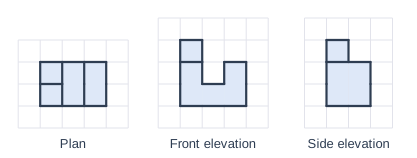
The diagram shows the plan, front elevation and side elevation of a solid made from cubes.

More than one solid has these three views.

Work out the greatest number of cubes and the least number of cubes the solid could have.

Drawings of a solid made from cubes, on squared paper. They are its plan, front elevation and side elevation, drawn on squared paper. Plan (looking down, back row at the top): ■■■ / ■■■, 6 squares. Front elevation (seen from the front): columns of 3, 1 and 2 squares from left to right (6 squares). Side elevation (seen from the right-hand side, so the back of the solid is on the left): columns of 3 and 2 squares from left to right (5 squares).

Model answer

The plan has 6 squares, so there are 6 stacks in 2 rows of 3, each with at least 1 cube.
Front elevation: the tallest stacks in the columns are 3, 1 and 2.
Side elevation: the tallest stack in the back row is 3 and in the front row is 2.
Greatest: make every stack as tall as allowed.
Back row: 3, 1, 2. Front row: 2, 1, 2 (the front row is at most 2 high). Total = 11 cubes.
Least: the 3 must be at the back on the left. The left column, the right column and the front row still need stacks of height 2 and the middle column only 1.
One stack of 2 at the front right covers both the right column and the front row: back row 3, 1, 1; front row 1, 1, 2. Total = 9 cubes.
Greatest = 11, least = 9

Explanation

Each stack can be no taller than the front elevation allows for its column and the side elevation allows for its row. For the greatest number, make every stack that tall; for the least, use as few tall stacks as possible while still showing the right height in every column and row. Every square on the plan needs at least one cube.

Mark scheme
  1. 1 mark

    M1 for a correct method for the greatest, e.g. each stack as tall as both elevations allow: back row 3, 1, 2 and front row 2, 1, 2

    the figure description gives one possible solid; the answers are fixed by the views, not by that solid

  2. 1 mark

    A1 for greatest 11

  3. 1 mark

    M1 for a correct method for the least, e.g. back row 3, 1, 1 and front row 1, 1, 2 (or a valid arrangement with 9 cubes)

    all 6 stacks must have at least 1 cube

  4. 1 mark

    A1 for least 9

Ready to try the rest? Every answer you write is marked against the mark scheme, so you can see exactly where the marks are.

Study Helper Hints first, answers after you try

Stuck on this one? Ask for a hint and I’ll point you in the right direction, without giving the answer away. Once you’ve checked your answer, I’ll show you how the marks are awarded.