Practise 29 exam-style questions on Comparing lengths, areas and volumes with ratio for AQA GCSE Maths (Higher calculator). Write your answer as you would in the exam and get it marked in seconds against the mark scheme, point by point, with the Study Helper on hand if you get stuck.
29 questions
1–5 marks each
Instant marking
No sign-up needed
20 questions, marked as you go
Sample questions with model answers
Here are 4 of the questions in this topic, each with a model answer, an explanation of why it earns the marks and the mark scheme an examiner would use.
Question 1
2 marks
Circle A has radius 4.5 cm. Circle B has radius 7.5 cm.
Work out the ratio area of circle A : area of circle B Give your answer in its simplest form.
Model answer
Ratio of radii: 4.5 : 7.5 = 3 : 5 All circles are similar, so the ratio of areas is \(3^2 : 5^2\) 9 : 25
Explanation
All circles are mathematically similar, so the ratio of their areas is the square of the ratio of their radii. Simplify 4.5 : 7.5 to 3 : 5 first, then square each part. You can also work out \(20.25\pi : 56.25\pi\) and simplify, but the π cancels.
Mark scheme
1 mark
M1 for 3 : 5 or \(4.5^2 : 7.5^2\) or \(20.25\pi : 56.25\pi\)
or 63.6... : 176.7...
1 mark
A1 for 9 : 25
correct answer with no working scores full marks
Question 2
2 marks
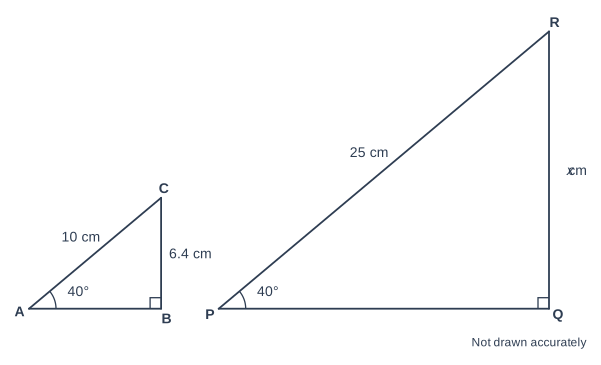
Amir and Beth have each drawn a right-angled triangle with an angle of 40°, as shown in the diagram. Amir's triangle has hypotenuse 10 cm. He measures the side opposite the 40° angle as 6.4 cm. Beth's triangle has hypotenuse 25 cm.
Use Amir's measurement to work out the value of x. Give a reason why your method works.
Model answer
Both triangles have angles 90°, 40° and 50°, so they are similar. Scale factor: \(25 \div 10 = 2.5\) \(x = 6.4 \times 2.5 = 16\) The method works because in similar triangles every pair of corresponding sides is in the same ratio, so opposite : hypotenuse is the same in both triangles.
Explanation
Right-angled triangles with the same acute angle are similar, so the ratio opposite ÷ hypotenuse is fixed for that angle; this fixed ratio is sin 40° (0.643 to 3 s.f.). That is exactly why trigonometry works: the trigonometric ratios depend only on the angle.
Mark scheme
1 mark
B1 for x = 16
from \(6.4 \times 2.5\) oe; accept 16.1 from \(25 \sin 40^\circ\)
1 mark
B1 for a correct reason, e.g. the triangles are similar because their angles are the same (90°, 40° and 50°), so corresponding sides are in the same ratio
accept 'opposite ÷ hypotenuse is the same in both triangles (it is sin 40°)'; do not accept 'the triangles look the same'
Question 3
3 marks
Two solid figurines are mathematically similar and are made from the same material. The smaller figurine is 7.5 cm tall and has a mass of 250 g. The larger figurine is 12 cm tall.
Work out the mass of the larger figurine.
Model answer
Length scale factor: \(12 \div 7.5 = 1.6\) Volume scale factor: \(1.6^3 = 4.096\) The figurines are made of the same material, so the masses are in the same ratio as the volumes. Mass: \(250 \times 4.096 = 1024\) g
Explanation
Mass = density × volume, and the density is the same for both figurines, so the mass scales like the volume: by the cube of the length scale factor. A common mistake is \(250 \times 1.6 = 400\) g.
Mark scheme
1 mark
M1 for \(12 \div 7.5\) (= 1.6) or 5 : 8
1 mark
M1dep for \(1.6^3\) (= 4.096) or 125 : 512
1 mark
A1 for 1024 g
accept 1.024 kg; correct answer with no working scores full marks
Question 4
4 marks
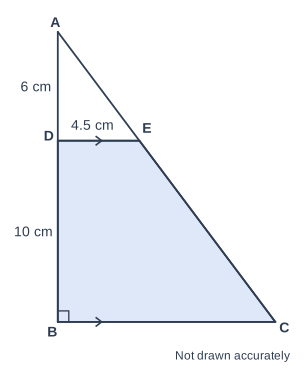
The diagram shows a right-angled triangle ABC. D is a point on AB and E is a point on AC. DE is parallel to BC.
Work out the area of the shaded trapezium DBCE.
Model answer
Triangles ADE and ABC are similar (DE is parallel to BC). AB = 6 + 10 = 16 cm, so the scale factor is \(\dfrac{16}{6} = \dfrac{8}{3}\) Area of triangle ADE: \(\frac{1}{2} \times 6 \times 4.5 = 13.5\) cm² Area of triangle ABC: \(13.5 \times \left(\dfrac{8}{3}\right)^2 = 96\) cm² Area of DBCE: \(96 - 13.5 = 82.5\) cm²
Explanation
Triangle ADE is similar to triangle ABC, with scale factor AB ÷ AD = 16 ÷ 6, not 10 ÷ 6. Either use the area scale factor \(\left(\frac{8}{3}\right)^2\), or find BC = 12 cm and use the trapezium formula. The shaded area is the large triangle minus the small one.
Mark scheme
1 mark
M1 for the area of triangle ADE, \(\frac{1}{2} \times 6 \times 4.5\) (= 13.5)
1 mark
M1 for the scale factor \(\frac{16}{6}\) (= \(\frac{8}{3}\)) or BC = 12
AB = 16 must be used
1 mark
M1dep for the area of triangle ABC, 96, e.g. \(\frac{1}{2} \times 16 \times 12\) or \(13.5 \times \left(\frac{8}{3}\right)^2\)
or the trapezium directly: \(\frac{1}{2}(4.5 + 12) \times 10\)
1 mark
A1 for 82.5 cm²
correct answer with no working scores full marks
Ready to try the rest? Every answer you write is marked against the mark scheme, so you can see exactly where the marks are.
Ctrl + Enter to check
Study HelperHints first, answers after you try
Stuck on this one? Ask for a hint and I’ll point you in the right direction, without giving the answer away. Once you’ve checked your answer, I’ll show you how the marks are awarded.