
Level:
Correct: 0
Incorrect: 0
Marks: 0/0
Exam Practice
Course:
Topics:
AQA GCSE Maths (Higher calculator) Smart practice A mixed round aimed at your weak spots
Unit 1
Number
Unit 2
Algebra
Unit 3
Ratio, proportion and rates of change
Unit 4
Geometry and measures
Unit 5
Probability
Unit 6
Statistics
Avg
score:
–
Topics
done:
0/97

Probabilities that sum to 1

Practise 28 exam-style questions on Probabilities that sum to 1 for AQA GCSE Maths (Higher calculator). Write your answer as you would in the exam and get it marked in seconds against the mark scheme, point by point, with the Study Helper on hand if you get stuck.

  • 28 questions
  • 1–5 marks each
  • Instant marking
  • No sign-up needed
20 questions, marked as you go

Sample questions with model answers

Here are 4 of the questions in this topic, each with a model answer, an explanation of why it earns the marks and the mark scheme an examiner would use.

Question 1

2 marks

The table shows the probabilities that a biased four-sided spinner lands on each number.
The probability for 3 is missing.

Work out the probability that the spinner lands on 3
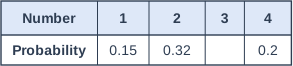
Table with columns "Number", "1", "2", "3", "4". Number: Probability; 1: 0.15; 2: 0.32; 3: (blank); 4: 0.2.

Model answer

P(3) = 1 − (0.15 + 0.32 + 0.2)
= 1 − 0.67
= 0.33

Explanation

The spinner must land on exactly one of the numbers 1, 2, 3 or 4, so the four probabilities add up to 1. Subtract the sum of the three known probabilities from 1. A common mistake is to subtract each one from 1 separately or to forget one of the probabilities.

Mark scheme
  1. 1 mark

    M1 for 1 − (0.15 + 0.32 + 0.2)

    oe

  2. 1 mark

    A1 for 0.33

    oe; correct answer with no working scores full marks
Question 2

2 marks

A fair six-sided dice is rolled.

Event A: the score is even
Event B: the score is a multiple of 3
Event C: the score is 1 or 5

Jo says,
"Between them, A, B and C include every score, so P(A) + P(B) + P(C) = 1"

Is Jo correct?
Give a reason for your answer.

Model answer

A = {2, 4, 6}, B = {3, 6}, C = {1, 5}
P(A) + P(B) + P(C) = \(\frac{3}{6} + \frac{2}{6} + \frac{2}{6} = \frac{7}{6}\)
No. The events do include every score, but A and B are not mutually exclusive: 6 is in both, so it is counted twice.

Explanation

Probabilities add up to 1 only when the events are exhaustive and mutually exclusive. Jo's events are exhaustive, but a score of 6 is both even and a multiple of 3, so it is counted twice and the total is \(\frac{7}{6}\). List the scores in each event to check for overlaps.

Mark scheme
  1. 1 mark

    B1 for P(A) + P(B) + P(C) = \(\frac{3}{6} + \frac{2}{6} + \frac{2}{6} = \frac{7}{6}\), or for '6 is in both A and B'

    oe

  2. 1 mark

    B1dep for 'No' with a reason, e.g. 'A and B are not mutually exclusive (6 is in both), so the probabilities do not add up to 1'

    must have a correct reason

Question 3

3 marks

A café sells ice cream in a cone or a tub.
The flavours are vanilla, chocolate and strawberry.
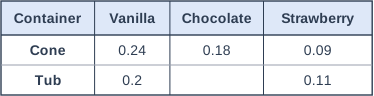
The table shows the probabilities of what a customer chosen at random buys.
One probability is missing.

Work out the probability that the customer buys chocolate ice cream.

Table with columns "Container", "Vanilla", "Chocolate", "Strawberry". Container: Cone; Vanilla: 0.24; Chocolate: 0.18; Strawberry: 0.09 | Container: Tub; Vanilla: 0.2; Chocolate: (blank); Strawberry: 0.11.

Model answer

P(tub and chocolate) = 1 − (0.24 + 0.18 + 0.09 + 0.2 + 0.11) = 1 − 0.82 = 0.18
P(chocolate) = 0.18 + 0.18 = 0.36

Explanation

The six cells of the table are all the possible choices and each customer makes exactly one of them, so the six probabilities add up to 1. Chocolate can be in a cone or a tub, so add both cells in the chocolate column. A common mistake is to give only the missing value 0.18.

Mark scheme
  1. 1 mark

    M1 for 1 − (0.24 + 0.18 + 0.09 + 0.2 + 0.11) (= 0.18)

    oe

  2. 1 mark

    M1dep for their 0.18 + 0.18 ||

  3. 1 mark

    A1 for 0.36

    oe; correct answer with no working scores full marks

Question 4

4 marks

Ella has a bag of 50 sweets.
Each sweet is strawberry, lime or orange.
The probability that a sweet taken at random is strawberry is 0.32
The probability that a sweet taken at random is lime is 0.12 more than the probability that it is orange.

Ella eats 4 lime sweets.

Work out the probability that the next sweet Ella takes at random is orange.

Model answer

P(lime) + P(orange) = 1 − 0.32 = 0.68
P(orange) = p and P(lime) = p + 0.12, so 2p + 0.12 = 0.68 and p = 0.28
Orange sweets: 0.28 × 50 = 14 (lime sweets: 0.4 × 50 = 20)
After Ella eats 4 lime sweets there are 46 sweets, and 14 of them are orange.
P(orange) = \(\frac{14}{46} = \frac{7}{23}\)

Explanation

The three probabilities add up to 1, so lime and orange share 0.68, with lime 0.12 more than orange. Turn the probabilities into numbers of sweets, then remember that eating 4 sweets reduces the total to 46. A common mistake is to give 0.28, forgetting that the probability changes after the lime sweets are eaten.

Mark scheme
  1. 1 mark

    M1 for 1 − 0.32 (= 0.68) or 50 − 0.32 × 50 (= 34)

    oe

  2. 1 mark

    M1dep for 2 × P(orange) + 0.12 = 0.68 or (34 − 6) ÷ 2

    oe

  3. 1 mark

    A1 for 14 orange sweets

    oe, e.g. P(orange) = 0.28

  4. 1 mark

    B1ft for \(\frac{14}{46}\)

    oe, e.g. \(\frac{7}{23}\); ft their number of orange sweets ÷ 46

Ready to try the rest? Every answer you write is marked against the mark scheme, so you can see exactly where the marks are.

Study Helper Hints first, answers after you try

Stuck on this one? Ask for a hint and I’ll point you in the right direction, without giving the answer away. Once you’ve checked your answer, I’ll show you how the marks are awarded.