Practise 18 exam-style questions on Constructions and loci for AQA GCSE Maths (Higher calculator). Write your answer as you would in the exam and get it marked in seconds against the mark scheme, point by point, with the Study Helper on hand if you get stuck.
18 questions
1–5 marks each
Instant marking
No sign-up needed
18 questions, marked as you go
Sample questions with model answers
Here are 4 of the questions in this topic, each with a model answer, an explanation of why it earns the marks and the mark scheme an examiner would use.
Question 1
1 mark
Mia constructs an equilateral triangle using a ruler and compasses. She then bisects one of its angles.
What is the size of each of the two angles formed?
Choose your answer.
15°
30°
45°
60°
Model answer
Each angle of an equilateral triangle is 60°. 60 ÷ 2 = 30°
Explanation
All three angles of an equilateral triangle are 60°, which is how a 60° angle is constructed with compasses. Bisecting cuts the angle exactly in half, giving 30°. Bisecting again would give 15°; 45° comes from bisecting a right angle.
Mark scheme
1 mark
B1 for 30°
Question 2
2 marks
Describe how an angle of 30° can be constructed using only a ruler and compasses.
Model answer
First construct a 60° angle: draw a line through A, draw an arc with centre A crossing the line at P, then with the same radius draw an arc with centre P crossing the first arc at Q. Join A to Q; angle QAP = 60° because triangle APQ is equilateral. Then bisect angle QAP: with the same radius, draw arcs with centres P and Q that cross at R. Join A to R. Angle RAP = 30°.
Explanation
Ruler-and-compass constructions can make 60° (from an equilateral triangle) and 90° (a perpendicular), and bisecting halves any angle. So 30° is half of 60°, and 45° is half of 90°. Keeping the compasses the same for each pair of arcs is what makes the constructions exact.
Mark scheme
1 mark
B1 for constructing an angle of 60°, e.g. draw an arc centre A crossing a line at P, then an arc of the same radius centre P crossing the first arc at Q, and join AQ
oe, e.g. 'construct an equilateral triangle'
1 mark
B1 for bisecting the 60° angle
oe, e.g. arcs of equal radius from P and Q crossing at R, then join AR
Question 3
3 marks
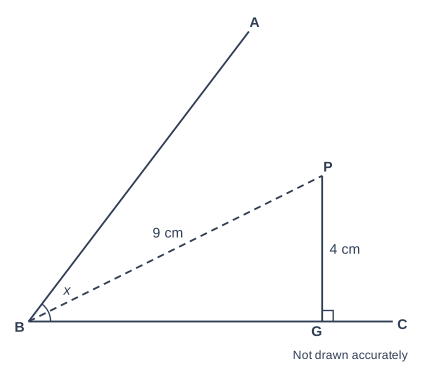
In the diagram, BP bisects angle ABC. G is the point on BC such that PG is perpendicular to BC. PG = 4 cm and BP = 9 cm
Work out the size of angle ABC. Give your answer to 1 decimal place.
Model answer
Triangle PBG has a right angle at G. \(\sin PBG = \dfrac{PG}{BP} = \dfrac{4}{9}\) Angle PBG = \(\sin^{-1}\left(\dfrac{4}{9}\right) = 26.387...^\circ\) BP bisects angle ABC, so angle ABC = 2 × 26.387... = 52.775...° Angle ABC = 52.8° (1 d.p.)
Explanation
PG is the perpendicular (shortest) distance from P to BC, which makes a right-angled triangle with hypotenuse BP, so use sine. Because BP is the angle bisector, angle PBG is only half of angle ABC, so double it. P is also 4 cm from BA, since points on an angle bisector are the same distance from both arms.
Mark scheme
1 mark
M1 for \(\sin PBG = \dfrac{4}{9}\)
oe
1 mark
M1dep for 2 × 26.38...
angle PBG = 26.387...°
1 mark
A1 for 52.8°
accept [52.7, 52.8] (52.775...); correct answer with no working scores full marks; SC1 for 26.4°
Question 4
4 marks
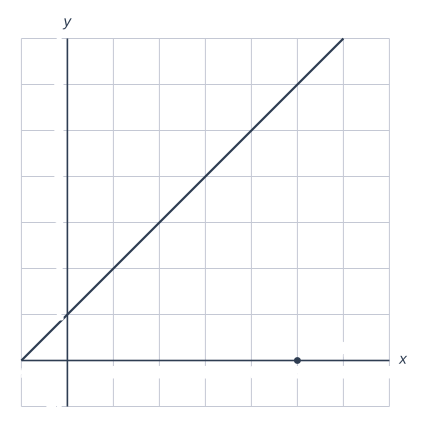
The diagram shows the line with equation y = x + 1 and the point P(5, 0).
Work out the shortest distance from P to the line. Give your answer to 3 significant figures.
Model answer
The shortest distance is along the perpendicular from P to the line. The line has gradient 1, so the perpendicular has gradient −1. Perpendicular through P(5, 0): \(y = -x + 5\) \(x + 1 = -x + 5\), so \(x = 2\) and \(y = 3\) The foot of the perpendicular is (2, 3). Distance = \(\sqrt{(5 - 2)^2 + (0 - 3)^2} = \sqrt{18} = 4.2426...\) 4.24 (3 s.f.)
Explanation
The shortest distance from a point to a line is the perpendicular distance, so find where the perpendicular from P meets the line and then use Pythagoras. A common mistake is to measure straight across or straight up to the line (horizontal distance 6 or vertical distance 6), which is longer than the perpendicular distance.
Mark scheme
1 mark
M1 for the perpendicular through P has gradient −1, e.g. y = −x + 5
oe
1 mark
M1dep for solving x + 1 = −x + 5
oe
1 mark
A1 for the foot of the perpendicular (2, 3)
1 mark
A1 for 4.24
accept [4.24, 4.243] or \(\sqrt{18}\) or \(3\sqrt{2}\); correct answer with no working scores full marks
Ready to try the rest? Every answer you write is marked against the mark scheme, so you can see exactly where the marks are.
Ctrl + Enter to check
Study HelperHints first, answers after you try
Stuck on this one? Ask for a hint and I’ll point you in the right direction, without giving the answer away. Once you’ve checked your answer, I’ll show you how the marks are awarded.