
Level:
Correct: 0
Incorrect: 0
Marks: 0/0
Exam Practice
Course:
Topics:
AQA GCSE Maths (Higher calculator) Smart practice A mixed round aimed at your weak spots
Unit 1
Number
Unit 2
Algebra
Unit 3
Ratio, proportion and rates of change
Unit 4
Geometry and measures
Unit 5
Probability
Unit 6
Statistics
Avg
score:
–
Topics
done:
0/97

Combined transformations

Practise 28 exam-style questions on Combined transformations for AQA GCSE Maths (Higher calculator). Write your answer as you would in the exam and get it marked in seconds against the mark scheme, point by point, with the Study Helper on hand if you get stuck.

  • 28 questions
  • 1–5 marks each
  • Instant marking
  • No sign-up needed
20 questions, marked as you go

Sample questions with model answers

Here are 4 of the questions in this topic, each with a model answer, an explanation of why it earns the marks and the mark scheme an examiner would use.

Question 1

2 marks

Shape A is translated by the vector \(\begin{pmatrix} 4 \\ -1 \end{pmatrix}\) to give shape B.
Shape B is translated by the vector \(\begin{pmatrix} -7 \\ 3 \end{pmatrix}\) to give shape C.

Write down the column vector of the single translation that maps shape C to shape A.

Model answer

A to C: \(\begin{pmatrix} 4 \\ -1 \end{pmatrix} + \begin{pmatrix} -7 \\ 3 \end{pmatrix} = \begin{pmatrix} -3 \\ 2 \end{pmatrix}\)
C to A is the opposite move: \(\begin{pmatrix} 3 \\ -2 \end{pmatrix}\)

Explanation

Add the two vectors to get the single translation from A to C, then reverse it by changing both signs, because going from C back to A undoes the move. A common mistake is to stop at \(\begin{pmatrix} -3 \\ 2 \end{pmatrix}\), which maps A to C, not C to A.

Mark scheme
  1. 1 mark

    B1 for \(\begin{pmatrix} -3 \\ 2 \end{pmatrix}\) (the translation from A to C) seen, or one correct component in the final answer

  2. 1 mark

    B1 for \(\begin{pmatrix} 3 \\ -2 \end{pmatrix}\)

    correct answer with no working scores full marks; do not accept the coordinates (3, −2) for this mark
Question 2

2 marks

Shape F is rotated 90° anticlockwise about the point (2, 1).
The image is then rotated 180° about the point (2, 1).

Describe fully the single transformation that maps shape F to the final image.

Model answer

Both rotations have the same centre, so the angles add: 90° + 180° = 270° anticlockwise.
270° anticlockwise is the same as 90° clockwise.
Rotation of 90° clockwise about (2, 1)

Explanation

When two rotations have the same centre, the single transformation is a rotation about that centre through the total angle, taking direction into account. A turn of 270° anticlockwise ends in the same position as 90° clockwise. 'Describe fully' needs the word rotation, the angle with its direction, and the centre.

Mark scheme
  1. 1 mark

    B1 for rotation 90° clockwise

    accept rotation 270° anticlockwise or −90°; if more than one transformation is given, award 0 marks

  2. 1 mark

    B1 for centre (2, 1)

    correct answer with no working scores full marks

Question 3

3 marks

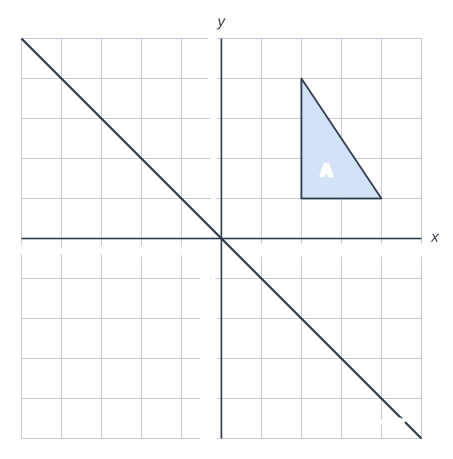
The diagram shows shape A and the line \(y = -x\)

Shape A is reflected in the line \(y = -x\) to give shape B.
Shape B is translated by the vector \(\begin{pmatrix} 2 \\ 2 \end{pmatrix}\) to give shape C.

Describe fully the single transformation that maps shape A to shape C.

A coordinate grid with x from −5 to 5 and y from −5 to 5; each grid square is 1 unit across, and the axes cross at the origin O. Shape A is a shaded triangle with vertices (2, 1), (4, 1) and (2, 4). The line labelled "y = −x" is a straight line sloping downwards from left to right passing through the origin and (−3, 3).

Model answer

A has vertices (2, 1), (4, 1) and (2, 4).
Reflect in \(y = -x\), \((x, y) \to (-y, -x)\): B has vertices (−1, −2), (−1, −4) and (−4, −2).
Translate by \(\begin{pmatrix} 2 \\ 2 \end{pmatrix}\): C has vertices (1, 0), (1, −2) and (−2, 0).
C is a mirror image of A. The mirror line passes through the midpoint of each vertex and its image:
midpoint of (2, 1) and (1, 0) = (1.5, 0.5); midpoint of (4, 1) and (1, −2) = (2.5, −0.5)
The line through these points has gradient −1 and \(x + y = 2\)
Reflection in the line \(y = -x + 2\)

Explanation

The translation \(\begin{pmatrix} 2 \\ 2 \end{pmatrix}\) is perpendicular to the mirror line \(y = -x\), so the combination is a reflection in a parallel line moved half of the translation, through (1, 1). To find a mirror line, join the midpoints of each point and its image. A common mistake is to think the answer is a rotation because the shape has moved diagonally.

Mark scheme
  1. 1 mark

    B1 for C with vertices (1, 0), (1, −2) and (−2, 0), or B with vertices (−1, −2), (−1, −4) and (−4, −2)

    may be implied by a correct final answer

  2. 1 mark

    B1 for reflection

    if more than one transformation is given, award 0 for the last two marks

  3. 1 mark

    B1 for in the line \(y = -x + 2\)

    oe, e.g. \(x + y = 2\) or \(y = 2 - x\); correct answer with no working scores full marks

Question 4

4 marks

In triangle ABC,
AB = 7.3 cm
BC = 5.8 cm
angle ABC = 48°

Triangle ABC is rotated and then reflected to give triangle PQR.

Work out the perimeter of triangle PQR.
Give your answer to 3 significant figures.
You must give a reason why your method works.

Model answer

Rotations and reflections do not change lengths, so triangle PQR is congruent to triangle ABC and has the same perimeter.
\(AC^2 = 7.3^2 + 5.8^2 - 2 \times 7.3 \times 5.8 \times \cos 48^\circ\)
\(AC^2 = 86.93 - 56.66... = 30.268...\)
\(AC = 5.5016...\) cm
Perimeter = 7.3 + 5.8 + 5.5016... = 18.6016...
Perimeter = 18.6 cm (3 s.f.)

Explanation

Rotations, reflections and translations (and any combination of them) keep all lengths and angles the same, so the image is congruent to the original. You know two sides and the angle between them, so use the cosine rule to find the third side, then add the three sides. A common mistake is to forget to square root \(AC^2\).

Mark scheme
  1. 1 mark

    B1 for a correct reason, e.g. rotations and reflections do not change lengths, so PQR is congruent to ABC and has the same perimeter

    accept 'the triangles are congruent'

  2. 1 mark

    M1 for \(AC^2 = 7.3^2 + 5.8^2 - 2 \times 7.3 \times 5.8 \times \cos 48^\circ\)

    oe

  3. 1 mark

    A1 for AC = 5.50 cm

    accept [5.5, 5.502] (5.5016...)

  4. 1 mark

    A1 for 18.6 cm

    accept [18.6, 18.61] (18.6016...)

Ready to try the rest? Every answer you write is marked against the mark scheme, so you can see exactly where the marks are.

Study Helper Hints first, answers after you try

Stuck on this one? Ask for a hint and I’ll point you in the right direction, without giving the answer away. Once you’ve checked your answer, I’ll show you how the marks are awarded.