
Level:
Correct: 0
Incorrect: 0
Marks: 0/0
Exam Practice
Course:
Topics:
AQA GCSE Maths (Higher calculator) Smart practice A mixed round aimed at your weak spots
Unit 1
Number
Unit 2
Algebra
Unit 3
Ratio, proportion and rates of change
Unit 4
Geometry and measures
Unit 5
Probability
Unit 6
Statistics
Avg
score:
–
Topics
done:
0/97

Ratios, fractions and linear functions

Practise 18 exam-style questions on Ratios, fractions and linear functions for AQA GCSE Maths (Higher calculator). Write your answer as you would in the exam and get it marked in seconds against the mark scheme, point by point, with the Study Helper on hand if you get stuck.

  • 18 questions
  • 1–5 marks each
  • Instant marking
  • No sign-up needed
18 questions, marked as you go

Sample questions with model answers

Here are 4 of the questions in this topic, each with a model answer, an explanation of why it earns the marks and the mark scheme an examiner would use.

Question 1

2 marks

At a football match, \(\frac{3}{11}\) of the crowd are under 18
There are 1384 people in the crowd who are 18 or over.

How many people are in the crowd altogether?

Model answer

18 or over: \(1 - \frac{3}{11} = \frac{8}{11}\) of the crowd
\(\frac{8}{11}\) of the crowd = 1384
\(\frac{1}{11}\) of the crowd = 1384 ÷ 8 = 173
Whole crowd = 11 × 173 = 1903

Explanation

The people who are 18 or over make up \(\frac{8}{11}\) of the crowd (the ratio under 18 : 18 or over is 3 : 8), so 1384 is 8 parts out of 11. A common mistake is to find \(\frac{3}{11}\) of 1384, but 1384 is not the whole crowd.

Mark scheme
  1. 1 mark

    M1 for 1384 ÷ 8 (= 173)

    oe, e.g. 1384 ÷ \(\frac{8}{11}\)

  2. 1 mark

    A1 for 1903

    correct answer with no working scores full marks
Question 2

2 marks

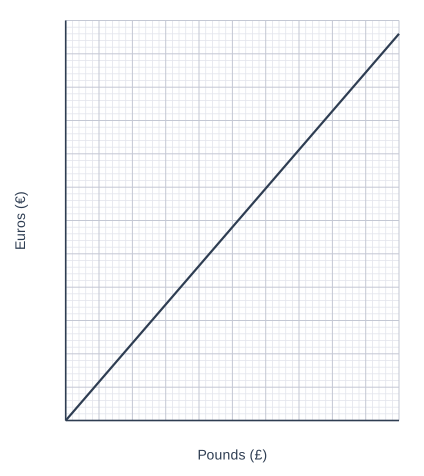
The conversion graph can be used to change between pounds (£) and euros (€).

Write a formula for the number of euros, E, in terms of the number of pounds, P.

A graph of Euros (€) (vertical axis, 0 to 120, marked every 10) against Pounds (£) (horizontal axis, 0 to 100, marked every 10), on a grid with 5 small squares to each large square. The graph is a straight line; its values can be read from the grid.

Model answer

From the graph, £100 = €116
So £1 = €1.16
E = 1.16P

Explanation

The line passes through the origin, so the ratio of euros to pounds is the same everywhere: 116 : 100 = 1.16 : 1. The formula is E = kP where k is the gradient of the graph, 1.16. Reading a point far along the line (such as £100) gives the most accurate value.

Mark scheme
  1. 1 mark

    M1 for a correct pair of values read from the graph, e.g. £100 = €116 or £50 = €58

    or the gradient 1.16 seen

  2. 1 mark

    A1 for E = 1.16P

    oe, e.g. \(E = \frac{116}{100}P\); do not accept P = 1.16E; correct answer with no working scores full marks

Question 3

3 marks

The lines \(y = 3x - 4\) and \(y = 12 - x\) meet at the point P.

Show that the x-coordinate and the y-coordinate of P are in the ratio 1 : 2

Model answer

At P: \(3x - 4 = 12 - x\)
\(4x = 16\)
\(x = 4\)
\(y = 12 - 4 = 8\)
x : y = 4 : 8 = 1 : 2, as required.

Explanation

Where two lines meet, both equations are true, so set the two expressions for y equal and solve. Then simplify x : y. Another way to see it: P lies on the line y = 2x, and every point on y = 2x has coordinates in the ratio 1 : 2.

Mark scheme
  1. 1 mark

    M1 for 3x − 4 = 12 − x

    oe

  2. 1 mark

    A1 for x = 4 and y = 8

  3. 1 mark

    A1 for 4 : 8 = 1 : 2, with a conclusion

    oe, e.g. y = 2x so x : y = 1 : 2; answer only scores 0

Question 4

4 marks

In a bag, \(\frac{3}{8}\) of the counters are red and the rest are green.

Sam adds 24 red counters to the bag.
Now \(\frac{9}{19}\) of the counters in the bag are red.

How many counters were in the bag at first?

Model answer

At first: red = 3k, green = 5k, total 8k
After: red = 3k + 24, total = 8k + 24
\(\dfrac{3k+24}{8k+24} = \dfrac{9}{19}\)
\(19(3k + 24) = 9(8k + 24)\)
\(57k + 456 = 72k + 216\)
\(240 = 15k\), so \(k = 16\)
Counters at first = 8 × 16 = 128
Check: 48 red, 80 green; then 72 red out of 152, and \(\frac{72}{152} = \frac{9}{19}\)

Explanation

\(\frac{3}{8}\) red means red : green = 3 : 5, so write the numbers as 3k and 5k. Only the red counters change, so the number of green counters stays 5k. Form an equation from the new fraction and solve it, then remember to give the original total, 8k.

Mark scheme
  1. 1 mark

    M1 for red = 3k and green = 5k (or red = \(\frac{3}{8}n\) and total after = n + 24)

    oe

  2. 1 mark

    M1dep for a correct equation, e.g. \(\dfrac{3k+24}{8k+24} = \dfrac{9}{19}\) or \(\dfrac{3k+24}{5k} = \dfrac{9}{10}\)

    oe

  3. 1 mark

    M1dep for 15k = 240 (k = 16)

    oe, e.g. 15n = 1920 using n = 8k

  4. 1 mark

    A1 for 128

    correct answer with no working scores full marks

Ready to try the rest? Every answer you write is marked against the mark scheme, so you can see exactly where the marks are.

Study Helper Hints first, answers after you try

Stuck on this one? Ask for a hint and I’ll point you in the right direction, without giving the answer away. Once you’ve checked your answer, I’ll show you how the marks are awarded.