Practise 29 exam-style questions on Transformations of graphs for AQA GCSE Maths (Higher calculator). Write your answer as you would in the exam and get it marked in seconds against the mark scheme, point by point, with the Study Helper on hand if you get stuck.
29 questions
1–5 marks each
Instant marking
No sign-up needed
20 questions, marked as you go
Sample questions with model answers
Here are 4 of the questions in this topic, each with a model answer, an explanation of why it earns the marks and the mark scheme an examiner would use.
Question 1
1 mark
Kim says,
"The graph of \(y = f(x + 4)\) is the graph of \(y = f(x)\) translated 4 units to the right."
What mistake has Kim made?
Model answer
The graph of \(y = f(x + 4)\) is the graph of \(y = f(x)\) translated 4 units to the left, by \(\begin{pmatrix}-4\\0\end{pmatrix}\), not to the right.
Explanation
In \(f(x + 4)\) each y-value appears 4 units earlier than it did: for example, the value f(0) is now reached when \(x = -4\). So adding inside the bracket moves the graph to the left, the opposite way to what the sign suggests.
Mark scheme
1 mark
B1 for saying the translation is 4 units to the left, not to the right
oe, e.g. it is a translation by \(\begin{pmatrix}-4\\0\end{pmatrix}\)
Question 2
2 marks
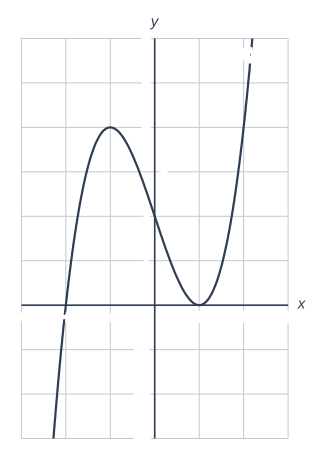
Here is the graph of \(y = f(x)\)
Write down the coordinates of the two turning points of the graph of \(y = -f(x)\)
Model answer
The turning points of \(y = f(x)\) are (−1, 4) and (1, 0). \(y = -f(x)\) is the reflection in the x-axis, so the y-coordinates change sign. (−1, −4) and (1, 0)
Explanation
Reflecting in the x-axis keeps each x-coordinate and changes the sign of each y-coordinate. The maximum point (−1, 4) becomes a minimum point (−1, −4), and the minimum point (1, 0), which is on the x-axis, stays where it is but becomes a maximum.
Mark scheme
1 mark
B1 for (−1, −4)
1 mark
B1 for (1, 0)
SC1 for (1, 4) and (−1, 0) (reflection in the y-axis) if no other marks are awarded
Question 3
3 marks
The graph of \(y = x^2 + 4x\) is translated by the vector \(\begin{pmatrix}-1\\5\end{pmatrix}\)
Work out the equation of the new graph. Give your answer in the form \(y = x^2 + bx + c\)
A translation of a units left and b units up changes \(y = f(x)\) into \(y = f(x + a) + b\), so replace every x by \((x + 1)\) and then add 5. Alternatively, complete the square: \(x^2 + 4x = (x + 2)^2 - 4\) has turning point (−2, −4), which moves to (−3, 1), giving \((x + 3)^2 + 1\).
Mark scheme
1 mark
M1 for \((x + 1)^2 + 4(x + 1)\)
or for the turning point (−2, −4) moved to (−3, 1)
1 mark
M1 for adding 5, e.g. \(y = (x + 1)^2 + 4(x + 1) + 5\)
or \(y = (x + 3)^2 + 1\)
1 mark
A1 for \(y = x^2 + 6x + 10\)
correct answer with no working scores full marks
Question 4
4 marks
The graph of \(y = x^2 + bx + c\) is translated by the vector \(\begin{pmatrix}2\\-3\end{pmatrix}\) to give the graph of \(y = x^2 - 8x + 13\)
Work out the values of b and c.
Model answer
\(x^2 - 8x + 13 = (x - 4)^2 - 3\), turning point (4, −3) The original graph had turning point \((4 - 2, -3 + 3) = (2, 0)\) Original graph: \(y = (x - 2)^2 = x^2 - 4x + 4\) \(b = -4\), \(c = 4\)
Explanation
Work backwards: find the turning point of the new graph, then undo the translation (2 left and 3 up) to get the turning point of the original. A U-shaped graph with \(x^2\) coefficient 1 and turning point (2, 0) is \(y = (x - 2)^2\). Check: \((x - 2 - 2)^2 - 3 = (x - 4)^2 - 3\).
Mark scheme
1 mark
M1 for \(x^2 - 8x + 13 = (x - 4)^2 - 3\)
or for \((x - 2)^2 + b(x - 2) + c - 3\)
1 mark
A1 for turning point (4, −3)
or for \(b - 4 = -8\)
1 mark
M1 for moving their turning point back by \(\begin{pmatrix}-2\\3\end{pmatrix}\), e.g. (2, 0) or \(y = (x - 2)^2\)
or for \(4 - 2b + c - 3 = 13\)
1 mark
A1 for \(b = -4\) and \(c = 4\)
correct answers with no working score full marks
Ready to try the rest? Every answer you write is marked against the mark scheme, so you can see exactly where the marks are.
Ctrl + Enter to check
Study HelperHints first, answers after you try
Stuck on this one? Ask for a hint and I’ll point you in the right direction, without giving the answer away. Once you’ve checked your answer, I’ll show you how the marks are awarded.