
Level:
Correct: 0
Incorrect: 0
Marks: 0/0
Exam Practice
Course:
Topics:
AQA GCSE Maths (Higher calculator) Smart practice A mixed round aimed at your weak spots
Unit 1
Number
Unit 2
Algebra
Unit 3
Ratio, proportion and rates of change
Unit 4
Geometry and measures
Unit 5
Probability
Unit 6
Statistics
Avg
score:
–
Topics
done:
0/97

Congruent triangles

Practise 28 exam-style questions on Congruent triangles for AQA GCSE Maths (Higher calculator). Write your answer as you would in the exam and get it marked in seconds against the mark scheme, point by point, with the Study Helper on hand if you get stuck.

  • 28 questions
  • 1–5 marks each
  • Instant marking
  • No sign-up needed
20 questions, marked as you go

Sample questions with model answers

Here are 4 of the questions in this topic, each with a model answer, an explanation of why it earns the marks and the mark scheme an examiner would use.

Question 1

2 marks

Tom says,

"If two triangles have the same three angles, they must be congruent."

Is Tom correct?
Give a reason for your answer.

Model answer

No.
Triangles with the same three angles have the same shape, but they can be different sizes. For example, an equilateral triangle with sides of 2 cm and one with sides of 5 cm both have angles of 60°, 60° and 60°, but they are not congruent.

Explanation

Congruent triangles are identical in shape and size. Equal angles fix the shape but not the size, so AAA is a condition for similar triangles, not congruent ones. At least one pair of equal sides is needed, as in ASA.

Mark scheme
  1. 1 mark

    B1 for No

    must have some reason

  2. 1 mark

    B1 for a correct reason, e.g. one triangle could be an enlargement of the other, so the sides can be different lengths

    accept a counter-example, e.g. equilateral triangles with sides 2 cm and 5 cm; accept 'they are similar but not necessarily congruent'
Question 2

2 marks

Triangle 1 has angles of 35° and 75°, with a side of 6 cm between these two angles.
Triangle 2 has angles of 75° and 70°, with a side of 6 cm between these two angles.

Sara says, "The triangles are congruent by ASA."

Is Sara correct?
Give a reason for your answer.

Model answer

No.
Triangle 1: third angle = 180 − 35 − 75 = 70°, and the 6 cm side is opposite the 70° angle.
Triangle 2: third angle = 180 − 75 − 70 = 35°, and the 6 cm side is opposite the 35° angle.
The equal sides are not in corresponding positions, so the triangles are not congruent.

Explanation

For ASA the equal side must be between the same two angles in both triangles. Here both triangles have the same three angles, so they are similar, but the 6 cm side is in a different place, so the triangles are different sizes. Always check that the matching side is in the matching position.

Mark scheme
  1. 1 mark

    B1 for No

    must have some reason

  2. 1 mark

    B1 for a correct reason, e.g. both triangles have angles 35°, 70° and 75°, but the 6 cm side is opposite the 70° angle in triangle 1 and opposite the 35° angle in triangle 2

    accept 'the 6 cm side is between different pairs of angles' oe

Question 3

3 marks

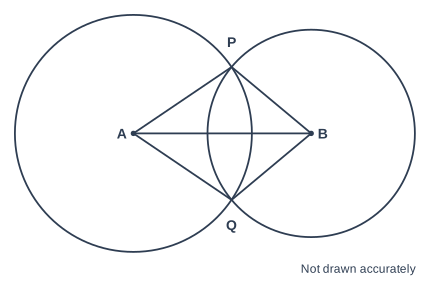
The diagram shows two circles that intersect at P and Q.
A is the centre of one circle and B is the centre of the other circle.

Prove that triangle APB is congruent to triangle AQB.

Geometry diagram, marked "Not drawn accurately". A circle with centre A; P and Q lie on it. Another circle with centre B; P and Q lie on it. Line segments AP, AQ, BP, BQ and AB are drawn.

Model answer

AP = AQ (radii of the circle with centre A)
BP = BQ (radii of the circle with centre B)
AB is common to both triangles
So triangle APB is congruent to triangle AQB (SSS).

Explanation

Any two radii of the same circle are equal, which gives two pairs of equal sides, and the line of centres AB is shared. It follows that angle PAB = angle QAB, so the line joining the centres bisects angle PAQ and is a line of symmetry of the diagram.

Mark scheme
  1. 1 mark

    B1 for AP = AQ (radii of the same circle)

  2. 1 mark

    B1 for BP = BQ (radii of the same circle) and AB is common

  3. 1 mark

    B1dep for congruent by SSS

    reasons must be given

Question 4

4 marks

Bilal says,

"There is only one triangle ABC with AB = 10 cm, BC = 7 cm and angle BAC = 40°"

Show that Bilal is wrong by working out the two possible sizes of angle ACB.
Give your answers to 1 decimal place.

Model answer

Sine rule: \(\dfrac{\sin C}{10} = \dfrac{\sin 40^\circ}{7}\)
\(\sin C = \dfrac{10 \sin 40^\circ}{7} = 0.91826...\)
\(C = 66.674...^\circ\) or \(C = 180 - 66.674... = 113.325...^\circ\)
Both are possible, since 40 + 113.3 < 180 (angle B would be 73.3° or 26.7°).
Angle ACB = 66.7° or 113.3°, so there are two different triangles and Bilal is wrong.

Explanation

Two sides and a non-included angle (SSA) do not always fix a triangle: because sin C = sin (180° − C), the sine rule gives an acute and an obtuse angle. Both are valid here because each leaves a positive third angle. This is why SSA is not a condition for congruence.

Mark scheme
  1. 1 mark

    M1 for \(\dfrac{\sin C}{10} = \dfrac{\sin 40^\circ}{7}\) oe

  2. 1 mark

    A1 for 66.7°

    accept [66.6, 66.7] (66.674...)

  3. 1 mark

    M1dep for 180 − their 66.7

  4. 1 mark

    A1 for 113.3°

    accept [113.3, 113.4] (113.325...); both angles needed to show Bilal is wrong

Ready to try the rest? Every answer you write is marked against the mark scheme, so you can see exactly where the marks are.

Study Helper Hints first, answers after you try

Stuck on this one? Ask for a hint and I’ll point you in the right direction, without giving the answer away. Once you’ve checked your answer, I’ll show you how the marks are awarded.