
Level:
Correct: 0
Incorrect: 0
Marks: 0/0
Exam Practice
Course:
Topics:
AQA GCSE Maths (Higher calculator) Smart practice A mixed round aimed at your weak spots
Unit 1
Number
Unit 2
Algebra
Unit 3
Ratio, proportion and rates of change
Unit 4
Geometry and measures
Unit 5
Probability
Unit 6
Statistics
Avg
score:
–
Topics
done:
0/97

Frequency trees and probability experiments

Practise 28 exam-style questions on Frequency trees and probability experiments for AQA GCSE Maths (Higher calculator). Write your answer as you would in the exam and get it marked in seconds against the mark scheme, point by point, with the Study Helper on hand if you get stuck.

  • 28 questions
  • 1–5 marks each
  • Instant marking
  • No sign-up needed
20 questions, marked as you go

Sample questions with model answers

Here are 4 of the questions in this topic, each with a model answer, an explanation of why it earns the marks and the mark scheme an examiner would use.

Question 1

1 mark

Jo spins a spinner 50 times.
The table shows her results.

Jo says,

"The relative frequency of green is \(\frac{12}{38}\), because it did not land on green 38 times."

What mistake has Jo made?
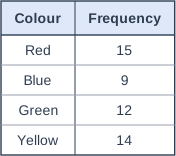
Table with columns "Colour", "Frequency". Colour: Red; Frequency: 15 | Colour: Blue; Frequency: 9 | Colour: Green; Frequency: 12 | Colour: Yellow; Frequency: 14.

Model answer

She has divided by the number of spins that were not green (38).
Relative frequency must be out of the total number of spins:
\(\dfrac{12}{50} = 0.24\)

Explanation

Relative frequency compares the number of times an outcome happened with the total number of trials. Jo has compared the number of greens with the number of non-greens, which is a ratio (12 : 38), not a relative frequency. The correct value is \(\frac{12}{50}\).

Mark scheme
  1. 1 mark

    B1 for a correct description, e.g. she should divide by the total number of spins, 50, not by 38

    oe, e.g. 'it should be 12/50'; 'she divided by the number of non-greens instead of the total'

Question 2

2 marks

A spinner is spun 150 times.
It lands on blue 37 times.

The spinner is spun another 600 times.
Estimate the number of times it will land on blue.

Model answer

Estimated probability of blue = \(\dfrac{37}{150}\)
Estimated number in 600 spins = \(\dfrac{37}{150} \times 600 = 148\)

Explanation

Use the relative frequency as an estimate of the probability, then multiply by the number of new trials. Since 600 is 4 times 150, you can also just multiply 37 by 4. This is only an estimate: the actual number will vary.

Mark scheme
  1. 1 mark

    M1 for \(\dfrac{37}{150} \times 600\)

    oe, e.g. 37 × 4

  2. 1 mark

    A1 for 148

    correct answer with no working scores full marks

Question 3

3 marks

Amy and Ben each throw the same drawing pin.
Amy throws it 50 times and it lands point up 18 times.
Ben throws it 150 times and it lands point up 48 times.

Amy says her estimate of the probability is the best one to use, because it is the higher one.

Work out the best estimate of the probability that the drawing pin lands point up, and give a reason why it is better than Amy's estimate.

Model answer

Combine all the results:
Point up: 18 + 48 = 66 times
Throws: 50 + 150 = 200
Best estimate = \(\dfrac{66}{200} = 0.33\)
This is better than Amy's estimate (\(\frac{18}{50}\) = 0.36) because it is based on 200 throws instead of 50, and more trials give a more reliable estimate.

Explanation

The more trials an estimate is based on, the more reliable it is, so combine the two sets of results into one experiment of 200 throws. Add the successes and add the trials - do not just average the two relative frequencies (0.36 and 0.32), because Ben's experiment is three times as big. A higher estimate is not a better one.

Mark scheme
  1. 1 mark

    M1 for \(\dfrac{18 + 48}{50 + 150}\)

    oe

  2. 1 mark

    A1 for \(\dfrac{66}{200}\)

    oe, e.g. 0.33, 33%, \(\frac{33}{100}\)

  3. 1 mark

    B1 for a correct reason, e.g. it uses all 200 throws, so it is based on more trials than Amy's 50

    oe; do not accept 'it is in the middle'

Question 4

4 marks

There are 120 people at a gym.
70 of the people are members and the rest are not members.
\(\frac{3}{7}\) of the members go swimming.
40% of the people who are not members go swimming.

One of the 120 people is chosen at random.
Work out the probability that this person goes swimming.

Model answer

Members who swim = \(\frac{3}{7} \times 70 = 30\)
Not members = 120 − 70 = 50
Not members who swim = 40% of 50 = 20
People who swim = 30 + 20 = 50
P(swims) = \(\dfrac{50}{120} = \dfrac{5}{12}\)

Explanation

A frequency tree organises this information: split the 120 people into members and non-members, then split each group into swimmers and non-swimmers. Find each group's swimmers separately, because the fraction and the percentage apply to different groups. The probability is the number who swim out of all 120 people.

Mark scheme
  1. 1 mark

    M1 for \(\frac{3}{7} \times 70\) (= 30)

  2. 1 mark

    M1 for 0.4 × (120 − 70) (= 20)

    oe

  3. 1 mark

    M1dep for (their 30 + their 20) ÷ 120

    dependent on at least one previous M mark

  4. 1 mark

    A1 for \(\dfrac{50}{120}\)

    oe, e.g. \(\frac{5}{12}\), 0.416..., 41.6...%; accept [0.41, 0.42]; correct answer with no working scores full marks

Ready to try the rest? Every answer you write is marked against the mark scheme, so you can see exactly where the marks are.

Study Helper Hints first, answers after you try

Stuck on this one? Ask for a hint and I’ll point you in the right direction, without giving the answer away. Once you’ve checked your answer, I’ll show you how the marks are awarded.