Practise 36 exam-style questions on Combined events and tree diagrams for AQA GCSE Maths (Higher calculator). Write your answer as you would in the exam and get it marked in seconds against the mark scheme, point by point, with the Study Helper on hand if you get stuck.
36 questions
1–5 marks each
Instant marking
No sign-up needed
20 questions, marked as you go
Sample questions with model answers
Here are 4 of the questions in this topic, each with a model answer, an explanation of why it earns the marks and the mark scheme an examiner would use.
Question 1
2 marks
Two fair six-sided dice are rolled.
Work out the probability that both dice show 6 or both dice show 5
Model answer
P(both 6) = \(\frac{1}{6} \times \frac{1}{6} = \frac{1}{36}\) P(both 5) = \(\frac{1}{6} \times \frac{1}{6} = \frac{1}{36}\) These cannot both happen, so add: P(both 6 or both 5) = \(\frac{1}{36} + \frac{1}{36} = \frac{2}{36} = \frac{1}{18}\)
Explanation
Multiply for 'and' within each outcome (first dice and second dice), then add for 'or' between the two outcomes, because 'both 6' and 'both 5' are mutually exclusive. A common mistake is to stop at \(\frac{1}{36}\), or to add the single-dice probabilities.
Mark scheme
1 mark
M1 for \(\frac{1}{6} \times \frac{1}{6}\) (= \(\frac{1}{36}\)) for one of the two outcomes
oe
1 mark
A1 for \(\frac{2}{36}\) or \(\frac{1}{18}\)
oe; accept 0.0555... or 0.0556; correct answer with no working scores full marks
Question 2
3 marks
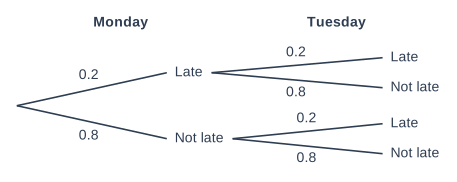
The probability that Tom's bus is late on any day is 0.2 Whether the bus is late on one day is independent of whether it is late on any other day. The tree diagram shows the probabilities for Monday and Tuesday.
Work out the probability that Tom's bus is late on exactly one of the two days.
Model answer
P(late Monday, not late Tuesday) = 0.2 × 0.8 = 0.16 P(not late Monday, late Tuesday) = 0.8 × 0.2 = 0.16 P(late on exactly one day) = 0.16 + 0.16 = 0.32
Explanation
Find every path through the tree that gives exactly one late day: late then not late, and not late then late. Multiply along each path, then add the paths because they cannot both happen. A common mistake is to include only one of the two orders and give 0.16.
Mark scheme
1 mark
M1 for 0.2 × 0.8 (= 0.16)
for either order
1 mark
M1 for 0.2 × 0.8 + 0.8 × 0.2
oe, e.g. 2 × 0.16, or 1 − (0.2 × 0.2 + 0.8 × 0.8)
1 mark
A1 for 0.32
oe; correct answer with no working scores full marks
Question 3
3 marks
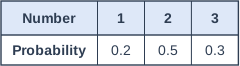
A biased spinner can land on 1, 2 or 3 The table shows the probability of each number. The spinner is spun twice and the two numbers are added.
Work out the probability that the total is 4
Model answer
A total of 4 comes from 1 then 3, 3 then 1, or 2 then 2. P(1 then 3) = 0.2 × 0.3 = 0.06 P(3 then 1) = 0.3 × 0.2 = 0.06 P(2 then 2) = 0.5 × 0.5 = 0.25 P(total is 4) = 0.06 + 0.06 + 0.25 = 0.37
Explanation
The outcomes are not equally likely, so you cannot just count them: multiply the probabilities for each way of making 4, then add the ways. Remember that 1 then 3 and 3 then 1 are different outcomes. Forgetting one of them gives 0.31.
Mark scheme
1 mark
M1 for one correct product: 0.2 × 0.3 (1 then 3), 0.3 × 0.2 (3 then 1) or 0.5 × 0.5 (2 then 2)
1 mark
M1 for 0.2 × 0.3 + 0.3 × 0.2 + 0.5 × 0.5
oe, e.g. 0.06 + 0.06 + 0.25
1 mark
A1 for 0.37
oe; correct answer with no working scores full marks
Question 4
4 marks
Ella has a bag of 12 sweets. 5 are orange, 4 are lemon and 3 are lime. She takes two sweets at random from the bag without replacement.
Work out the probability that the two sweets are different flavours.
A tree diagram has 9 paths, and 6 of them give different flavours, so it is quicker to find the 3 same-flavour paths and subtract from 1. Without replacement, each second fraction has denominator 11 and a numerator one less for the same flavour. A common mistake is to add the different-flavour paths but count each pair of flavours in only one order.
Mark scheme
1 mark
M1 for one correct product for two sweets of the same flavour, e.g. \(\frac{5}{12} \times \frac{4}{11}\)
or one correct product for two different flavours, e.g. \(\frac{5}{12} \times \frac{4}{11}\) for orange then lemon
1 mark
M1 for all three same-flavour products: \(\frac{20}{132} + \frac{12}{132} + \frac{6}{132}\) (= \(\frac{38}{132}\))
or all six different-flavour products
1 mark
M1dep for \(1 - \frac{38}{132}\)
or adding the six different-flavour products: \(2 \times \frac{20 + 15 + 12}{132}\)
1 mark
A1 for \(\frac{94}{132}\) or \(\frac{47}{66}\)
oe; accept 0.712...; correct answer with no working scores full marks
Ready to try the rest? Every answer you write is marked against the mark scheme, so you can see exactly where the marks are.
Ctrl + Enter to check
Study HelperHints first, answers after you try
Stuck on this one? Ask for a hint and I’ll point you in the right direction, without giving the answer away. Once you’ve checked your answer, I’ll show you how the marks are awarded.