Level:
Correct: 0
Incorrect: 0
Marks: 0/0
Practice
Course:
Topics:
Year 7 Maths Smart practice A mixed round aimed at your weak spots
Unit 1
Place value and the number system
Unit 2
Calculating
Unit 3
Factors, multiples and powers
Unit 4
Fractions
Unit 5
Fractions, decimals and percentages
Unit 6
Algebraic expressions
Unit 7
Equations and inequalities
Unit 8
Sequences and graphs
Unit 9
Ratio and proportion
Unit 10
Measures, perimeter, area and volume
Unit 11
Angles and shapes
Unit 12
Probability
Unit 13
Statistics
Avg
score:
–
Topics
done:
0/63

Writing and simplifying ratios

Practise 28 questions on Writing and simplifying ratios for Year 7 Maths. Tap or type your answer and find out straight away if you are right, with the Study Helper on hand if you get stuck.

  • 28 questions
  • 1–5 marks each
  • Instant marking
  • No sign-up needed
20 questions, marked as you go

Sample questions with model answers

Here are 4 of the questions in this topic, each with a model answer, an explanation of why it earns the marks and the mark scheme.

Question 1

1 mark

What is the ratio \(6 : 10\) in its simplest form?

Model answer

Divide both parts by 2.
\(6 : 10 = 3 : 5\)

Explanation

To simplify a ratio, divide both parts by the same number. The highest common factor of 6 and 10 is 2, and \(6 \div 2 = 3\) and \(10 \div 2 = 5\). 3 and 5 have no common factor other than 1, so \(3 : 5\) is the simplest form. A common mistake is to subtract the same number from both parts, which changes the ratio.

Mark scheme
  1. 1 mark

    \(3 : 5\)

    Only \(3 : 5\) scores the mark. Do not accept \(5 : 3\), or the fraction \(\dfrac{3}{5}\).

Question 2

2 marks

Find the values of \(a\) and \(b\).

\(4 : 7 = 12 : a = b : 35\)

Model answer

\(4 \times 3 = 12\), so \(a = 7 \times 3 = 21\)
\(7 \times 5 = 35\), so \(b = 4 \times 5 = 20\)
\(a = 21\) and \(b = 20\)

Explanation

In equivalent ratios both parts are multiplied by the same number. To get from 4 to 12 you multiply by 3, so multiply 7 by 3 too: \(a = 21\). To get from 7 to 35 you multiply by 5, so \(b = 4 \times 5 = 20\). A common mistake is to add instead of multiply, which gives \(a = 15\).

Mark scheme
  1. 1 mark

    \(a = 21\)

    Accept 21. A common wrong answer is 15 (adding 8 to 7, because \(4 + 8 = 12\)).

  2. 1 mark

    \(b = 20\)

    Accept 20. A common wrong answer is 32 (adding 28 to 4, because \(7 + 28 = 35\)). The two marks are independent. A correct answer with no working scores full marks.

Question 3

2 marks

In a group of friends, the ratio of boys to girls is \(3 : 4\).

Jamal says, "This means that \(\dfrac{3}{4}\) of the group are boys."

Is Jamal right? How do you know?

Model answer

No. There are \(3 + 4 = 7\) parts altogether, and the boys are 3 of them.
So \(\dfrac{3}{7}\) of the group are boys, not \(\dfrac{3}{4}\).

Explanation

A ratio compares one part with another part. To write a fraction of the whole group, add the parts to find the total: \(3 + 4 = 7\). The boys are 3 of these 7 parts, so \(\dfrac{3}{7}\) of the group are boys. Jamal has put the boys over the girls, which is a common mistake.

Mark scheme
  1. 1 mark

    No, with a relevant but incomplete reason, e.g. "No, you have to add 3 and 4" or "No, a ratio is not the same as a fraction"

    "No" alone scores 0.

  2. 1 mark

    A complete correct reason: there are \(3 + 4 = 7\) parts, so \(\dfrac{3}{7}\) of the group are boys / \(\dfrac{3}{4}\) compares the boys with the girls, not with the whole group / e.g. with 3 boys and 4 girls, 3 out of 7 friends are boys

    A complete correct reason on its own scores both marks.

Question 4

4 marks

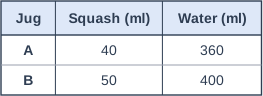
The table shows how much squash and water are in two jugs of orange drink. The stronger drink has more squash compared with the water.

The ratio of squash to water for each jug can be written in the form \(1 : n\). What is n for each jug? Which jug has the stronger drink?

Table with columns "Jug", "Squash (ml)", "Water (ml)". Jug: A; Squash (ml): 40; Water (ml): 360 | Jug: B; Squash (ml): 50; Water (ml): 400.

Model answer

Jug A: \(40 : 360 = 1 : 9\) (divide by 40)
Jug B: \(50 : 400 = 1 : 8\) (divide by 50)
Jug B is stronger, because it has 8 ml of water for each 1 ml of squash, but jug A has 9 ml.

Explanation

Writing both ratios in the form \(1 : n\) makes them easy to compare, because the squash part is 1 in both. Jug A has 9 parts water to 1 part squash and jug B has only 8, so jug B's drink is less watery: it is stronger. A common mistake is to say jug B is stronger just because it has more squash; it also has more water, so you must compare the ratios.

Mark scheme
  1. 1 mark

    Divides both parts by the amount of squash for at least one jug, e.g. \(360 \div 40\) or \(400 \div 50\); or the correct ratios \(1 : 9\) and \(1 : 8\) with no working

    Implied by either correct ratio.

  2. 1 mark

    Jug A: \(1 : 9\)

    Accept \(n = 9\) for jug A. Do not accept \(9 : 1\).

  3. 1 mark

    Jug B: \(1 : 8\)

    Accept \(n = 8\) for jug B. Do not accept \(8 : 1\).

  4. 1 mark

    Jug B, with a reason: it has 8 ml of water for every 1 ml of squash and jug A has 9 ml / jug B has less water for each ml of squash

    Follow through from their two ratios. "B" alone scores 0. Do not accept "B, because it has more squash" (it also has more water). Correct ratios with no working score the first 3 marks; this last mark needs the reason.

Ready to try the rest? Tap or type your answers and see straight away how you did.

Topic notes

Writing and simplifying ratios

The big idea

A ratio compares two or more amounts. If a smoothie uses 3 cups of milk for every 2 cups of fruit, the ratio of milk to fruit is written \(3 : 2\) and said "3 to 2". The order matters: the ratio of fruit to milk is \(2 : 3\).

Writing a ratio

Write the numbers in the same order as the words in the question. A bar model shows a ratio as equal boxes, one box for each part:

A bar model: 2 bars, one above the other, lined up at the left and drawn to the same scale: bar 1 (labelled "Blue paint") split into 3 equal boxes; all shaded (3 units long); bar 2 (labelled "White paint") split into 7 equal boxes (7 units long). The bars have lengths in the ratio 3 : 7 (every box is the same size). A brace on the right spans bars 1 to 2 and is labelled 10 parts in all.
Blue paint and white paint mixed in the ratio 3 : 7. Every box is the same amount of paint.

Equivalent ratios and simplest form

Equivalent ratios compare amounts in the same way. You make them by multiplying or dividing every part by the same number: \(2 : 3 = 4 : 6 = 20 : 30\).

To simplify a ratio, divide every part by a common factor (a number that divides into all the parts). The ratio is in its simplest form when no whole number except 1 divides into every part. Dividing by the highest common factor (the biggest number that divides into every part) gets there in one step.

A fruit salad has 150 g of grapes, 250 g of melon and 100 g of kiwi. Write the ratio melon : grapes : kiwi in its simplest form.

Write the amounts in the order the question asks for, melon first:

\(250 : 150 : 100\)

Divide every part by 50, the highest common factor: \(5 : 3 : 2\)

5, 3 and 2 have no common factor except 1, so this is the simplest form.

Ratios with different units

Change the amounts into the same unit first, then simplify. Leave the units out of the answer.

A jam recipe uses 1.5 kg of strawberries and 600 g of sugar. Write the ratio strawberries : sugar in its simplest form.

Change kilograms into grams: 1.5 kg = 1500 g.

\(1500 : 600\)

Divide both parts by 100: \(15 : 6\). Then divide both by 3: \(5 : 2\).

Ratios and fractions

A ratio compares part with part. A fraction compares part with the whole. In the bar model there are \(3 + 7 = 10\) equal parts altogether, so \(\dfrac{3}{10}\) of the paint is blue and \(\dfrac{7}{10}\) is white. Blue is not \(\dfrac{3}{7}\) of the paint: that compares blue with white only.

In a survey, 28 pupils say they have a pet and 20 say they do not. Write the ratio "pet : no pet" in its simplest form, and the fraction of pupils with a pet.

\(28 : 20\). Divide both parts by 4: \(7 : 5\).

There are \(7 + 5 = 12\) parts altogether, so \(\dfrac{7}{12}\) of the pupils have a pet.

Check with the real numbers: \(\dfrac{28}{48} = \dfrac{7}{12}\).

Stretch: the form \(1 : n\)

To write a ratio in the form \(1 : n\), divide both parts by the first part. The second number can be a decimal: \(4 : 18 = 1 : 4.5\). This form makes ratios easy to compare, because the first part is always 1.

Remember

  • The order of the numbers matches the order of the words.
  • Simplify by dividing every part by the same number.
  • Put the amounts into the same units before you simplify.
  • In the ratio \(a : b\), the first amount is \(\dfrac{a}{a + b}\) of the whole.

Common mistakes

  • Writing the numbers in the order they appear in the question, not the order asked for.
  • Taking the same number away from both parts: \(6 : 9\) is not the same as \(4 : 7\).
  • Stopping too early: \(20 : 30 = 10 : 15\), but 10 and 15 can still be divided by 5, giving \(2 : 3\).
  • Ignoring units: 50 cm : 2 m is \(50 : 200 = 1 : 4\), not \(25 : 1\).
  • Using the ratio numbers as a fraction: if boys : girls is \(2 : 5\), the boys are \(\dfrac{2}{7}\) of the group, not \(\dfrac{2}{5}\).

Top tip

Before you simplify, write the labels above the numbers (melon : grapes : kiwi). Then the numbers can't get swapped round as you work.

Study Helper Hints first, answers after you try

Stuck on this one? Ask for a hint and I’ll point you in the right direction, without giving the answer away. Once you’ve checked your answer, I’ll show you how the marks are awarded.