Level:
Correct: 0
Incorrect: 0
Marks: 0/0
Practice
Course:
Topics:
Year 7 Maths Smart practice A mixed round aimed at your weak spots
Unit 1
Place value and the number system
Unit 2
Calculating
Unit 3
Factors, multiples and powers
Unit 4
Fractions
Unit 5
Fractions, decimals and percentages
Unit 6
Algebraic expressions
Unit 7
Equations and inequalities
Unit 8
Sequences and graphs
Unit 9
Ratio and proportion
Ratio, proportion and rates of change
Writing and simplifying ratios
Quick practice5 skills
Sharing in a ratio
Quick practice5 skills
Proportion and best buys
Quick practice5 skills
Scale drawings and maps
Quick practice4 skills
Unit 10
Measures, perimeter, area and volume
Unit 11
Angles and shapes
Unit 12
Probability
Unit 13
Statistics
Avg
score:
–
Topics
done:
0/63

Percentages of amounts

Practise 30 questions on Percentages of amounts for Year 7 Maths. Tap or type your answer and find out straight away if you are right, with the Study Helper on hand if you get stuck.

  • 30 questions
  • 1–5 marks each
  • Instant marking
  • No sign-up needed
20 questions, marked as you go

Sample questions with model answers

Here are 4 of the questions in this topic, each with a model answer, an explanation of why it earns the marks and the mark scheme.

Question 1

1 mark

Work out 1% of £600.

Model answer

1% is \(\dfrac{1}{100}\).
\(600 \div 100 = 6\), so £6

Explanation

1% means 1 out of every 100, so divide by 100: \(600 \div 100 = 6\). Finding 1% is useful for building other percentages, such as 3% or 99%. A common mistake is to divide by 10, which finds 10%.

Mark scheme
  1. 1 mark

    £6

    Accept 6 or £6.00. £60 (10%) or £0.60 scores 0.

Question 2

2 marks

Work out 60% of 45 kg.

Model answer

10% of 45 = 4.5
60% = \(6 \times 4.5 = 27\), so 27 kg

Explanation

Find 10% first: \(45 \div 10 = 4.5\). 60% is six lots of 10%, so \(6 \times 4.5 = 27\) kg. You could also add 50% (22.5) and 10% (4.5). A common mistake is to make an error with the decimal 4.5: check that 27 kg is a bit more than half of 45 kg.

Mark scheme
  1. 1 mark

    10% of 45 = 4.5, or 50% = 22.5, or 20% = 9; or the correct answer 27 kg with no working

  2. 1 mark

    27 kg

    Accept 27 without units. 18 kg (40%) scores the first mark only. A correct answer with no working scores full marks.

Question 3

3 marks

A theme park had 840 visitors on Monday. 45% of the visitors were children. The rest were adults.

How many adults visited the theme park on Monday?

Model answer

Adults are \(100 - 45 = 55\), so 55% of the visitors.
50% of 840 = 420
5% of 840 = 42
55% = \(420 + 42 = 462\) adults

Explanation

If 45% are children, then the other 55% are adults, because all the visitors make 100%. Build 55% from 50% (420) and 5% (42): 462 adults. You could also find the children, 378, and subtract from 840. A common mistake is to give the number of children when the question asks for adults.

Mark scheme
  1. 1 mark

    10% of 840 = 84, or 5% = 42, or 50% = 420; or the correct answer 462 with no working

  2. 1 mark

    378 children (45%), or adults = 55%

  3. 1 mark

    462

    378 (the children) scores the first two marks. A correct answer with no working scores full marks.

Question 4

4 marks

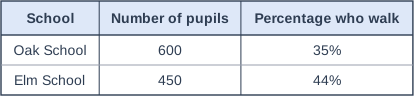
The table shows the number of pupils at two schools and the percentage of pupils who walk to school.

Work out how many pupils walk to each school. Which school has more pupils who walk to school?

Table with columns "School", "Number of pupils", "Percentage who walk". School: Oak School; Number of pupils: 600; Percentage who walk: 35% | School: Elm School; Number of pupils: 450; Percentage who walk: 44%.

Model answer

Oak School: 10% of 600 = 60, so 30% = 180 and 5% = 30
35% = \(180 + 30 = 210\) pupils
Elm School: 10% of 450 = 45, so 40% = 180, and 1% = 4.5, so 4% = 18
44% = \(180 + 18 = 198\) pupils
210 is more than 198, so Oak School has more pupils who walk.

Explanation

Work out the number of pupils who walk at each school. 35% of 600 is 210 and 44% of 450 is 198. Elm School has the bigger percentage, but it is a percentage of fewer pupils, so Oak School has more walkers. A common mistake is to compare the percentages only.

Mark scheme
  1. 1 mark

    a correct start for either school, e.g. 10% of 600 = 60 or 10% of 450 = 45

  2. 1 mark

    Oak School: 35% of 600 = 210

  3. 1 mark

    Elm School: 44% of 450 = 198

  4. 1 mark

    Oak School

    Needs the previous mark, and the Oak value (210) correct. 'Oak School' with no working scores 0. 'Elm School, because 44% is bigger' scores 0.

Ready to try the rest? Tap or type your answers and see straight away how you did.

Topic notes

Percentages of amounts

The big idea

Finding a percentage of an amount means finding that many hundredths of it. You can work out most percentages in your head: find a few easy ones first, then build the rest from them.

The building blocks

PercentageHow to find itOf 360
100%the whole amount360
50%halve it (divide by 2)180
25%divide by 4, or halve and halve again90
10%divide by 1036
5%find 10%, then halve it18
1%divide by 1003.6
A bar model: one bar, split into 4 equal boxes; written in the boxes (counting from the left): box 1: 90, box 2: 90, box 3: 90, box 4: 90; boxes 1, 2 and 3 shaded. A brace above the bar spans the whole bar and is labelled 100% = 360. A brace below the bar spans box 1 and is labelled 25% = 90. A brace below the bar spans boxes 1 to 3 and is labelled 75% = 270 (drawn outside the shorter brace).
360 split into 4 equal parts. Each part is 25% of 360, which is 90, so three parts (75%) are 270.

Building other percentages

Add, subtract or multiply the building blocks:

  • 30% is 3 lots of 10%, so 30% of 360 is \(3 \times 36 = 108\)
  • 35% is 25% + 10%, so 35% of 360 is \(90 + 36 = 126\)
  • 99% is 100% − 1%, so 99% of 360 is \(360 - 3.6 = 356.4\)
  • 3% is 3 lots of 1%, so 3% of 360 is \(3 \times 3.6 = 10.8\)

A 750 ml bottle of squash is 30% fruit juice. How much fruit juice is in the bottle?

10% of 750 ml: \(750 \div 10 = 75\) ml

30% is 3 lots of 10%: \(3 \times 75 = 225\) ml

There is 225 ml of fruit juice.

A computer game costs £60. Club members pay 95% of the usual price. How much does a member pay?

10% of £60 is £6, so 5% is half of that: £3

95% is 100% take away 5%: £60 − £3 = £57

A member pays £57.

Rhys has 2 hours for homework this week. He spends 45% of the time on maths. How many minutes is that?

The answer is wanted in minutes, so change the units first: 2 hours = 120 minutes.

10% of 120 is 12, so 40% is \(4 \times 12 = 48\). 5% is half of 10%: 6.

45% = 40% + 5%, so \(48 + 6 = 54\) minutes.

Check: 45% is a bit less than half, and 54 is a bit less than 60. ✓

Percentages over 100%

100% is the whole amount, so a percentage over 100% gives more than you started with. 200% is double. 150% is 100% + 50%, so 150% of 30 kg is \(30 + 15 = 45\) kg.

Comparing and word problems

To compare percentages of different amounts, work each one out. 20% of 90 is 18, but 25% of 68 is 17. So 20% of 90 is more, even though 20% is the smaller percentage.

A discount is money taken off a price. VAT (value added tax) is a tax added on to many prices, often 20%. A question may ask for the discount or the VAT itself: that is just a percentage of the price. For example, 10% of a £35 bill is £3.50, so 20% VAT on it is £7. (Working out the new price is in Percentage change.)

Stretch: using a multiplier

A percentage can be written as a decimal, called a multiplier: 45% = \(\dfrac{45}{100}\) = 0.45. Multiplying by it finds the percentage in one step.

Use a multiplier to find 45% of 80.

45% = 0.45, so work out \(0.45 \times 80\).

\(45 \times 80 = 3600\), and dividing by 100 gives 36.

So 45% of 80 is 36.

For more than 100%, the multiplier is bigger than 1: 120% of 45 is \(1.2 \times 45 = 54\).

Common mistakes

  • Dividing by the percentage: \(140 \div 5 = 28\) finds 20% of 140, not 5%. 5% is half of 10%, so 5% of 140 is 7.
  • Taking the percentage away: 50% of 86 is not \(86 - 50\). It is half of 86, which is 43.
  • Dividing by 100 to find 10%: 10% is a tenth, so divide by 10.
  • Giving the new price when the question asks how much is taken off, or the other way round.

Top tip

Write down 10% (and 1% if you need it) before you start: almost every percentage can be built from them. In a word problem, read the last line again to see exactly what amount it asks for.

Study Helper Hints first, answers after you try

Stuck on this one? Ask for a hint and I’ll point you in the right direction, without giving the answer away. Once you’ve checked your answer, I’ll show you how the marks are awarded.