Level:
Correct: 0
Incorrect: 0
Marks: 0/0
Practice
Course:
Topics:
Year 7 Maths Smart practice A mixed round aimed at your weak spots
Unit 1
Place value and the number system
Unit 2
Calculating
Unit 3
Factors, multiples and powers
Unit 4
Fractions
Unit 5
Fractions, decimals and percentages
Unit 6
Algebraic expressions
Unit 7
Equations and inequalities
Unit 8
Sequences and graphs
Unit 9
Ratio and proportion
Ratio, proportion and rates of change
Writing and simplifying ratios
Quick practice5 skills
Sharing in a ratio
Quick practice5 skills
Proportion and best buys
Quick practice5 skills
Scale drawings and maps
Quick practice4 skills
Unit 10
Measures, perimeter, area and volume
Unit 11
Angles and shapes
Unit 12
Probability
Unit 13
Statistics
Avg
score:
–
Topics
done:
0/63

Prime factors, HCF and LCM

Practise 29 questions on Prime factors, HCF and LCM for Year 7 Maths. Tap or type your answer and find out straight away if you are right, with the Study Helper on hand if you get stuck.

  • 29 questions
  • 1–5 marks each
  • Instant marking
  • No sign-up needed
20 questions, marked as you go

Sample questions with model answers

Here are 4 of the questions in this topic, each with a model answer, an explanation of why it earns the marks and the mark scheme.

Question 1

1 mark

Write \(2 \times 2 \times 2 \times 5\) in index form.

Model answer

There are three 2s, so \(2 \times 2 \times 2 = 2^3\).
Answer: \(2^3 \times 5\)

Explanation

Index form groups the repeated primes as powers. Three 2s multiplied together is \(2^3\), and the single 5 stays as it is. A common mistake is to write \(2^3 + 5\): the factors are multiplied, so keep the times sign.

Mark scheme
  1. 1 mark

    \(2^3 \times 5\)

    Accept \(5 \times 2^3\) or \(2^3 \times 5^1\). Do not accept 40 on its own (not index form), \(8 \times 5\) or \(2^3 + 5\).

Question 2

2 marks

Find the highest common factor of 30 and 45.

Model answer

Factors of 30: 1, 2, 3, 5, 6, 10, 15, 30
Factors of 45: 1, 3, 5, 9, 15, 45
Common factors: 1, 3, 5, 15
HCF = 15

Explanation

List the factors of each number in pairs so you do not miss any, then pick out the factors in both lists. The highest one, 15, is the HCF. With prime factors, both numbers share a 3 and a 5, and \(3 \times 5 = 15\).

Mark scheme
  1. 1 mark

    Factors of both numbers listed (at least 1, 3, 5, 15 for each), or \(30 = 2 \times 3 \times 5\) and \(45 = 3 \times 3 \times 5\); or the correct answer 15 with no working

  2. 1 mark

    15

    Do not accept 3 or 5 (common factors, but not the highest) or 90 (the lowest common multiple). A correct answer with no working scores full marks.

Question 3

3 marks

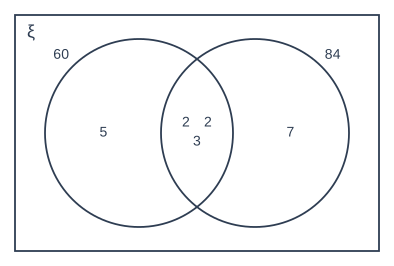
The Venn diagram shows the prime factors of 60 and 84.

Find the highest common factor and the lowest common multiple of 60 and 84.

A Venn diagram: a rectangle labelled ΞΎ (the universal set) containing two overlapping circles labelled "60" and "84". The elements written in each region are: in "60" only: 5; in both "60" and "84": 2, 2, 3; in "84" only: 7; outside both circles: empty.

Model answer

HCF: multiply the numbers in the overlap.
\(2 \times 2 \times 3 = 12\)
LCM: multiply all the numbers in the diagram.
\(5 \times 2 \times 2 \times 3 \times 7 = 420\)

Explanation

The overlap holds the prime factors that 60 and 84 share, so multiplying them gives the highest common factor, 12. Every number in the diagram is needed to build both 60 and 84, so multiplying all of them gives the lowest common multiple, 420. A common mistake is to multiply \(60 \times 84\), which gives a common multiple that is far too big.

Mark scheme
  1. 1 mark

    HCF = 12 (the product of the numbers in the overlap, \(2 \times 2 \times 3\))

    A correct answer with no working scores this mark.

  2. 1 mark

    Method for the LCM: multiplies all the numbers in the diagram, \(5 \times 2 \times 2 \times 3 \times 7\); or the correct answer 420 with no working

    Also award for \(60 \times 7\) or \(84 \times 5\), or for listing multiples as far as 420.

  3. 1 mark

    LCM = 420

    Do not accept 5,040 (\(60 \times 84\)). Both answers must be clearly labelled or in the order asked. A correct answer with no working scores full marks.

Question 4

4 marks

Three lights flash at a funfair. The red light flashes every 6 seconds, the green light every 8 seconds and the blue light every 10 seconds. All three flash together at the start.

After how many seconds do all three next flash together?

How many times do all three flash together in the first 15 minutes after the start? Do not count the start.

Model answer

\(6 = 2 \times 3\), \(8 = 2 \times 2 \times 2\), \(10 = 2 \times 5\)
LCM \(= 2 \times 2 \times 2 \times 3 \times 5 = 120\)
They next flash together after 120 seconds.
15 minutes \(= 15 \times 60 = 900\) seconds
\(900 \div 120 = 7.5\)
So they flash together 7 times.

Explanation

All three flash together at times that are multiples of 6, 8 and 10, and the first is their lowest common multiple, 120 seconds. Then count the multiples of 120 that fit into 900 seconds: 7 whole ones. A common mistake is to round 7.5 up to 8, but the 8th time is after the 15 minutes are over.

Mark scheme
  1. 1 mark

    Multiples of 6, 8 and 10 listed, or \(6 = 2 \times 3\), \(8 = 2^3\), \(10 = 2 \times 5\), or the LCM of two of the numbers found (24, 30 or 40); or the correct answers with no working

  2. 1 mark

    120 seconds

    Accept 2 minutes. Do not accept 480 (\(6 \times 8 \times 10\)).

  3. 1 mark

    15 minutes = 900 seconds, and \(900 \div 120 = 7.5\), or the times listed: 120, 240, 360, 480, 600, 720, 840

    Follow through from the pupil's own answer for the first time.

  4. 1 mark

    7 times

    Do not accept 8 (7.5 rounded up: the 8th time would be at 960 seconds, after 15 minutes) or 7.5. A correct answer with no working scores full marks.

Ready to try the rest? Tap or type your answers and see straight away how you did.

Topic notes

Prime factors, HCF and LCM

The big idea

Every whole number bigger than 1 is either a prime number or can be made by multiplying prime numbers together. Writing a number as a product of prime factors (a product is the answer to a multiplication) shows what it is built from. It also gives a neat way to find the highest common factor and the lowest common multiple of two numbers.

Factor trees

Split the number into any factor pair. Keep splitting each branch until it ends in a prime number.

Flow chart of 9 boxes joined by arrows, read from top to bottom. The first box is "180". From "180", 2 arrows branch out side by side: the left arrow leads to "18"; the right arrow leads to "10". From "18", 2 arrows branch out side by side: the left arrow leads to "2" (shaded); the right arrow leads to "9". From "10", 2 arrows branch out side by side: the left arrow leads to "2" (shaded); the right arrow leads to "5" (shaded). From "9", 2 arrows branch out side by side: the left arrow leads to "3" (shaded); the right arrow leads to "3" (shaded).
A factor tree for 180. The shaded boxes are the prime factors: 2, 3, 3, 2 and 5.

Multiply the primes at the ends of the branches, smallest first:

\(180 = 2 \times 2 \times 3 \times 3 \times 5\)

In index form, repeated primes are written as powers: \(180 = 2^2 \times 3^2 \times 5\).

If you start with a different pair, such as \(180 = 12 \times 15\), you still end with two 2s, two 3s and a 5. Every number has only one prime factorisation.

Repeated division

Another method: keep dividing by a prime number until you reach 1. Try 2 first, then 3, then 5, then 7, and so on.

Write 126 as a product of prime factors in index form.

Divide byAnswer
2\(126 \div 2 = 63\)
3\(63 \div 3 = 21\)
3\(21 \div 3 = 7\)
7\(7 \div 7 = 1\)

The primes you divided by are 2, 3, 3 and 7, so \(126 = 2 \times 3 \times 3 \times 7 = 2 \times 3^2 \times 7\)

HCF and LCM

  • The highest common factor (HCF) is the biggest number that divides into both numbers.
  • The lowest common multiple (LCM) is the smallest number that both numbers divide into.

For small numbers, listing works well. The factors of 16 are 1, 2, 4, 8, 16 and the factors of 24 are 1, 2, 3, 4, 6, 8, 12, 24, so the HCF of 16 and 24 is 8. For the LCM of 9 and 12, list the multiples of 12 (12, 24, 36) until you reach one that 9 divides into: the LCM is 36.

For bigger numbers, use prime factors and a Venn diagram.

Find the HCF and the LCM of 24 and 150.

\(24 = 2 \times 2 \times 2 \times 3\) and \(150 = 2 \times 3 \times 5 \times 5\)

Both lists have one 2 and one 3, so put a 2 and a 3 in the overlap. Put the other primes in their own circles.

A Venn diagram: a rectangle labelled ξ (the universal set) containing two overlapping circles labelled "24 = 2×2×2×3" and "150 = 2×3×5×5". The elements written in each region are: in "24 = 2×2×2×3" only: 2, 2; in both "24 = 2×2×2×3" and "150 = 2×3×5×5": 2, 3; in "150 = 2×3×5×5" only: 5, 5; outside both circles: empty. (ξ = {2, 2, 2, 3, 5, 5}; 24 = 2×2×2×3 = {2, 2, 2, 3}; 150 = 2×3×5×5 = {2, 3, 5, 5}.)
The prime factors of 24 and 150. The shared primes, 2 and 3, go in the overlap.

HCF: multiply the numbers in the overlap. \(2 \times 3 = 6\)

LCM: multiply every number in the diagram. \(2 \times 2 \times 2 \times 3 \times 5 \times 5 = 600\)

Word problems: HCF or LCM?

  • Splitting things into the biggest equal groups or pieces, with nothing left over: use the HCF.
  • Things that repeat and happen together again (buses leaving a station), or the smallest amount two pack sizes both make (rolls and sausages): use the LCM.

A gardener waters her tomatoes every 4 days and feeds them every 10 days. She does both today. In how many days will she next do both on the same day?

This is about things repeating, so find the LCM of 4 and 10.

Multiples of 10: 10, 20. 4 does not divide into 10, but \(20 \div 4 = 5\).

The LCM is 20, so she next does both in 20 days.

A floor is 112 cm by 70 cm. It is covered with square tiles, all the same size, with no gaps and no cut tiles. What is the biggest tile that can be used, and how many are needed?

The side of a tile must divide into 112 and 70, and be as big as possible: this is the HCF.

\(112 = 2 \times 2 \times 2 \times 2 \times 7\) and \(70 = 2 \times 5 \times 7\)

They share \(2 \times 7 = 14\), so the tiles are 14 cm by 14 cm.

\(112 \div 14 = 8\) tiles along and \(70 \div 14 = 5\) tiles down, so \(8 \times 5 = 40\) tiles.

Common mistakes

  • Stopping before every factor is prime: \(3 \times 3 \times 6\) is not finished, because \(6 = 2 \times 3\).
  • Writing 1 as a prime factor. 1 is not prime.
  • Mixing up HCF and LCM. The HCF can never be bigger than the smaller number; the LCM can never be smaller than the bigger number.
  • Thinking the LCM is always the two numbers multiplied: the LCM of 8 and 12 is 24, not 96.

Top tip

Check a prime factorisation by multiplying it back out. If you do not get the number you started with, look again at your tree.

Study Helper Hints first, answers after you try

Stuck on this one? Ask for a hint and I’ll point you in the right direction, without giving the answer away. Once you’ve checked your answer, I’ll show you how the marks are awarded.