Level:
Correct: 0
Incorrect: 0
Marks: 0/0
Practice
Course:
Topics:
Year 7 Maths Smart practice A mixed round aimed at your weak spots
Unit 1
Place value and the number system
Unit 2
Calculating
Unit 3
Factors, multiples and powers
Unit 4
Fractions
Unit 5
Fractions, decimals and percentages
Unit 6
Algebraic expressions
Unit 7
Equations and inequalities
Unit 8
Sequences and graphs
Unit 9
Ratio and proportion
Ratio, proportion and rates of change
Writing and simplifying ratios
Quick practice5 skills
Sharing in a ratio
Quick practice5 skills
Proportion and best buys
Quick practice5 skills
Scale drawings and maps
Quick practice4 skills
Unit 10
Measures, perimeter, area and volume
Unit 11
Angles and shapes
Unit 12
Probability
Unit 13
Statistics
Avg
score:
–
Topics
done:
0/63

Comparing and ordering fractions

Practise 23 questions on Comparing and ordering fractions for Year 7 Maths. Tap or type your answer and find out straight away if you are right, with the Study Helper on hand if you get stuck.

  • 23 questions
  • 1–5 marks each
  • Instant marking
  • No sign-up needed
20 questions, marked as you go

Sample questions with model answers

Here are 4 of the questions in this topic, each with a model answer, an explanation of why it earns the marks and the mark scheme.

Question 1

1 mark

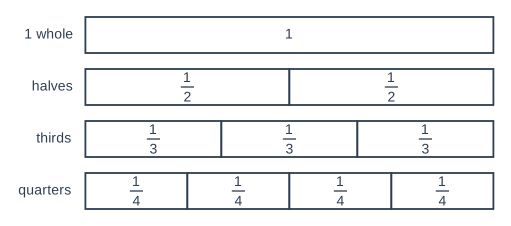
The diagram shows a fraction wall. One whole is split into halves, thirds and quarters.

Use the fraction wall to decide which is bigger, \(\dfrac{2}{3}\) or \(\dfrac{3}{4}\).

A bar model: 4 bars, one above the other, lined up at the left and drawn to the same scale: bar 1 (labelled "1 whole") a single part with 1 written in it; bar 2 (labelled "halves") made of 2 parts whose lengths are in the ratio 6 : 6; written in the parts (counting from the left): part 1: 1/2, part 2: 1/2; bar 3 (labelled "thirds") made of 3 parts whose lengths are in the ratio 4 : 4 : 4; written in the parts (counting from the left): part 1: 1/3, part 2: 1/3, part 3: 1/3; bar 4 (labelled "quarters") made of 4 parts whose lengths are in the ratio 3 : 3 : 3 : 3; written in the parts (counting from the left): part 1: 1/4, part 2: 1/4, part 3: 1/4, part 4: 1/4. The bars are the same length.

Model answer

On the wall, 3 quarters reach further across than 2 thirds.
\(\dfrac{3}{4}\) is bigger.

Explanation

Look along the thirds row and stop after 2 thirds, then look along the quarters row and stop after 3 quarters. Three quarters reaches further along the whole, so it is bigger. You can check with a common denominator: \(\dfrac{2}{3} = \dfrac{8}{12}\) and \(\dfrac{3}{4} = \dfrac{9}{12}\). A common mistake is to think \(\dfrac{2}{3}\) is bigger because each third is bigger than each quarter, but you have more quarters.

Mark scheme
  1. 1 mark

    \(\dfrac{3}{4}\)

    Accept three quarters in words. Do not accept 2/3.

Question 2

2 marks

Put these fractions in order of size. Start with the smallest.

\(\dfrac{3}{4}\)   \(\dfrac{5}{8}\)   \(\dfrac{1}{2}\)

Model answer

\(\dfrac{3}{4} = \dfrac{6}{8}\) and \(\dfrac{1}{2} = \dfrac{4}{8}\)
In order: \(\dfrac{4}{8}, \dfrac{5}{8}, \dfrac{6}{8}\)
\(\dfrac{1}{2}, \dfrac{5}{8}, \dfrac{3}{4}\)

Explanation

Both 2 and 4 go into 8, so write every fraction in eighths. Then the parts are the same size and you can just compare numerators: 4, 5, 6. A common mistake is to order the fractions by their denominators, which puts \(\dfrac{5}{8}\) last.

Mark scheme
  1. 1 mark

    The fractions written with a common denominator, e.g. \(\dfrac{6}{8}, \dfrac{5}{8}, \dfrac{4}{8}\), or as decimals 0.75, 0.625, 0.5; or the correct order with no working

    Any common denominator (16, 24 ...) with all three numerators correct.

  2. 1 mark

    \(\dfrac{1}{2}, \dfrac{5}{8}, \dfrac{3}{4}\)

    Must be smallest first. Accept the fractions written as 4/8, 5/8, 6/8 in that order. A correct answer with no working scores full marks.

Question 3

3 marks

Put these fractions in order of size. Start with the smallest.

\(\dfrac{2}{3}\)   \(\dfrac{3}{5}\)   \(\dfrac{7}{10}\)   \(\dfrac{4}{5}\)

Model answer

Use 30 as the common denominator.
\(\dfrac{2}{3} = \dfrac{20}{30}\), \(\dfrac{3}{5} = \dfrac{18}{30}\), \(\dfrac{7}{10} = \dfrac{21}{30}\), \(\dfrac{4}{5} = \dfrac{24}{30}\)
In order: 18, 20, 21, 24
\(\dfrac{3}{5}, \dfrac{2}{3}, \dfrac{7}{10}, \dfrac{4}{5}\)

Explanation

Find a number that 3, 5 and 10 all go into: 30 works. Write each fraction in thirtieths, then order the numerators. The tricky pair is \(\dfrac{2}{3}\) and \(\dfrac{7}{10}\), which are very close: 20 thirtieths and 21 thirtieths. A common mistake is to use 10 as the common denominator, but 3 does not go into 10.

Mark scheme
  1. 1 mark

    At least two of the fractions written correctly with a common denominator, e.g. \(\dfrac{20}{30}\), \(\dfrac{18}{30}\), \(\dfrac{21}{30}\), \(\dfrac{24}{30}\); or the correct order with no working

    Any common denominator that works for all four (30, 60 ...). Accept decimals: 0.666..., 0.6, 0.7, 0.8.

  2. 1 mark

    All four fractions written correctly with a common denominator (or as decimals)

  3. 1 mark

    \(\dfrac{3}{5}, \dfrac{2}{3}, \dfrac{7}{10}, \dfrac{4}{5}\)

    Must be smallest first. Accept the order written in thirtieths (18/30, 20/30, 21/30, 24/30). A correct answer with no working scores full marks.

Question 4

4 marks

Which fractions with a denominator of 24 are between \(\dfrac{5}{8}\) and \(\dfrac{5}{6}\)? Tap all of them.

Model answer

\(\dfrac{5}{8} = \dfrac{15}{24}\)
\(\dfrac{5}{6} = \dfrac{20}{24}\)
The numerators between 15 and 20 are 16, 17, 18 and 19.
\(\dfrac{16}{24}, \dfrac{17}{24}, \dfrac{18}{24}, \dfrac{19}{24}\)

Explanation

Write both fractions as twenty-fourths: multiply the top and bottom of \(\dfrac{5}{8}\) by 3, and of \(\dfrac{5}{6}\) by 4. Then every numerator between 15 and 20 gives a fraction in between. A common mistake is to include \(\dfrac{15}{24}\) and \(\dfrac{20}{24}\), which are the end fractions themselves, not between them.

Mark scheme
  1. 1 mark

    \(\dfrac{5}{8} = \dfrac{15}{24}\); or the correct answer with no working

  2. 1 mark

    \(\dfrac{5}{6} = \dfrac{20}{24}\)

  3. 1 mark

    At least two of \(\dfrac{16}{24}\), \(\dfrac{17}{24}\), \(\dfrac{18}{24}\), \(\dfrac{19}{24}\), with no wrong fractions

    Accept 16/24 written as 2/3 and 18/24 written as 3/4.

  4. 1 mark

    \(\dfrac{16}{24}\), \(\dfrac{17}{24}\), \(\dfrac{18}{24}\) and \(\dfrac{19}{24}\), and no others

    Do not include 15/24 or 20/24: they are equal to the two given fractions, so they are not between them. A correct answer with no working scores full marks.

Ready to try the rest? Tap or type your answers and see straight away how you did.

Topic notes

Comparing and ordering fractions

The big idea

To compare two fractions fairly, the parts need to be the same size. If the denominators match, just compare the numerators. If they do not, change the fractions into equivalent fractions that do match. The symbol < means "is less than" and > means "is greater than".

Same denominator or same numerator

  • Same denominator: the parts are the same size, so the bigger numerator is the bigger fraction. \(\dfrac{7}{10} > \dfrac{3}{10}\)
  • Same numerator: the bigger the denominator, the more parts the whole is cut into, so the smaller each part is. A tenth is smaller than a seventh, so \(\dfrac{3}{10} < \dfrac{3}{7}\).

Using a common denominator

A common denominator is a number that both denominators divide into (a common multiple). Write each fraction as an equivalent fraction with that denominator, then compare the numerators.

Which is bigger, \(\dfrac{4}{5}\) or \(\dfrac{5}{7}\)?

Both 5 and 7 divide into 35, so use 35ths.

\(\dfrac{4}{5} = \dfrac{28}{35}\) (multiply the top and bottom by 7)

\(\dfrac{5}{7} = \dfrac{25}{35}\) (multiply the top and bottom by 5)

28 is more than 25, so \(\dfrac{4}{5}\) is bigger.

A bar model: 2 bars, one above the other, lined up at the left and drawn to the same scale: bar 1 (labelled "four fifths") made of 5 parts whose lengths are in the ratio 7 : 7 : 7 : 7 : 7; parts 1, 2, 3 and 4 shaded (35 units long); bar 2 (labelled "five sevenths") made of 7 parts whose lengths are in the ratio 5 : 5 : 5 : 5 : 5 : 5 : 5; parts 1, 2, 3, 4 and 5 shaded (35 units long). The bars are the same length.
Two bars of the same length: more of the top bar is shaded, so four fifths is bigger than five sevenths.

Three jugs are the same size. Jug A is \(\dfrac{5}{6}\) full, jug B is \(\dfrac{3}{4}\) full and jug C is \(\dfrac{7}{12}\) full. Put them in order, starting with the fullest.

6, 4 and 12 all divide into 12, so use twelfths.

  • A: \(\dfrac{5}{6} = \dfrac{10}{12}\)
  • B: \(\dfrac{3}{4} = \dfrac{9}{12}\)
  • C: \(\dfrac{7}{12}\) stays the same

In order, fullest first: A (\(\dfrac{5}{6}\)), B (\(\dfrac{3}{4}\)), C (\(\dfrac{7}{12}\)).

Fractions on a number line

Fractions further to the right on a number line are bigger. An improper fraction (numerator bigger than the denominator) is more than 1, so it sits to the right of 1. In quarters, \(\dfrac{4}{4} = 1\) and \(\dfrac{8}{4} = 2\).

A horizontal scale from 0 to 2, divided into 8 equal parts by long marks. Every long mark is numbered (0, ¼, ½, ¾, 1, 1¼, 1½, 1¾ and 2). Long marks are every ¼. Words under the scale: "5/4" at 1¼, "6/4" at 1½ and "7/4" at 1¾.
A number line from 0 to 2 in quarters. The improper fractions 5/4, 6/4 and 7/4 are between 1 and 2.

Comparing fractions with decimals

Change the decimal into a fraction, or the fraction into a decimal. These are worth knowing: \(\dfrac{1}{2} = 0.5\), \(\dfrac{1}{4} = 0.25\), \(\dfrac{3}{4} = 0.75\), \(\dfrac{1}{5} = 0.2\), \(\dfrac{1}{10} = 0.1\) and \(\dfrac{1}{8} = 0.125\).

Sam ran 0.7 of a cross-country course. Lily ran \(\dfrac{5}{8}\) of it. Who ran further?

Method 1: \(0.7 = \dfrac{7}{10}\). Both 10 and 8 divide into 40, so \(\dfrac{7}{10} = \dfrac{28}{40}\) and \(\dfrac{5}{8} = \dfrac{25}{40}\). 28 is more than 25.

Method 2: \(\dfrac{1}{8} = 0.125\), so \(\dfrac{5}{8} = 5 \times 0.125 = 0.625\), which is less than 0.7.

Both ways, Sam ran further.

Stretch: a fraction between two fractions

To find a fraction between \(\dfrac{2}{5}\) and \(\dfrac{1}{2}\), write them as \(\dfrac{4}{10}\) and \(\dfrac{5}{10}\). There is no whole number between 4 and 5, so double the tops and bottoms again: \(\dfrac{8}{20}\) and \(\dfrac{10}{20}\). Now \(\dfrac{9}{20}\) fits in between.

Common mistakes

  • Thinking a bigger denominator means a bigger fraction. \(\dfrac{1}{9}\) is smaller than \(\dfrac{1}{4}\).
  • Comparing only the numerators when the denominators are different.
  • Thinking \(\dfrac{2}{3} = 0.6\). Two thirds is 0.666..., which is a little more than 0.6.
  • Writing the changed fractions (like \(\dfrac{10}{12}\)) in the final answer instead of the fractions you were given.

Top tip

Before you order fractions, check whether the question wants the smallest first or the biggest first. Then give your answer using the fractions in the question.

Study Helper Hints first, answers after you try

Stuck on this one? Ask for a hint and I’ll point you in the right direction, without giving the answer away. Once you’ve checked your answer, I’ll show you how the marks are awarded.