Practise 28 questions on The probability scale and single events for Year 7 Maths. Tap or type your answer and find out straight away if you are right, with the Study Helper on hand if you get stuck.
28 questions
1–5 marks each
Instant marking
No sign-up needed
20 questions, marked as you go
Sample questions with model answers
Here are 4 of the questions in this topic, each with a model answer, an explanation of why it earns the marks and the mark scheme.
Question 1
1 mark
Arrow A on the probability scale shows the probability that Sophie's train is late.
What is this probability as a decimal?
Model answer
There are 5 small steps from 0 to 0.5, so each step is 0.1. Arrow A is 3 steps from 0. 0.3
Explanation
First work out what each small mark is worth. The gap from 0 to 0.5 is split into 5 equal parts, so each part is 0.1. Arrow A is on the third mark after 0, so it shows 0.3. A common mistake is to count each small mark as 1 instead of 0.1.
Mark scheme
1 mark
0.3
Accept .3 or 0.30. The question asks for a decimal, so do not accept 3/10 or 30% alone. Do not accept 3 or 0.03.
Question 2
2 marks
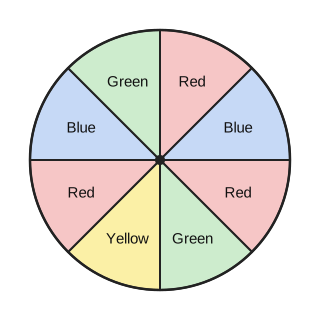
The diagram shows a fair spinner with 8 equal sections.
Nadia spins the spinner once.
Work out the probability that the spinner does not land on Red.
Model answer
3 sections are Red, so 8 - 3 = 5 sections are not Red. P(not Red) = \(\dfrac{5}{8}\)
Explanation
Count the sections that are not Red: 2 Blue, 2 Green and 1 Yellow make 5. All 8 sections are equally likely, so the probability is \(\dfrac{5}{8}\). You could also do \(1 - \dfrac{3}{8}\). A common mistake is to give \(\dfrac{3}{8}\), which is the probability of landing on Red.
Mark scheme
1 mark
5 sections are not red, or P(red) = 3/8 seen; or the correct answer \(\dfrac{5}{8}\) with no working
1 mark
\(\dfrac{5}{8}\)
Accept 0.625 or 62.5%. Do not accept 5 : 8 or 3/8. A correct answer with no working scores full marks.
Question 3
3 marks
Twenty cards are numbered 1 to 20. Grace takes one card at random.
Work out the probability that the number on the card is a multiple of 4 or a multiple of 5. Give your answer as a fraction in its simplest form.
Model answer
Multiples of 4: 4, 8, 12, 16, 20 Multiples of 5: 5, 10, 15, 20 Cards that work: 4, 5, 8, 10, 12, 15, 16, 20 (8 cards) P = \(\dfrac{8}{20}\) = \(\dfrac{2}{5}\)
Explanation
List the cards that are multiples of 4 and the cards that are multiples of 5. The number 20 is in both lists, but it is only one card, so count it once: that makes 8 cards out of 20. Then simplify \(\dfrac{8}{20}\) by dividing top and bottom by 4. A common mistake is to add 5 + 4 and get \(\dfrac{9}{20}\).
Mark scheme
1 mark
Multiples of 4 (4, 8, 12, 16, 20) and multiples of 5 (5, 10, 15, 20) listed; or the correct answer \(\dfrac{2}{5}\) with no working
Allow one slip in the lists.
1 mark
8 cards counted (4, 5, 8, 10, 12, 15, 16, 20), with 20 counted only once, or \(\dfrac{8}{20}\) seen
9/20 (counting 20 twice) scores the first mark only.
1 mark
\(\dfrac{2}{5}\)
Simplest form only for this mark: 8/20 or 4/10 scores 2 marks. Do not accept 0.4 for this mark. A correct answer with no working scores full marks.
Question 4
4 marks
Three friends each play a different game.
Kai's chance of winning is \(\dfrac{2}{5}\). Zara's chance of winning is 35%. Liam spins a fair spinner with 7 equal sections. 3 of the sections say WIN.
What are Kai's and Zara's chances as decimals? What is Liam's chance as a fraction, and as a decimal? Who has the best chance of winning?
Model answer
Kai: \(\dfrac{2}{5}\) = 0.4 Zara: 35% = 0.35 Liam: \(\dfrac{3}{7}\) Compare \(\dfrac{3}{7}\) and \(\dfrac{2}{5}\): \(\dfrac{3}{7} = \dfrac{15}{35}\) and \(\dfrac{2}{5} = \dfrac{14}{35}\), so \(\dfrac{3}{7}\) is bigger. Liam has the best chance.
Explanation
To compare probabilities, put them in the same form. Kai's \(\dfrac{2}{5}\) is 0.4, which beats Zara's 0.35. Liam's chance is \(\dfrac{3}{7}\), which is hard to change to a decimal, so compare it with \(\dfrac{2}{5}\) using the common denominator 35: \(\dfrac{15}{35}\) is more than \(\dfrac{14}{35}\). A common mistake is to think Kai wins because 2 out of 5 sounds close to a half.
Mark scheme
1 mark
Kai's and Zara's chances in the same form, e.g. \(\dfrac{2}{5}\) = 40% (or 0.4) and 35% = 0.35
Any common form: decimals, percentages or fractions with a common denominator.
1 mark
Liam's probability is \(\dfrac{3}{7}\)
1 mark
A correct comparison of \(\dfrac{3}{7}\) with \(\dfrac{2}{5}\), e.g. \(\dfrac{15}{35}\) and \(\dfrac{14}{35}\), or \(\dfrac{3}{7}\) is about 0.43 (or 43%)
Accept 3/7 written as 0.428... or 42.9% or any value from 0.42 to 0.43.
1 mark
Liam
Needs the comparison mark. 'Liam' with no working scores 0, because the question asks you to show how you decide.
Ready to try the rest? Tap or type your answers and see straight away how you did.
Ctrl + Enter to check
Study HelperHints first, answers after you try
Stuck on this one? Ask for a hint and I’ll point you in the right direction, without giving the answer away. Once you’ve checked your answer, I’ll show you how the marks are awarded.