Practise 29 questions on Equivalent fractions and simplifying for Year 7 Maths. Tap or type your answer and find out straight away if you are right, with the Study Helper on hand if you get stuck.
29 questions
1–4 marks each
Instant marking
No sign-up needed
20 questions, marked as you go
Sample questions with model answers
Here are 4 of the questions in this topic, each with a model answer, an explanation of why it earns the marks and the mark scheme.
Question 1
1 mark
What fraction is equivalent to \(\dfrac{3}{5}\) and has a denominator of 20?
Model answer
\(5 \times 4 = 20\), so multiply the numerator by 4 too. \(\dfrac{3}{5} = \dfrac{3 \times 4}{5 \times 4} = \dfrac{12}{20}\)
Explanation
Find what the denominator was multiplied by: 5 times 4 is 20. Then do the same to the numerator: 3 times 4 is 12. Whatever you do to the bottom, you must do to the top.
Mark scheme
1 mark
\(\dfrac{12}{20}\)
Do not accept 18/20 (from adding 15 to the numerator as well as the denominator) or 15/20.
Question 2
2 marks
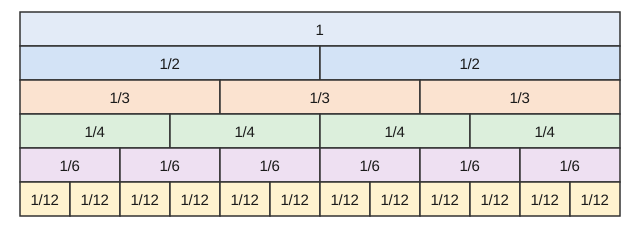
The diagram shows a fraction wall.
Use the fraction wall to answer these.
How many sixths are equal to \(\dfrac{2}{3}\)?
How many twelfths are equal to \(\dfrac{3}{4}\)?
Model answer
Two thirds of the wall line up with four sixths, so \(\dfrac{2}{3} = \dfrac{4}{6}\). Three quarters line up with nine twelfths, so \(\dfrac{3}{4} = \dfrac{9}{12}\).
Explanation
On a fraction wall, fractions that line up end to end are the same size, so they are equivalent. Look down from the end of the second third: it lines up with the end of the fourth sixth. You can check by calculating: \(\dfrac{2 \times 2}{3 \times 2} = \dfrac{4}{6}\) and \(\dfrac{3 \times 3}{4 \times 3} = \dfrac{9}{12}\).
Mark scheme
1 mark
4 (sixths)
Accept 4/6.
1 mark
9 (twelfths)
Accept 9/12. Both answers must be clearly matched to the right question.
Question 3
3 marks
Find the missing number.
\(\dfrac{\square}{28} = \dfrac{30}{42}\)
Model answer
\(\dfrac{30}{42} = \dfrac{30 \div 6}{42 \div 6} = \dfrac{5}{7}\) \(7 \times 4 = 28\), so \(\dfrac{5}{7} = \dfrac{5 \times 4}{7 \times 4} = \dfrac{20}{28}\) The missing number is 20.
Explanation
You cannot get from 42 to 28 by multiplying or dividing by a whole number, so you cannot do it in one step. First simplify \(\dfrac{30}{42}\) to \(\dfrac{5}{7}\), then multiply the top and bottom by 4 to reach a denominator of 28. A common mistake is to subtract 14 from both numbers, which changes the size of the fraction.
Mark scheme
1 mark
\(\dfrac{30}{42}\) simplified correctly, e.g. \(\dfrac{15}{21}\) or \(\dfrac{5}{7}\); or the correct answer 20 with no working
1 mark
\(\dfrac{5}{7}\) with a method to change it to a denominator of 28, e.g. \(28 \div 7 = 4\)
Also award for another correct method, e.g. \(42 \div 3 \times 2 = 28\) so \(30 \div 3 \times 2\).
1 mark
20
Accept 20/28. Do not accept 16 (from taking 14 away from 30, as \(42 - 14 = 28\)). A correct answer with no working scores full marks.
Question 4
4 marks
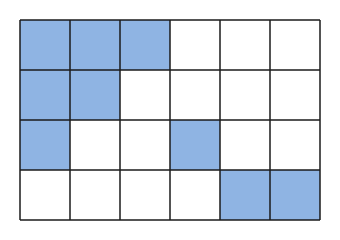
The grid is made of equal squares.
What fraction of the grid is shaded? Give your answer in its simplest form.
How many more squares need to be shaded so that \(\dfrac{3}{4}\) of the grid is shaded?
Model answer
The grid has \(6 \times 4 = 24\) squares and 9 are shaded. \(\dfrac{9}{24} = \dfrac{9 \div 3}{24 \div 3} = \dfrac{3}{8}\) \(\dfrac{3}{4} = \dfrac{18}{24}\), so 18 squares must be shaded. \(18 - 9 = 9\) more squares
Explanation
Count the squares: 6 across and 4 down make 24, and 9 are shaded, so \(\dfrac{9}{24}\), which simplifies to \(\dfrac{3}{8}\). For three quarters, write \(\dfrac{3}{4}\) with a denominator of 24: \(\dfrac{18}{24}\). A common mistake is to give 18, but 9 squares are already shaded.
Mark scheme
1 mark
\(\dfrac{9}{24}\) seen (9 shaded out of 24 squares); or the correct answers \(\dfrac{3}{8}\) and 9 with no working
1 mark
\(\dfrac{3}{8}\)
Only the simplest form scores this mark.
1 mark
\(\dfrac{3}{4} = \dfrac{18}{24}\), or 18 squares for three quarters of the grid
Follow through from the pupil's own count of squares in the grid.
1 mark
9 more squares
Do not accept 18 (the total needed, not how many more). A correct answer with no working scores full marks.
Ready to try the rest? Tap or type your answers and see straight away how you did.
Ctrl + Enter to check
Study HelperHints first, answers after you try
Stuck on this one? Ask for a hint and I’ll point you in the right direction, without giving the answer away. Once you’ve checked your answer, I’ll show you how the marks are awarded.