Practise 25 questions on Perimeter for Year 7 Maths. Tap or type your answer and find out straight away if you are right, with the Study Helper on hand if you get stuck.
25 questions
1–5 marks each
Instant marking
No sign-up needed
20 questions, marked as you go
Sample questions with model answers
Here are 4 of the questions in this topic, each with a model answer, an explanation of why it earns the marks and the mark scheme.
Question 1
1 mark
A square has sides of 5 cm.
What is the perimeter of the square?
Model answer
\(4 \times 5 = 20\) cm
Explanation
A square has four equal sides, so its perimeter is 4 × 5 = 20 cm. 25 cm is wrong because 5 × 5 = 25 is the area of the square (in cm²), not the distance round it. 10 cm adds only two sides.
Mark scheme
1 mark
20 cm
Only 20 cm scores the mark.
Question 2
2 marks
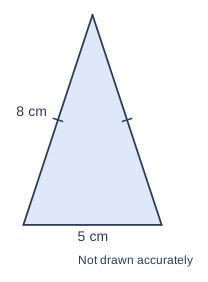
The diagram shows an isosceles triangle.
Work out the perimeter of the triangle.
Model answer
The two sloping sides are equal, so both are 8 cm. \(8 + 8 + 5 = 21\) cm
Explanation
The small marks on the two sloping sides show that they are the same length, so both are 8 cm. Then add all three sides: 8 + 8 + 5 = 21 cm. A common mistake is to add only the two numbers shown and forget the third side.
Mark scheme
1 mark
Uses 8 cm for both of the equal sides, e.g. \(8 + 8 + 5\); or the correct answer 21 cm with no working
The marks on the two sloping sides show they are equal.
1 mark
21 (cm)
Do not accept 13 (only the labelled sides added) or 18. A correct answer with no working scores full marks.
Question 3
3 marks
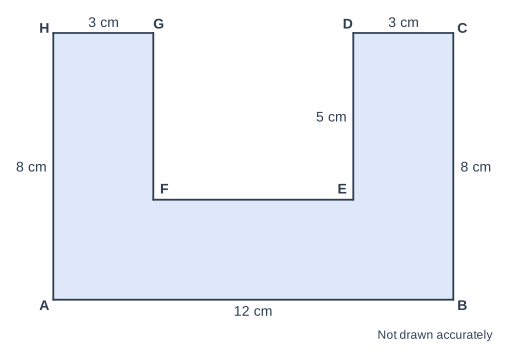
The diagram shows a shape with a gap in the top. All the corners are right angles.
Work out the perimeter of the shape.
Model answer
Bottom of the gap: \(12 - 3 - 3 = 6\) cm Left side of the gap: 5 cm (the same height as the right side of the gap) Perimeter: \(12 + 8 + 3 + 5 + 6 + 5 + 3 + 8 = 50\) cm
Explanation
Two sides inside the gap have no lengths, so find them first. The whole shape is 12 cm wide, and the two top parts are 3 cm each, so the bottom of the gap is 12 − 3 − 3 = 6 cm. The two sides of the gap are the same height, so the missing one is 5 cm. Then go all the way round, adding all eight sides: 50 cm. Tick off each side as you add it so you do not miss one.
Mark scheme
1 mark
The bottom of the gap found: EF = \(12 - 3 - 3 = 6\) cm; or the correct answer 50 cm with no working
1 mark
The other side of the gap found: FG = 5 cm (the same as DE)
Accept \(8 - 3 = 5\) using the height of the bottom part.
1 mark
50 (cm)
ft adding all eight sides with their two missing lengths. Do not accept 39 (only the labelled sides added). A correct answer with no working scores full marks.
Question 4
4 marks
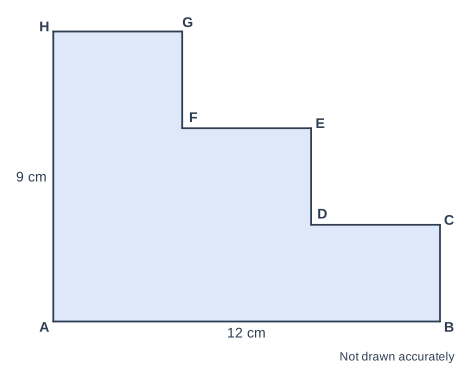
The diagram shows a shape. All the corners are right angles.
Zak says, "You cannot work out the perimeter of this shape, because some of the lengths are missing."
Show that Zak is wrong by working out the perimeter of the shape.
Model answer
The tops of the steps add up to the bottom: 12 cm. The sides of the steps add up to the left side: 9 cm. Perimeter = \(12 + 12 + 9 + 9 = 42\) cm So the perimeter can be worked out, and Zak is wrong.
Explanation
You do not need every single length. If you slide all the short horizontal sides of the steps up, they make a line as long as the 12 cm bottom. If you slide all the short vertical sides across, they make a line as tall as the 9 cm side. So the perimeter is the same as a 12 cm by 9 cm rectangle: 12 + 12 + 9 + 9 = 42 cm. Zak is wrong.
Mark scheme
1 mark
States or uses that the short horizontal sides of the steps add up to 12 cm (the same as the bottom)
May be seen as 24 cm for all the horizontal sides.
1 mark
States or uses that the short vertical sides of the steps add up to 9 cm (the same as the left side)
May be seen as 18 cm for all the vertical sides.
1 mark
A correct total for all the sides, e.g. \(12 + 12 + 9 + 9\) or \(24 + 18\) or \(2 \times 12 + 2 \times 9\)
1 mark
42 (cm)
This is a 'show that' question, so 42 cm with no working scores this mark only. Students who assume the steps are all equal (4 cm across and 3 cm up each) and add them to get 42 cm score 3 marks: the diagram does not show the steps are equal. 'You can measure it' scores 0 (the diagram is not drawn accurately).
Ready to try the rest? Tap or type your answers and see straight away how you did.
Ctrl + Enter to check
Study HelperHints first, answers after you try
Stuck on this one? Ask for a hint and I’ll point you in the right direction, without giving the answer away. Once you’ve checked your answer, I’ll show you how the marks are awarded.