Level:
Correct: 0
Incorrect: 0
Marks: 0/0
Practice
Course:
Topics:
Year 7 Maths Smart practice A mixed round aimed at your weak spots
Unit 1
Place value and the number system
Unit 2
Calculating
Unit 3
Factors, multiples and powers
Unit 4
Fractions
Unit 5
Fractions, decimals and percentages
Unit 6
Algebraic expressions
Unit 7
Equations and inequalities
Unit 8
Sequences and graphs
Unit 9
Ratio and proportion
Ratio, proportion and rates of change
Writing and simplifying ratios
Quick practice5 skills
Sharing in a ratio
Quick practice5 skills
Proportion and best buys
Quick practice5 skills
Scale drawings and maps
Quick practice4 skills
Unit 10
Measures, perimeter, area and volume
Unit 11
Angles and shapes
Unit 12
Probability
Unit 13
Statistics
Avg
score:
–
Topics
done:
0/63

Angles in polygons

Practise 23 questions on Angles in polygons for Year 7 Maths. Tap or type your answer and find out straight away if you are right, with the Study Helper on hand if you get stuck.

  • 23 questions
  • 1–5 marks each
  • Instant marking
  • No sign-up needed
20 questions, marked as you go

Sample questions with model answers

Here are 4 of the questions in this topic, each with a model answer, an explanation of why it earns the marks and the mark scheme.

Question 1

1 mark

What is the sum of the interior angles of a hexagon?

Model answer

\((6 - 2) \times 180 = 720\)
\(720^\circ\)

Explanation

A hexagon has 6 sides, so it splits into \(6 - 2 = 4\) triangles from one vertex, and \(4 \times 180 = 720\). The wrong answer \(1080^\circ\) comes from \(6 \times 180\), which counts too many triangles.

Mark scheme
  1. 1 mark

    \(720^\circ\)

    Accept 720. Any other answer scores 0.

Question 2

2 marks

Work out the size of each interior angle of a regular pentagon.

Model answer

\((5 - 2) \times 180 = 540\)
\(540 \div 5 = 108\)
Each interior angle is \(108^\circ\).

Explanation

First find the total of the interior angles: a pentagon splits into 3 triangles, so its angles add up to \(540^\circ\). In a regular pentagon the 5 angles are equal, so divide by 5. A common mistake is to divide 360 by 5, which gives \(72^\circ\).

Mark scheme
  1. 1 mark

    \(3 \times 180 = 540\) seen; or the correct answer \(108^\circ\) with no working

    Also award this mark for the exterior-angle method: \(360 \div 5 = 72\) and \(180 - 72\) seen.

  2. 1 mark

    \(108^\circ\)

    Accept 108. 72 (from \(360 \div 5\)) scores 0. A correct answer with no working scores full marks.

Question 3

3 marks

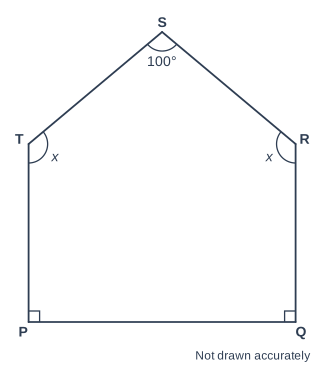
The diagram shows a pentagon PQRST.
It has two right angles.
The two angles marked \(x\) are equal.

Work out the size of angle \(x\).

Geometry diagram, marked "Not drawn accurately". Pentagon PQRST. Angle TPQ is marked as a right angle (90°). Angle PQR is marked as a right angle (90°). Angle RST is marked 100°. Angle QRS is marked x. Angle STP is marked x.

Model answer

Angle sum of a pentagon: \(3 \times 180 = 540\)
\(540 - 90 - 90 - 100 = 260\)
\(260 \div 2 = 130\)
\(x = 130^\circ\)

Explanation

The pentagon's angles add up to \(540^\circ\). Take away the two right angles and the \(100^\circ\) to leave \(260^\circ\) for the two equal angles, then halve it. A common mistake is to forget that each square corner counts as \(90^\circ\).

Mark scheme
  1. 1 mark

    540 used as the angle sum of a pentagon (from \(3 \times 180\)); or the correct answer \(130^\circ\) with no working

  2. 1 mark

    \(540 - 90 - 90 - 100 = 260\)

    Follow through their angle sum.

  3. 1 mark

    \(130^\circ\)

    Accept 130 or \(x = 130\). A correct answer with no working scores full marks.

Question 4

4 marks

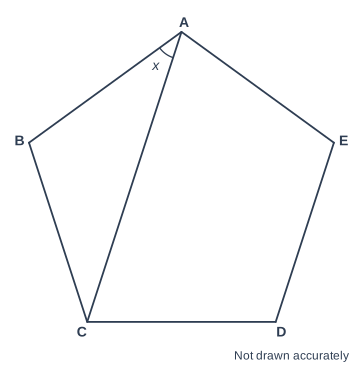
The diagram shows a regular pentagon ABCDE.
The diagonal AC has been drawn.

Work out the size of angle \(x\).

Geometry diagram, marked "Not drawn accurately". Regular pentagon ABCDE. Line segment AC is drawn. Angle BAC is marked x.

Model answer

Angle sum \(= 3 \times 180 = 540^\circ\)
Angle ABC \(= 540 \div 5 = 108^\circ\)
AB = BC, so triangle ABC is isosceles.
\(x = (180 - 108) \div 2 = 36^\circ\)

Explanation

First find an interior angle of the regular pentagon: \(108^\circ\). The sides AB and BC are equal because the pentagon is regular, so triangle ABC is isosceles and its other two angles are equal. They share \(180 - 108 = 72^\circ\), so each one is \(36^\circ\). A common mistake is to forget to halve the \(72^\circ\).

Mark scheme
  1. 1 mark

    540 as the angle sum of the pentagon; or the correct answer \(36^\circ\) with no working

    Or the exterior angle \(360 \div 5 = 72^\circ\) found (the exterior-angle route to the interior angle).

  2. 1 mark

    Angle ABC \(= 108^\circ\)

  3. 1 mark

    \((180 - 108) \div 2\) or \(72 \div 2\) seen

    Uses the fact that triangle ABC is isosceles (AB = BC). Follow through their angle ABC.

  4. 1 mark

    \(36^\circ\)

    Accept 36 or \(x = 36\). 72 (not halved) scores 0 for this mark. A correct answer with no working scores full marks.

Ready to try the rest? Tap or type your answers and see straight away how you did.

Topic notes

Angles in polygons

The big idea

A polygon is a flat shape with straight sides. The angles inside it are its interior angles. You can find what they add up to for any polygon by splitting it into triangles, because you already know that the angles in a triangle add up to 180°.

Splitting a polygon into triangles

Pick one vertex (corner) and draw a diagonal to every other vertex you can. The triangles fit exactly inside the polygon, and together their angles make up all its interior angles.

Geometry diagram, marked "Diagram NOT accurately drawn". Hexagon ABCDEF (shaded). Dashed line segments AC, AD and AE are drawn. The text "1" is written inside hexagon ABCDEF. The text "2" is written inside hexagon ABCDEF. The text "3" is written inside hexagon ABCDEF. The text "4" is written inside hexagon ABCDEF.
The diagonals from vertex A split this hexagon into 4 triangles, so its interior angles add up to 4 × 180° = 720°.

You always get 2 fewer triangles than the polygon has sides. So for a polygon with \(n\) sides:

\[ \text{sum of interior angles} = (n - 2) \times 180^\circ \]
PolygonSidesTrianglesSum of interior angles
Triangle31180°
Quadrilateral42360°
Pentagon53540°
Hexagon64720°
Octagon861080°

Each extra side adds one more triangle, so the sum goes up by 180° each time.

Regular polygons

In a regular polygon all the sides are equal and all the interior angles are equal. To find one angle, work out the sum, then share it equally between the angles: divide by the number of sides, not the number of triangles.

Find each angle of a hexagonal nut

A metal nut (the kind that screws onto a bolt) is a regular hexagon. Work out the size of each interior angle.

A hexagon has 6 sides, so it splits into \(6 - 2 = 4\) triangles.

Sum: \(4 \times 180 = 720^\circ\)

Each angle: \(720 \div 6 = 120^\circ\)

Missing angles in other polygons

Find the angle sum first, then subtract the angles you know. A polygon can have a reflex interior angle, and the rule still works.

Geometry diagram, marked "Diagram NOT accurately drawn". L-shaped hexagon ABCDEF (shaded). Angle FAB is marked as a right angle (90°). Angle ABC is marked as a right angle (90°). Angle BCD is marked as a right angle (90°). Angle DEF is marked as a right angle (90°). Angle EFA is marked as a right angle (90°). Reflex angle CDE is marked x (x = 270°).
The floor plan of an L-shaped room. It has 6 sides, five right angles and one reflex angle, x.

Find the reflex angle in the L-shaped room

The room has 6 sides, so it is a hexagon. Its interior angles add up to \((6 - 2) \times 180 = 720^\circ\).

The five right angles make \(5 \times 90 = 450^\circ\).

\(x = 720 - 450 = 270^\circ\)

Check: a reflex angle must be between 180° and 360°, and 270° is.

You can also work backwards: divide the angle sum by 180 to find the number of triangles, then add 2 to find the number of sides. So no polygon has angles that add up to 1000°, because \(1000 \div 180 = 5.55...\) is not a whole number of triangles.

Stretch: exterior angles and tessellation

If you carry one side of a polygon on past a corner, the angle between that extension and the next side is an exterior angle. The interior and exterior angles at a corner sit on a straight line, so they add up to 180°. Walking once round any polygon, you turn through all the exterior angles and end up facing the way you started, so the exterior angles add up to 360°. In a regular polygon with \(n\) sides, each exterior angle is \(360 \div n\).

Shapes tessellate when copies fit together with no gaps or overlaps. At each point where corners meet, the angles must add up to exactly 360°. On their own, only three regular polygons tessellate: equilateral triangles (60°), squares (90°) and regular hexagons (120°).

Do squares and equilateral triangles tessellate together?

The tiles have sides of the same length. Each angle of a square is 90° and each angle of an equilateral triangle is 60°.

One square and four triangles at a point: \(90 + 4 \times 60 = 330^\circ\), which leaves a 30° gap.

Two squares and three triangles: \(2 \times 90 + 3 \times 60 = 180 + 180 = 360^\circ\). They fit exactly, so squares and equilateral triangles can tessellate together.

Common mistakes

  • Multiplying the number of sides by 180°: it is the number of triangles, \(n - 2\), times 180°.
  • Dividing by the number of triangles instead of the number of angles for a regular polygon.
  • Forgetting that a small square in a corner means 90°.
  • Giving the number of triangles when the question asks for the number of sides.

Top tip

Check the formula on a shape you know: a triangle gives \((3 - 2) \times 180 = 180^\circ\) and a square gives \(4 \times 90 = 360^\circ\). If your method does not work for these, it is wrong.

Study Helper Hints first, answers after you try

Stuck on this one? Ask for a hint and I’ll point you in the right direction, without giving the answer away. Once you’ve checked your answer, I’ll show you how the marks are awarded.