Practise 24 questions on Reasoning and proof with numbers for Year 7 Maths. Tap or type your answer and find out straight away if you are right, with the Study Helper on hand if you get stuck.
24 questions
1–4 marks each
Instant marking
No sign-up needed
20 questions, marked as you go
Sample questions with model answers
Here are 4 of the questions in this topic, each with a model answer, an explanation of why it earns the marks and the mark scheme.
Question 1
1 mark
Give a counterexample to show that this statement is false.
'Every multiple of 3 is odd.'
Model answer
6 is a multiple of 3 (\(2 \times 3 = 6\)), and 6 is even. So not every multiple of 3 is odd.
Explanation
A counterexample is one example that makes a statement false. It must fit the first part of the statement (be a multiple of 3) but not the second part (be odd). Every second multiple of 3 is even: 6, 12, 18 and so on.
Mark scheme
1 mark
Any even multiple of 3, e.g. 6, 12, 18, 24, 30
Do not accept an odd multiple of 3 (such as 9 or 15) or an even number that is not a multiple of 3 (such as 8).
Question 2
2 marks
Kai says, 'Every multiple of 6 is also a multiple of 3.'
Is Kai right? How do you know?
Model answer
Yes. \(6 = 2 \times 3\), so every multiple of 6 is made of groups of 6, and each group of 6 is two groups of 3. So every multiple of 6 is a multiple of 3.
Explanation
Because 3 is a factor of 6, anything you can split into 6s you can also split into 3s. That is why the 6 times table is every second number in the 3 times table. Notice that the opposite is not true: 9 is a multiple of 3 but not of 6.
Mark scheme
1 mark
Yes, with a relevant but incomplete reason, e.g. examples only (6, 12 and 18 are all in the 3 times table)
'Yes' on its own scores 0.
1 mark
A complete correct reason: 6 is a multiple of 3 (\(6 = 2 \times 3\)), so any multiple of 6 is 3 times (2 times a whole number) / the 6 times table is every second number in the 3 times table / any multiple of 6 can be split into groups of 3
A complete correct reason on its own scores both marks.
Question 3
3 marks
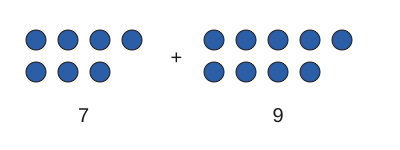
The diagram shows the numbers 7 and 9 drawn as dots, arranged in pairs.
Lily says, 'When you add two odd numbers, the answer is always even.'
Give two examples that fit Lily's statement. Then use the idea of pairs to explain why it is always true.
Model answer
\(7 + 9 = 16\) and \(3 + 5 = 8\): both answers are even. 7 is 3 pairs with 1 dot left over. 9 is 4 pairs with 1 dot left over. When you put them together, the two left-over dots make another pair. So the total is all pairs, with nothing left over, so it is even. This works for any two odd numbers.
Explanation
Every odd number can be arranged as pairs with exactly one dot left over. When you add two odd numbers, the two left-over dots join up to make one more pair. Nothing is left over, so the total is always even. Examples show that it works; the pairs picture shows why.
Mark scheme
1 mark
Two correct examples of two odd numbers that add to an even number, e.g. \(7 + 9 = 16\) and \(3 + 5 = 8\)
Both examples must be correct. \(7 + 9 = 16\) may be one of them.
1 mark
A relevant but incomplete explanation, e.g. 'an odd number is pairs with one left over'
1 mark
A complete explanation: each odd number has one dot left over, and the two left-over dots make a new pair, so the total is all pairs with none left over, which is even
A complete explanation on its own scores the second and third marks. Accept the same idea in other words, e.g. 'each odd number is an even number with 1 more, and the two extra 1s make 2, so the total is even'. 'Because odd + odd = even' just repeats Lily's statement and scores 0 for the explanation.
Question 4
4 marks
Ella says, 'Think of a number. Double it. Add 10. Halve the answer. Then take away the number you first thought of. You always get 5.'
Test Ella's trick with two different starting numbers. Then explain why the answer is always 5.
Model answer
Start with 3: \(3 \times 2 = 6\), \(6 + 10 = 16\), \(16 \div 2 = 8\), \(8 - 3 = 5\) Start with 10: \(10 \times 2 = 20\), \(20 + 10 = 30\), \(30 \div 2 = 15\), \(15 - 10 = 5\) Why: after doubling and adding 10, you have two lots of your number and 10. Halving that gives one lot of your number and 5. Taking away your number leaves just 5.
Explanation
Testing shows the trick works, but explaining needs you to follow what happens to any number. Doubling then halving brings you back to your number, and the 10 you added becomes 5 when it is halved. Taking away your starting number removes it, so 5 is all that is left, whatever number you choose.
Mark scheme
1 mark
One correct test, e.g. start with 3: 6, 16, 8, then \(8 - 3 = 5\)
Every step must be correct.
1 mark
A second correct test with a different starting number, e.g. start with 10: 20, 30, 15, then \(15 - 10 = 5\)
1 mark
A relevant but incomplete explanation, e.g. 'doubling and then halving gets you back to the number you started with' or 'half of 10 is 5'
1 mark
A complete explanation: doubling and then halving cancel out, and the 10 is halved to 5, so after halving you have your number + 5; taking away your number leaves 5
A complete explanation on its own scores the third and fourth marks. Algebra is not needed, but a correct algebraic explanation is fine.
Ready to try the rest? Tap or type your answers and see straight away how you did.
Ctrl + Enter to check
Study HelperHints first, answers after you try
Stuck on this one? Ask for a hint and I’ll point you in the right direction, without giving the answer away. Once you’ve checked your answer, I’ll show you how the marks are awarded.