Level:
Correct: 0
Incorrect: 0
Marks: 0/0
Practice
Course:
Topics:
Year 7 Maths Smart practice A mixed round aimed at your weak spots
Unit 1
Place value and the number system
Unit 2
Calculating
Unit 3
Factors, multiples and powers
Unit 4
Fractions
Unit 5
Fractions, decimals and percentages
Unit 6
Algebraic expressions
Unit 7
Equations and inequalities
Unit 8
Sequences and graphs
Unit 9
Ratio and proportion
Ratio, proportion and rates of change
Writing and simplifying ratios
Quick practice5 skills
Sharing in a ratio
Quick practice5 skills
Proportion and best buys
Quick practice5 skills
Scale drawings and maps
Quick practice4 skills
Unit 10
Measures, perimeter, area and volume
Unit 11
Angles and shapes
Unit 12
Probability
Unit 13
Statistics
Avg
score:
–
Topics
done:
0/63

Expanding and factorising brackets

Practise 28 questions on Expanding and factorising brackets for Year 7 Maths. Tap or type your answer and find out straight away if you are right, with the Study Helper on hand if you get stuck.

  • 28 questions
  • 1–5 marks each
  • Instant marking
  • No sign-up needed
20 questions, marked as you go

Sample questions with model answers

Here are 4 of the questions in this topic, each with a model answer, an explanation of why it earns the marks and the mark scheme.

Question 1

1 mark

What is the missing number?

\(3(x + \square) = 3x + 21\)

Model answer

\(3 \times \square = 21\), so the missing number is 7.
Check: \(3(x + 7) = 3x + 21\)

Explanation

When you expand, the 3 multiplies the missing number to give 21. So the missing number is \(21 \div 3 = 7\). A common mistake is to write 21, forgetting that the number in the bracket gets multiplied by 3.

Mark scheme
  1. 1 mark

    7

    Do not accept 21, 18 or 63.

Question 2

2 marks

Expand and simplify \(2(x + 3) + 4(x - 1)\)

Model answer

\(2(x + 3) = 2x + 6\)
\(4(x - 1) = 4x - 4\)
\(2x + 6 + 4x - 4 = 6x + 2\)

Explanation

Expand each bracket first, then collect like terms. \(2x + 4x = 6x\) and \(6 - 4 = 2\), so the answer is \(6x + 2\). A common mistake is to lose the minus sign from \(4 \times -1\) and get \(6x + 10\).

Mark scheme
  1. 1 mark

    Both brackets expanded correctly, \(2x + 6\) and \(4x - 4\); or the correct answer \(6x + 2\) with no working

    Also award this mark for three of the four terms \(2x\), \(+6\), \(4x\), \(-4\) correct.

  2. 1 mark

    \(6x + 2\)

    Accept \(2 + 6x\) or \(2(3x + 1)\). Do not accept \(6x + 10\) or \(6x + 5\). A correct answer with no working scores full marks.

Question 3

3 marks

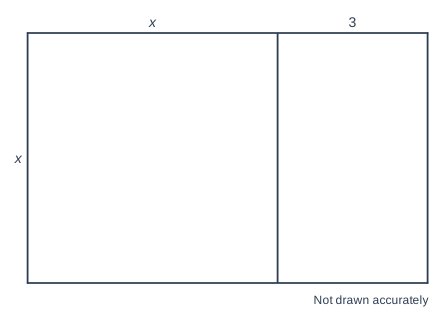
The diagram shows a rectangle split into a square and a smaller rectangle.
The rectangle is \(x\) units tall. The square is \(x\) units wide and the smaller rectangle is 3 units wide.

Write an expression for the area of each part.

Then write an expression for the area of the whole rectangle, first with brackets and then without brackets.

Geometry diagram, marked "Not drawn accurately". A rectangle (its vertices are not labelled). A vertical line with no labelled ends is drawn. The unlabelled side going to the right is labelled x. The unlabelled side going to the right is labelled 3. The unlabelled side going upwards is labelled x.

Model answer

Square: \(x \times x = x^2\)
Smaller rectangle: \(x \times 3 = 3x\)
Whole rectangle: \(x(x + 3) = x^2 + 3x\)

Explanation

The square is \(x\) by \(x\), so its area is \(x^2\); the smaller rectangle is \(x\) by 3, so its area is \(3x\). The whole rectangle is \(x\) high and \(x + 3\) wide, so its area is \(x(x + 3)\). Adding the two parts shows that \(x(x + 3) = x^2 + 3x\), which is how a letter outside a bracket expands.

Mark scheme
  1. 1 mark

    Square: \(x^2\) and smaller rectangle: \(3x\)

    Both needed. Accept \(x \times x\) for the square.

  2. 1 mark

    Whole rectangle with brackets: \(x(x + 3)\)

    Accept \((x + 3) \times x\). Do not accept \(x \times x + 3\) without brackets.

  3. 1 mark

    Whole rectangle without brackets: \(x^2 + 3x\)

    Accept \(3x + x^2\). Do not accept \(x^2 + 3\) or \(4x\).

Question 4

4 marks

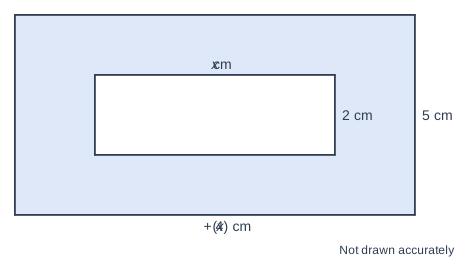
The diagram shows a small rectangle, 2 cm by \(x\) cm, cut out of a larger rectangle, 5 cm by \((x + 4)\) cm.
The shaded region is what is left.

Write an expression for the area of the shaded region.
Give your answer in its simplest form.

Geometry diagram, marked "Not drawn accurately". A large rectangle (its vertices are not labelled) (shaded). A small rectangle (its vertices are not labelled) (filled white). The unlabelled side going to the right is labelled (x + 4) cm. The unlabelled side going upwards is labelled 5 cm. The unlabelled side going to the right is labelled x cm. The unlabelled side going upwards is labelled 2 cm.

Model answer

Large rectangle: \(5(x + 4) = 5x + 20\)
Small rectangle: \(2 \times x = 2x\)
Shaded area: \(5x + 20 - 2x = 3x + 20\) cm²

Explanation

The shaded area is the large rectangle take away the small one. Expand \(5(x + 4) = 5x + 20\), then subtract \(2x\): \(5x - 2x = 3x\), and the 20 stays. A common mistake is to write \(5(x + 4)\) as \(5x + 4\), forgetting to multiply the 4.

Mark scheme
  1. 1 mark

    Large rectangle area \(5(x + 4)\) or \(5x + 20\); or the correct answer \(3x + 20\) with no working

  2. 1 mark

    Small rectangle area \(2x\)

  3. 1 mark

    Their small area subtracted from their large area, e.g. \(5x + 20 - 2x\)

  4. 1 mark

    \(3x + 20\)

    Accept \(20 + 3x\). Ignore units. Do not accept \(3x + 4\), \(7x + 20\) or \(5x + 18\). A correct answer with no working scores full marks.

Ready to try the rest? Tap or type your answers and see straight away how you did.

Topic notes

Expanding and factorising brackets

The big idea

\(4(x + 6)\) means 4 lots of \(x + 6\). Expanding (or multiplying out) the bracket writes it without brackets: \(4x + 24\). Factorising is the opposite: it puts the bracket back in. The two forms are equivalent: they have the same value whatever number \(x\) is.

Expanding a bracket

Multiply every term inside the bracket by the number outside it. An area model shows why. A rectangle 4 units tall and \(x + 6\) units wide has area \(4(x + 6)\). Split it into two parts and add their areas: \(4x + 24\).

Geometry diagram, marked "Diagram NOT accurately drawn". A rectangle (its vertices are not labelled). A vertical line with no labelled ends is drawn. The unlabelled side going upwards is labelled 4. The unlabelled side going to the right is labelled x. The unlabelled side going to the right is labelled 6. The text "4 × x = 4x" is written inside the shape. The text "4 × 6 = 24" is written inside the shape.
The area of the whole rectangle is 4(x + 6). The two parts have areas 4x and 24, so 4(x + 6) = 4x + 24.

A minus sign inside the bracket stays with its term: \(3(y - 6) = 3y - 18\), and \(5(4 - k) = 20 - 5k\).

A regular pentagon has 5 equal sides. Each side is \((2x - 1)\) cm long. Write an expression for its perimeter without brackets.

The perimeter is 5 lots of the side: \(5(2x - 1)\)

Multiply each term by 5: \(5 \times 2x = 10x\) and \(5 \times (-1) = -5\)

The perimeter is \(10x - 5\) cm.

Expanding and simplifying

When there are two brackets, expand each one, then collect like terms.

A café sells muffins for \((m + 40)\) pence each and cookies for \((m - 10)\) pence each. Ella buys 3 muffins and 4 cookies. Write an expression for the total cost in its simplest form.

Total cost: \(3(m + 40) + 4(m - 10)\)

Expand each bracket: \(3m + 120 + 4m - 40\)

Collect like terms: \(3m + 4m = 7m\) and \(120 - 40 = 80\)

The total cost is \(7m + 80\) pence.

Factorising

  1. Find the highest common factor (HCF) of the terms: the biggest number that divides into all of them.
  2. Write the HCF outside the bracket.
  3. Divide each term by the HCF and write the answers inside the bracket.
  4. Check by expanding.

Factorise fully means take out the highest common factor, so that the terms left in the bracket have no common factor.

Factorise fully \(24t + 36\)

Factors of 24: 1, 2, 3, 4, 6, 8, 12, 24

Factors of 36: 1, 2, 3, 4, 6, 9, 12, 18, 36

The highest common factor is 12. Divide each term by 12: \(24t \div 12 = 2t\) and \(36 \div 12 = 3\)

So \(24t + 36 = 12(2t + 3)\)

Check: \(12 \times 2t + 12 \times 3 = 24t + 36\) ✓

\(6(4t + 6)\) is equal to \(24t + 36\), but it is not fully factorised, because \(4t\) and 6 still have a common factor of 2.

Stretch: a letter outside the bracket

The term outside the bracket can be a letter. Multiply each term inside by it, remembering that \(p \times p = p^2\):

\(p(p + 7) = p \times p + p \times 7 = p^2 + 7p\)

Common mistakes

  • Multiplying only the first term: \(6(a + 2)\) is \(6a + 12\), not \(6a + 2\).
  • Adding instead of multiplying: \(4(2y + 1)\) is \(8y + 4\), not \(6y + 4\).
  • Losing a minus sign: in \(2(x - 3)\), \(2 \times (-3) = -6\), so it is \(2x - 6\).
  • Stopping too early: \(10x + 20 = 2(5x + 10)\) is true, but fully factorised it is \(10(x + 2)\).
  • Leaving out the 1: \(5x + 5 = 5(x + 1)\), because \(5 \div 5 = 1\).

Top tip

Always check a factorised answer by expanding it in your head. You should get back exactly what you started with.

Study Helper Hints first, answers after you try

Stuck on this one? Ask for a hint and I’ll point you in the right direction, without giving the answer away. Once you’ve checked your answer, I’ll show you how the marks are awarded.