Level:
Correct: 0
Incorrect: 0
Marks: 0/0
Practice
Course:
Topics:
Year 7 Maths Smart practice A mixed round aimed at your weak spots
Unit 1
Place value and the number system
Unit 2
Calculating
Unit 3
Factors, multiples and powers
Unit 4
Fractions
Unit 5
Fractions, decimals and percentages
Unit 6
Algebraic expressions
Unit 7
Equations and inequalities
Unit 8
Sequences and graphs
Unit 9
Ratio and proportion
Ratio, proportion and rates of change
Writing and simplifying ratios
Quick practice5 skills
Sharing in a ratio
Quick practice5 skills
Proportion and best buys
Quick practice5 skills
Scale drawings and maps
Quick practice4 skills
Unit 10
Measures, perimeter, area and volume
Unit 11
Angles and shapes
Unit 12
Probability
Unit 13
Statistics
Avg
score:
–
Topics
done:
0/63

Sequences and term-to-term rules

Practise 29 questions on Sequences and term-to-term rules for Year 7 Maths. Tap or type your answer and find out straight away if you are right, with the Study Helper on hand if you get stuck.

  • 29 questions
  • 1–5 marks each
  • Instant marking
  • No sign-up needed
20 questions, marked as you go

Sample questions with model answers

Here are 4 of the questions in this topic, each with a model answer, an explanation of why it earns the marks and the mark scheme.

Question 1

1 mark

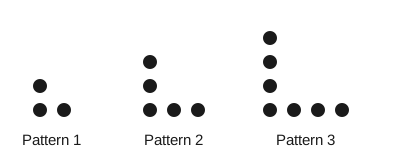
The diagram shows the first three patterns in a sequence of patterns made from dots.

How many dots will there be in Pattern 4?

Three patterns made from dots, labelled Pattern 1, Pattern 2 and Pattern 3. Each pattern is an L shape: a corner dot with a line of dots going up from it and a line of dots going right from it. Pattern 1 has 1 dot up and 1 dot to the right of the corner. Pattern 2 has 2 dots up and 2 dots to the right. Pattern 3 has 3 dots up and 3 dots to the right.

Model answer

Pattern 1 has 3 dots, Pattern 2 has 5 dots and Pattern 3 has 7 dots.
The number of dots goes up by 2 each time.
\(7 + 2 = 9\)
Pattern 4 has 9 dots.

Explanation

Count the dots in each pattern: 3, 5, 7. Each new pattern adds one dot to the top of the L and one dot to the end of the L, so 2 more dots each time. Pattern 4 has \(7 + 2 = 9\) dots. A common mistake is to add only 1 dot, forgetting that both arms of the L get longer.

Mark scheme
  1. 1 mark

    9

    Accept 9 (dots) only. Do not accept 8 (adding 1) or 4.

Question 2

2 marks

Here is a sequence.

\(\dfrac{1}{4}, \; \dfrac{1}{2}, \; \dfrac{3}{4}, \; 1, \; \dots\)

What are the next two terms?

Model answer

The terms go up by \(\dfrac{1}{4}\) each time.
\(1 + \dfrac{1}{4} = 1\dfrac{1}{4}\)
\(1\dfrac{1}{4} + \dfrac{1}{4} = 1\dfrac{1}{2}\)
The next two terms are \(1\dfrac{1}{4}\) and \(1\dfrac{1}{2}\).

Explanation

Write every term in quarters: \(\dfrac{1}{4}, \dfrac{2}{4}, \dfrac{3}{4}, \dfrac{4}{4}\). Now you can see the rule is add \(\dfrac{1}{4}\). The next terms are \(\dfrac{5}{4} = 1\dfrac{1}{4}\) and \(\dfrac{6}{4} = 1\dfrac{1}{2}\). A common mistake is to think the sequence stops at 1 or jumps to 2.

Mark scheme
  1. 1 mark

    \(1\dfrac{1}{4}\)

    Accept \(\dfrac{5}{4}\), 1 1/4 typed with a space, or 1.25.

  2. 1 mark

    \(1\dfrac{1}{2}\)

    Accept \(\dfrac{3}{2}\), \(\dfrac{6}{4}\), \(1\dfrac{2}{4}\), 1 1/2 typed with a space, or 1.5. Follow through: award this mark for their first answer + \(\dfrac{1}{4}\). Do not accept 2. Correct answers with no working score full marks.

Question 3

3 marks

A tomato plant is 12 cm tall.

It grows 1.5 cm every week.

After how many weeks will the plant first be taller than 25 cm?

Model answer

Heights after each week: 13.5, 15, 16.5, 18, 19.5, 21, 22.5, 24, 25.5
After 8 weeks: 24 cm (not taller than 25 cm)
After 9 weeks: 25.5 cm
The answer is 9 weeks.

Explanation

The heights make a sequence with the rule add 1.5. Keep adding 1.5 to 12 and count the weeks until the height goes over 25 cm. After 8 weeks it is 24 cm, still not taller than 25 cm, but after 9 weeks it is 25.5 cm. A common mistake is to answer 8, or to stop at 25 cm, when the question asks for taller than 25 cm.

Mark scheme
  1. 1 mark

    Starts adding 1.5 cm a week: 13.5, 15, 16.5, ... (at least three correct heights), or works out \(25 - 12 = 13\) (cm still to grow); or the correct answer 9 weeks with no working

  2. 1 mark

    Finds the height is 24 cm after 8 weeks and 25.5 cm after 9 weeks, or works out \(13 \div 1.5 = 8.66...\) (more than 8 weeks)

    Also award for a full correct list of heights: 13.5, 15, 16.5, 18, 19.5, 21, 22.5, 24, 25.5.

  3. 1 mark

    9 (weeks)

    Do not accept 8 (after 8 weeks the plant is 24 cm, which is not taller than 25 cm) or 8.7. A correct answer with no working scores full marks.

Question 4

4 marks

In a sequence, each term is found by adding the two terms before it.

The first term is 4.
The fourth term is 22.

Work out the fifth term.

Model answer

Try a second term of 8: 4, 8, 12, 20. Too small.
Try 9: 4, 9, 13, 22. Correct.
Fifth term: \(13 + 22 = 35\)

Explanation

You need the second term first. Try a number, build the sequence and check whether the fourth term comes out as 22: with 9 you get 4, 9, 13, 22, which works. (Each extra 1 on the second term adds 2 to the fourth term, because the second term is used twice.) Then the fifth term is the third plus the fourth: \(13 + 22 = 35\). A common mistake is to add the same number each time, as in a linear sequence.

Mark scheme
  1. 1 mark

    A correct method for the second term, e.g. a trial such as 4, 8, 12, 20 checked against 22 / noticing that the fourth term is the first term plus two lots of the second term, so \(22 - 4 = 18\) and \(18 \div 2\); or the correct answer 35 with no working

  2. 1 mark

    Second term = 9

  3. 1 mark

    Third term = 13

    Follow through: 4 + their second term.

  4. 1 mark

    35

    From \(13 + 22\). Follow through: their third term + 22. A correct answer with no working scores full marks.

Ready to try the rest? Tap or type your answers and see straight away how you did.

Topic notes

Sequences and term-to-term rules

The big idea

A sequence is a list of numbers or patterns that follow a rule. Each number in the list is called a term. The term-to-term rule tells you how to get from one term to the next, such as "add 4", "subtract 0.5" or "multiply by 2". Once you know the rule, you can carry on the sequence and fill in any gaps.

Finding the rule

Look at how you get from each term to the next one.

  • An ascending sequence gets bigger: 2, 9, 16, 23, ... (add 7).
  • A descending sequence gets smaller: 18, 14, 10, 6, ... (subtract 4). It can carry on below zero into the negative numbers: 2, \(-2\), \(-6\).
  • If the differences (the gaps between neighbouring terms) are not all the same, try multiplying: 3, 12, 48, ... (multiply by 4).

A rule must work for every step, so check it on all the terms. Rules can use fractions and decimals too: \(\dfrac{1}{3}, \; 1, \; 1\dfrac{2}{3}, \dots\) adds \(\dfrac{2}{3}\) each time. In a two-step rule, such as "multiply by 3, then subtract 1", do the steps in the order given.

At 6 pm the temperature is 3 °C. It falls by 1.5 °C every hour. What is the temperature at 10 pm?

The rule is subtract 1.5. Write one term for each hour, from 6 pm to 10 pm:

3, 1.5, 0, \(-1.5\), \(-3\)

After zero the terms are negative. At 10 pm the temperature is \(-3\) °C.

Linear and non-linear sequences

In a linear (or arithmetic) sequence, the same number is added or subtracted every time, so the differences are all the same. Any other sequence is non-linear. Learn these non-linear sequences by name:

SequenceFirst termsHow it works
Square numbers1, 4, 9, 16, 25\(1 \times 1\), \(2 \times 2\), ...
Triangular numbers1, 3, 6, 10, 15add 2, then 3, then 4, ...
Doubling1, 2, 4, 8, 16multiply by 2
Fibonacci-type2, 5, 7, 12, 19add the two terms before

Patterns of shapes

To turn a pattern into a sequence, count something in each pattern (squares, sticks or dots) and look at how the count changes.

Geometry diagram, drawn accurately to scale. A square (its vertices are not labelled) (shaded). A square (its vertices are not labelled) (shaded). A square (its vertices are not labelled) (shaded). A square (its vertices are not labelled) (shaded). A square (its vertices are not labelled) (shaded). A square (its vertices are not labelled) (shaded). A square (its vertices are not labelled) (shaded). A square (its vertices are not labelled) (shaded). A square (its vertices are not labelled) (shaded). A square (its vertices are not labelled) (shaded). The text "Pattern 1" is written. The text "Pattern 2" is written. The text "Pattern 3" is written.
Patterns 1, 2 and 3 have 1, 3 and 6 squares. Each new pattern adds a bottom row that is one square longer.

How many squares will there be in Pattern 5?

Count the squares: 1, 3, 6. Each new pattern adds a bottom row one square longer than the last, so you add 2, then 3, then 4, then 5.

Pattern 4: \(6 + 4 = 10\) squares. Pattern 5: \(10 + 5 = 15\) squares.

These are the triangular numbers: a non-linear sequence, because the differences change.

Missing terms

To fill a gap, find the rule from two terms that are next to each other. To go backwards, use the inverse (the opposite) of the rule: the inverse of "multiply by 2" is "divide by 2".

Each term is double the one before. Fill in the gaps: \(\square, \; \square, \; 12, \; 24, \; \square\)

Going forwards, double: \(24 \times 2 = 48\).

Going backwards, halve: \(12 \div 2 = 6\), then \(6 \div 2 = 3\).

The sequence is 3, 6, 12, 24, 48.

Is a number in the sequence?

Carry on the sequence until you reach the number or jump past it. A pattern can be quicker: the terms might all be odd, or always end in 3 or 8.

Buses leave at 7:10 am and then every 15 minutes. Does a bus leave at 9:00 am?

The times make a sequence with the rule add 15 minutes: 7:10, 7:25, 7:40, 7:55, 8:10, ...

The minutes always go 10, 25, 40, 55, so the sequence jumps from 8:55 to 9:10. No bus leaves at 9:00 am.

Remember

  • The term-to-term rule takes you from one term to the next.
  • A linear sequence adds or subtracts the same amount every time.
  • Square numbers: 1, 4, 9, 16, 25. Triangular numbers: 1, 3, 6, 10, 15.
  • To go backwards, use the inverse of the rule.

Common mistakes

  • Using a rule that only works once. In 3, 6, 12, 24, "add 3" works for the first step only: the rule is multiply by 2.
  • Losing the minus sign below zero: 5, 2, \(-1\), \(-4\), not 1 and 4.
  • Using terms that are not next to each other to find the rule. In 5, \(\square\), 17, the jump from 5 to 17 is two steps of 6.
  • Doing a two-step rule in the wrong order: "multiply by 2, then add 1" turns 4 into 9, not 10.

Top tip

Write each difference above the gap between two terms. If they are all the same, the sequence is linear. If they change in a pattern (2, 3, 4, ...), carry on the pattern to find the next difference.

Study Helper Hints first, answers after you try

Stuck on this one? Ask for a hint and I’ll point you in the right direction, without giving the answer away. Once you’ve checked your answer, I’ll show you how the marks are awarded.