Level:
Correct: 0
Incorrect: 0
Marks: 0/0
Practice
Course:
Topics:
Year 7 Maths Smart practice A mixed round aimed at your weak spots
Unit 1
Place value and the number system
Unit 2
Calculating
Unit 3
Factors, multiples and powers
Unit 4
Fractions
Unit 5
Fractions, decimals and percentages
Unit 6
Algebraic expressions
Unit 7
Equations and inequalities
Unit 8
Sequences and graphs
Unit 9
Ratio and proportion
Ratio, proportion and rates of change
Writing and simplifying ratios
Quick practice5 skills
Sharing in a ratio
Quick practice5 skills
Proportion and best buys
Quick practice5 skills
Scale drawings and maps
Quick practice4 skills
Unit 10
Measures, perimeter, area and volume
Unit 11
Angles and shapes
Unit 12
Probability
Unit 13
Statistics
Avg
score:
–
Topics
done:
0/63

Measuring and drawing angles

Practise 24 questions on Measuring and drawing angles for Year 7 Maths. Tap or type your answer and find out straight away if you are right, with the Study Helper on hand if you get stuck.

  • 24 questions
  • 1–5 marks each
  • Instant marking
  • No sign-up needed
20 questions, marked as you go

Sample questions with model answers

Here are 4 of the questions in this topic, each with a model answer, an explanation of why it earns the marks and the mark scheme.

Question 1

1 mark

Maya is facing north. She turns 90° clockwise.

Which direction is she facing now?

Model answer

East

Explanation

A turn of 90° is a quarter turn. Going clockwise (the way the hands of a clock move) from north, the next main compass point is east. A common mistake is to turn anticlockwise and get west.

Mark scheme
  1. 1 mark

    East

    Accept E. Do not accept west.

Question 2

2 marks

Zara measures the marked angle in the diagram. She says the angle is 130°.

What is the correct size of the angle? What mistake has Zara made?

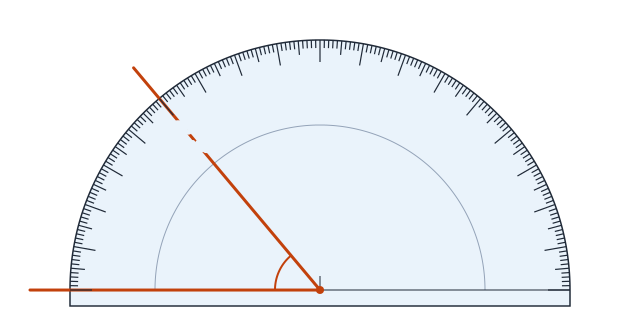
A protractor is placed on an angle. Its centre is on the vertex of the angle, and one arm of the angle lies along the base line, pointing to the left. The other arm points up and to the left and crosses the protractor's scales. The protractor has an outer scale with black numbers (0 on the left to 180 on the right) and an inner scale with blue numbers (0 on the right to 180 on the left), with a mark at every degree. A small arc marks the angle between the arms.

Model answer

The angle is 50°.
Zara used the wrong scale. The arm along the base line points left, where the outer scale reads 0, so she should read the outer scale (50). She read the inner scale, which reads 180 on that arm.

Explanation

Always start counting from the 0 that lies on one arm of the angle. Here the arm on the base line points left, and the outer scale has its 0 there, so the angle is 50°. A quick estimate also catches the mistake: the angle is clearly smaller than a right angle, so 130° cannot be right.

Mark scheme
  1. 1 mark

    50°

    Accept 50.

  2. 1 mark

    Explains that Zara read the wrong scale: the arm on the base line is at 0 on the outer scale, so she should have used the outer scale (she used the inner scale, which starts at 180 on that arm)

    Also accept 'the angle is acute (smaller than a right angle), so it cannot be 130°, which is obtuse'. 'She read it wrong' alone scores 0.

Question 3

2 marks

Leo is facing west. He turns clockwise until he is facing south.

Through how many degrees has he turned? What type of angle is this?

Model answer

West to north: 90°
North to east: 90°
East to south: 90°
Total: 270°, a reflex angle.

Explanation

Clockwise from west you pass north, then east, and then reach south: three quarter turns, so \(3 \times 90 = 270°\). This is more than 180° but less than 360°, so it is a reflex angle. A common mistake is to turn anticlockwise, which only takes 90° from west to south.

Mark scheme
  1. 1 mark

    270°

    Accept 270. Do not accept 90 (that is the anticlockwise turn).

  2. 1 mark

    Reflex

    Follow through: the correct type for their angle (e.g. 90° gives right angle) scores this mark.

Question 4

4 marks

Work out how many degrees the hour hand of a clock turns through between 2 pm and 5:30 pm.

Then work out how many degrees the minute hand turns through in the same time.

Model answer

From 2 pm to 5:30 pm is 3.5 hours.
Hour hand: 360° in 12 hours, so 30° each hour.
\(3.5 \times 30 = 105°\)
Minute hand: 360° each hour.
\(3.5 \times 360 = 1080 + 180 = 1260°\)

Explanation

First find the time: 3 and a half hours. The hour hand goes once round in 12 hours, so it turns 30° an hour, and \(3.5 \times 30 = 105°\). The minute hand goes once round every hour, so it turns \(3.5 \times 360 = 1260°\), which is three and a half full turns. A common mistake is to forget the extra half hour.

Mark scheme
  1. 1 mark

    The hour hand turns 30° each hour (\(360 \div 12\)); or the correct answers 105° and 1260° with no working

    Also award for 3.5 hours (or \(3\dfrac{1}{2}\) hours) seen with any rate.

  2. 1 mark

    Hour hand: 105° (\(3.5 \times 30\))

    Do not accept 90 (only 3 hours) or 3.5.

  3. 1 mark

    The minute hand turns 360° each hour

    Seen or used.

  4. 1 mark

    Minute hand: 1260° (\(3.5 \times 360\))

    Accept 1,260. Do not accept 180 (only the half hour) or 1080 (only 3 hours). A correct answer with no working scores full marks.

Ready to try the rest? Tap or type your answers and see straight away how you did.

Topic notes

Measuring and drawing angles

The big idea

An angle is an amount of turn. It is measured in degrees, written °. A full turn is 360°. You measure and draw angles with a protractor, but a good estimate first stops most mistakes.

Types of angle

TypeSize
Acuteless than 90°
Right angleexactly 90° (a quarter turn)
Obtusemore than 90° but less than 180°
Straight angleexactly 180° (a half turn, a straight line)
Reflexmore than 180° but less than 360°

Estimating

Compare the angle with ones you know: a right angle (90°), half a right angle (45°) and a straight line (180°). An angle a little wider than half a right angle is about 50° or 60°. An angle a little wider than a right angle is about 100° or 110°.

Reading a protractor

A protractor has two scales that run in opposite directions, an inner scale and an outer scale.

  1. Put the centre of the protractor exactly on the vertex (the corner of the angle).
  2. Line up the base line (the 0 to 180 line) with one arm of the angle.
  3. Find the scale that reads 0 on that arm.
  4. Count round on that scale to the other arm, and read the number.
Geometry diagram, drawn accurately to scale. A semicircle on the straight line joining its ends as diameter, drawn above it (centre O). BO is extended beyond O. Line segments OA and OB are drawn. The text "0" is written near B. The text "180" is written near B. The text "40" is written near A. The text "140" is written near A. Angle BOA is marked 40°.
A protractor (the semicircle) measuring angle AOB, with its centre on O. On arm OB the inner scale reads 0 and the outer scale reads 180, so use the inner scale: it reads 40 on arm OA, and angle AOB = 40°. The outer scale reads 140 on OA, which is wrong: the angle is clearly acute.

If neither arm is on 0, read where each arm crosses the same scale and subtract the smaller number from the bigger one.

Measuring a reflex angle

A protractor only goes up to 180°. To measure a reflex angle, measure the smaller angle on the other side, then subtract it from 360°, because the two angles together make a full turn.

Measure the reflex angle in a cheese

A round cheese has one slice cut out. Ali wants the reflex angle at the centre of the cheese that is left. He measures the gap where the slice was: it is 50°.

The gap and the cheese that is left make a full turn: 360°.

Reflex angle: \(360 - 50 = 310^\circ\)

Check: 310° is between 180° and 360°, so it is reflex.

Drawing an angle

  1. Use a ruler to draw a straight line. Mark the vertex at one end.
  2. Put the centre of the protractor on the vertex, with the base line along your line.
  3. Start at the 0 on your line and count round to the angle you need. Make a small mark.
  4. Take the protractor away and use a ruler to join the vertex to the mark.

To draw a reflex angle such as 230°, draw \(360 - 230 = 130^\circ\) in the usual way. The angle on the outside is 230°.

Turns and compass directions

A quarter turn is 90°, a half turn is 180°, a three-quarter turn is 270° and a full turn is 360°. Clockwise is the way the hands of a clock move; anticlockwise is the other way.

Geometry diagram, drawn accurately to scale. A line is drawn from N part of the way towards S. A line is drawn from NE part of the way towards SW. A line is drawn from E part of the way towards W. A line is drawn from SE part of the way towards NW. A line is drawn from S part of the way towards N. A line is drawn from SW part of the way towards NE. A line is drawn from W part of the way towards E. A line is drawn from NW part of the way towards SE. The angle at an unlabelled point between the lines to N and NE is marked 45°. The angle at an unlabelled point between the lines to E and S is marked as a right angle (90°).
The eight compass points are 45° apart. Turning 90° clockwise from east takes you to south.

Where does the weathervane point?

A weathervane points south-west. The wind turns it 135° clockwise. Which direction does it point now?

Each step between compass points is 45°, so 135° is \(135 \div 45 = 3\) steps.

Clockwise from south-west: west (1), north-west (2), north (3).

It now points north.

Common mistakes

  • Reading the wrong scale. This gives 180° minus the right answer, such as 140° instead of 40°.
  • Putting the centre of the protractor somewhere other than the vertex.
  • Subtracting from 180° instead of 360° when finding a reflex angle.
  • Counting the compass points you pass instead of the 45° gaps between them.

Top tip

Before you read a protractor, decide whether the angle is acute or obtuse. If it is clearly acute, your answer must be less than 90°, so you can spot a wrong-scale reading straight away.

Study Helper Hints first, answers after you try

Stuck on this one? Ask for a hint and I’ll point you in the right direction, without giving the answer away. Once you’ve checked your answer, I’ll show you how the marks are awarded.