Level:
Correct: 0
Incorrect: 0
Marks: 0/0
Practice
Course:
Topics:
Year 7 Maths Smart practice A mixed round aimed at your weak spots
Unit 1
Place value and the number system
Unit 2
Calculating
Unit 3
Factors, multiples and powers
Unit 4
Fractions
Unit 5
Fractions, decimals and percentages
Unit 6
Algebraic expressions
Unit 7
Equations and inequalities
Unit 8
Sequences and graphs
Unit 9
Ratio and proportion
Ratio, proportion and rates of change
Writing and simplifying ratios
Quick practice5 skills
Sharing in a ratio
Quick practice5 skills
Proportion and best buys
Quick practice5 skills
Scale drawings and maps
Quick practice4 skills
Unit 10
Measures, perimeter, area and volume
Unit 11
Angles and shapes
Unit 12
Probability
Unit 13
Statistics
Avg
score:
–
Topics
done:
0/63

Reflection, rotation and translation

Practise 27 questions on Reflection, rotation and translation for Year 7 Maths. Tap or type your answer and find out straight away if you are right, with the Study Helper on hand if you get stuck.

  • 27 questions
  • 1–5 marks each
  • Instant marking
  • No sign-up needed
20 questions, marked as you go

Sample questions with model answers

Here are 4 of the questions in this topic, each with a model answer, an explanation of why it earns the marks and the mark scheme.

Question 1

1 mark

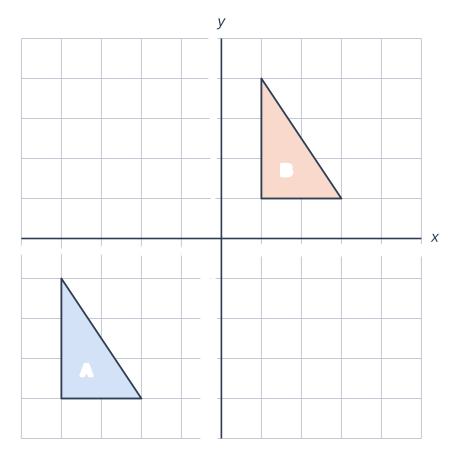
The diagram shows shape A and shape B.

Which type of transformation maps shape A onto shape B?

A coordinate grid with x from −5 to 5 and y from −5 to 5; each grid square is 1 unit across, and the axes cross at the origin O. Shape A is a shaded triangle with vertices (−4, −4), (−2, −4) and (−4, −1). Shape B is a shaded triangle with vertices (1, 1), (3, 1) and (1, 4).

Model answer

Translation

Explanation

Shape B faces the same way and is the same way up as shape A: it has just slid to a new position. A slide is a translation. A reflection would flip the shape over and a rotation would turn it, so the image would face a different way.

Mark scheme
  1. 1 mark

    Translation

    Any other answer scores 0.

Question 2

2 marks

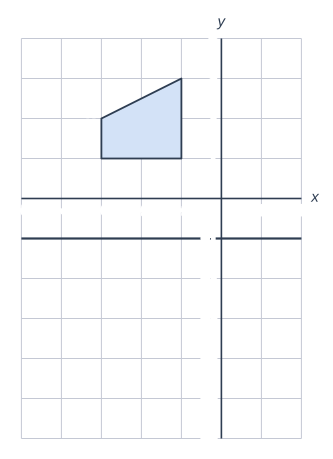
The diagram shows shape KLMN and the line \(y = -1\).

Shape KLMN is reflected in the line \(y = -1\).
What are the coordinates of the images of K, L, M and N?

A coordinate grid with x from −5 to 2 and y from −6 to 4; each grid square is 1 unit across, and the axes cross at the origin O. Quadrilateral KLMN (shaded) is drawn with vertices K(−3, 1), L(−1, 1), M(−1, 3) and N(−3, 2). The line labelled "y = −1" is a horizontal straight line crossing the y-axis at (0, −1).

Model answer

K \((-3, 1)\) is 2 above the line, so its image is 2 below: \((-3, -3)\)
L \((-1, 1)\) is 2 above, so its image is \((-1, -3)\)
M \((-1, 3)\) is 4 above, so its image is \((-1, -5)\)
N \((-3, 2)\) is 3 above, so its image is \((-3, -4)\)

Explanation

The line \(y = -1\) is horizontal, so each x-coordinate stays the same. For each corner, count the squares down to the mirror line and then the same number below it. A common mistake is to count from the x-axis instead of from the line \(y = -1\).

Mark scheme
  1. 1 mark

    At least two of the four images correct: K \((-3, -3)\), L \((-1, -3)\), M \((-1, -5)\), N \((-3, -4)\)

  2. 1 mark

    All four correct: \((-3, -3)\), \((-1, -3)\), \((-1, -5)\) and \((-3, -4)\)

    Coordinates must be written (x, y). (-3, -1), (-1, -1), (-1, -3), (-3, -2) (reflected in the x-axis) scores 0.

Question 3

3 marks

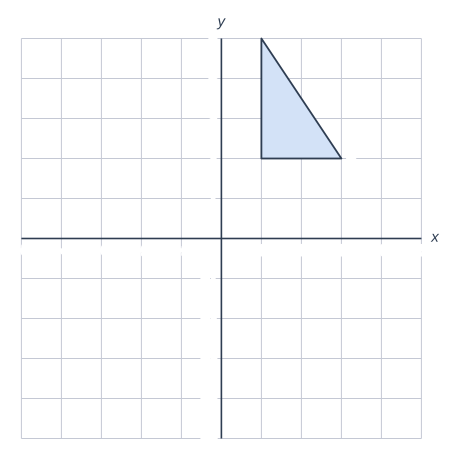
The diagram shows triangle ABC.

Triangle ABC is rotated through \(90^\circ\) clockwise about the origin.
What are the coordinates of the images of A, B and C?

A coordinate grid with x from −5 to 5 and y from −5 to 5; each grid square is 1 unit across, and the axes cross at the origin O. Triangle ABC (shaded) is drawn with vertices A(1, 2), B(3, 2) and C(1, 5).

Model answer

A \((1, 2) \to (2, -1)\)
B \((3, 2) \to (2, -3)\)
C \((1, 5) \to (5, -1)\)

Explanation

Imagine tracing the triangle and the axes, then turning the tracing a quarter turn clockwise about O: the part that was above the x-axis swings round to the right and down. For a quarter turn clockwise about the origin, the point \((x, y)\) goes to \((y, -x)\), so \((1, 2)\) goes to \((2, -1)\). A common mistake is to turn anticlockwise instead.

Mark scheme
  1. 1 mark

    One image correct: A \((2, -1)\), B \((2, -3)\) or C \((5, -1)\)

    Or all three images given as a rotation of \(90^\circ\) anticlockwise: \((-2, 1)\), \((-2, 3)\), \((-5, 1)\).

  2. 1 mark

    Two images correct

  3. 1 mark

    All three correct: \((2, -1)\), \((2, -3)\) and \((5, -1)\)

    Coordinates must be written (x, y).

Question 4

4 marks

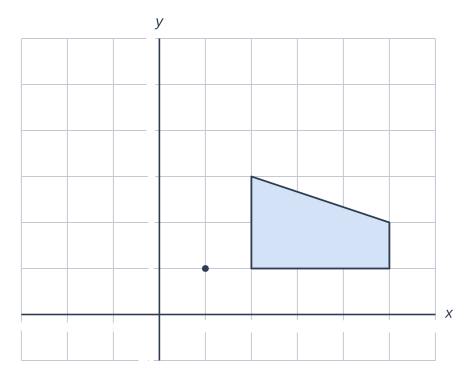
The diagram shows shape PQRS and the point C.

Shape PQRS is rotated through \(90^\circ\) anticlockwise about the point C.
What are the coordinates of the images of P, Q, R and S?

A coordinate grid with x from −3 to 6 and y from −1 to 6; each grid square is 1 unit across, and the axes cross at the origin O. Quadrilateral PQRS (shaded) is drawn with vertices P(2, 1), Q(5, 1), R(5, 2) and S(2, 3). Point C is marked with a dot at (1, 1).

Model answer

C is \((1, 1)\). Turn each corner a quarter turn anticlockwise about C:
P \((2, 1)\) is 1 right of C, so its image is 1 above C: \((1, 2)\)
Q \((5, 1)\) is 4 right of C, so its image is 4 above C: \((1, 5)\)
R \((5, 2)\) is 4 right and 1 up, so its image is 4 up and 1 left: \((0, 5)\)
S \((2, 3)\) is 1 right and 2 up, so its image is 1 up and 2 left: \((-1, 2)\)

Explanation

Work from the centre C. For a quarter turn anticlockwise, a move to the right of C becomes a move up, and a move up becomes a move to the left. Do this for each corner in turn and check that the image is the same shape and size. A common mistake is to rotate about the origin instead of about C.

Mark scheme
  1. 1 mark

    Image of P: \((1, 2)\)

  2. 1 mark

    Image of Q: \((1, 5)\)

  3. 1 mark

    Image of R: \((0, 5)\)

  4. 1 mark

    Image of S: \((-1, 2)\)

    Coordinates must be written (x, y). If every image is given for a clockwise rotation about C instead, i.e. (1, 0), (1, -3), (2, -3), (3, 0), award 1 mark in total.

Ready to try the rest? Tap or type your answers and see straight away how you did.

Topic notes

Reflection, rotation and translation

The big idea

A transformation moves a shape to a new position. The starting shape is the object and the shape after the move is the image. Reflections, rotations and translations never change the size or shape, so the image is always congruent to the object: every length, angle and area stays the same. Only the position, and sometimes the way the shape faces, changes.

Reflection

A reflection flips a shape over a mirror line. Each corner of the image is the same distance from the mirror line as the matching corner of the object, but on the other side, measured straight across at right angles to the line.

On a coordinate grid:

  • Reflecting in the y-axis keeps each y-coordinate and changes the sign of each x-coordinate: (5, 3) goes to (−5, 3).
  • Reflecting in the x-axis keeps each x-coordinate and changes the sign of each y-coordinate: (5, 3) goes to (5, −3).
  • A line such as \(x = -1\) is vertical (every point on it has x-coordinate −1). A line such as \(y = 2\) is horizontal.
A coordinate grid with x from −6 to 4 and y from −1 to 5; each grid square is 1 unit across, and the axes cross at the origin O. Shape A is a shaded quadrilateral PQRS with vertices P(0, 1), Q(3, 1), R(3, 2) and S(1, 4). (Quadrilateral; area 5.5 square units.) Shape B is a shaded quadrilateral P′Q′R′S′ with vertices P′(−2, 1), Q′(−5, 1), R′(−5, 2) and S′(−3, 4). (Quadrilateral; area 5.5 square units.) The line labelled "x = −1" is a vertical straight line crossing the x-axis at (−1, 0). (Shape B is the image of shape A under a reflection in the line x = −1.)
Shape A reflected in the line x = −1 gives shape B. Each corner of B is the same distance from the mirror line as the matching corner of A.

Complete a symmetrical logo

Ella is designing a logo with the line \(x = -1\) as its line of symmetry. She has drawn the right-hand half, shape A. Where are the corners of the left-hand half?

Reflect A in \(x = -1\), one corner at a time. The line is vertical, so count squares across to it, then the same number beyond it. The y-coordinates stay the same.

  • P(0, 1) is 1 square right of the line, so P′ is 1 square left of it: (−2, 1).
  • Q(3, 1) is 4 squares right, so Q′ is (−5, 1).
  • R(3, 2) is 4 squares right, so R′ is (−5, 2).
  • S(1, 4) is 2 squares right, so S′ is (−3, 4).

Rotation

A rotation turns a shape about a fixed point called the centre of rotation. To rotate a shape you need three things: the angle (such as 90° or 180°), the direction (clockwise or anticlockwise) and the centre. A turn of 180° is the same either way, so it needs no direction.

A rotation of 180° about the origin changes the sign of both coordinates: (5, 3) goes to (−5, −3).

A coordinate grid with x from −1 to 5 and y from −1 to 6; each grid square is 1 unit across, and the axes cross at the origin O. Shape A is a shaded triangle DEF with vertices D(2, 5), E(4, 5) and F(2, 6). (Right-angled scalene triangle; area 1 square unit.) Shape B is a shaded triangle D′E′F′ with vertices D′(2, 3), E′(2, 1) and F′(3, 3). (Right-angled scalene triangle; area 1 square unit.) Point C is marked with a dot at (1, 4). (Shape B is the image of shape A under a rotation of 90° clockwise about (1, 4).)
Triangle A rotated 90° clockwise about C(1, 4) gives triangle B.

Turn a puzzle piece

In a puzzle game, the triangle piece A is turned 90° clockwise about the point C(1, 4). Where do its corners end up?

Work out how to get from C to each corner. A quarter turn clockwise turns a move right into a move down, and a move up into a move right.

  • D(2, 5) is 1 right and 1 up from C. After the turn: 1 down and 1 right, so D′ is (2, 3).
  • E(4, 5) is 3 right and 1 up. After the turn: 3 down and 1 right, so E′ is (2, 1).
  • F(2, 6) is 1 right and 2 up. After the turn: 1 down and 2 right, so F′ is (3, 3).

Check: DE and D′E′ are both 2 squares long.

Translation

A translation slides a shape without turning or flipping it. Every point moves the same distance in the same direction, so the image faces the same way as the object. Describe it in words, such as "4 squares right and 5 squares down".

Describe the move in a computer game

A game character moves from (−3, 2) to (1, −3). Describe the translation.

Across: from −3 to 1 is 4 squares right.

Up or down: from 2 to −3 is 5 squares down.

The translation is 4 squares right and 5 squares down.

Describing a single transformation

TransformationWhat you must give
Reflectionthe mirror line, such as "in the line \(x = 2\)"
Rotationthe angle, the direction (not needed for 180°) and the centre
Translationthe move across and the move up or down

Stretch: column vectors

A column vector describes a translation with two numbers, one above the other. The top number is the move across (right is positive, left is negative). The bottom number is the move up or down (up is positive, down is negative). The game character's move is \(\begin{pmatrix} 4 \\ -5 \end{pmatrix}\).

Common mistakes

  • Mixing up the lines \(x = 2\) (vertical) and \(y = 2\) (horizontal).
  • Reflecting in an axis, or rotating about the origin, when the question gives a different line or centre.
  • Swapping the two numbers in a column vector, or leaving out the minus sign for a move left or down.
  • Describing two transformations when the question asks for a single one.

Top tip

Use tracing paper for rotations. Trace the shape and mark the centre, hold the centre still with your pencil point, then turn the paper a quarter or half turn and see where the shape lands.

Study Helper Hints first, answers after you try

Stuck on this one? Ask for a hint and I’ll point you in the right direction, without giving the answer away. Once you’ve checked your answer, I’ll show you how the marks are awarded.