Practise 29 questions on Metric units and converting for Year 7 Maths. Tap or type your answer and find out straight away if you are right, with the Study Helper on hand if you get stuck.
29 questions
1–5 marks each
Instant marking
No sign-up needed
20 questions, marked as you go
Sample questions with model answers
Here are 4 of the questions in this topic, each with a model answer, an explanation of why it earns the marks and the mark scheme.
Question 1
1 mark
Change 2.5 litres into millilitres.
Model answer
\(2.5 \times 1000 = 2500\) ml
Explanation
There are 1000 millilitres in 1 litre, so multiply the number of litres by 1000. Multiplying by 1000 moves each digit three places to the left: 2.5 becomes 2500. A common mistake is to multiply by 100, which gives 250 ml.
Mark scheme
1 mark
2500 (ml)
Accept 2,500. Do not accept 250 or 25.
Question 2
2 marks
A bottle holds 75 cl of water. Raj pours out 300 ml.
How many millilitres of water are left in the bottle?
Model answer
75 cl = \(75 \times 10 = 750\) ml \(750 - 300 = 450\) ml
Explanation
First put both amounts in the same unit. There are 10 millilitres in 1 centilitre, so 75 cl is 750 ml. Then subtract: 750 − 300 = 450 ml. A common mistake is to subtract before changing the units.
Mark scheme
1 mark
75 cl = 750 ml; or the correct answer 450 ml with no working
1 cl = 10 ml.
1 mark
450 (ml)
Accept 45 cl or 0.45 litres if the unit is written. Do not accept 7200 (1 cl taken as 100 ml). A correct answer with no working scores full marks.
Question 3
2 marks
Ruby cycles 12 km. Sam cycles 8 miles.
1 mile is about 1.6 km.
How far does Sam cycle in kilometres? Who cycles further?
Model answer
\(8 \times 1.6 = 12.8\) km 12.8 km is more than 12 km, so Sam cycles further.
Explanation
To compare the distances, put them in the same unit. Change Sam's 8 miles into kilometres by multiplying by 1.6: 8 × 1.6 = 12.8 km. That is more than Ruby's 12 km, so Sam cycles further. A common mistake is to say Ruby, because 12 is bigger than 8, without changing the units.
Mark scheme
1 mark
8 miles changed to kilometres: \(8 \times 1.6 = 12.8\) km; or 12 km changed to miles: \(12 \div 1.6 = 7.5\) miles
Accept a correct build-up, e.g. 1 mile is 1.6 km, 2 miles 3.2 km, 4 miles 6.4 km, 8 miles 12.8 km.
1 mark
Sam, with a correct comparison: 12.8 km is more than 12 km, or 8 miles is more than 7.5 miles
'Sam' with no working scores 0, because the question asks students to show how they decide.
Question 4
4 marks
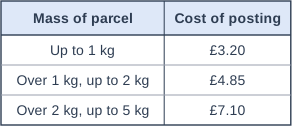
Sophie posts a parcel. It holds a book with a mass of 450 g and 3 mugs. Each mug has a mass of 320 g. The empty box has a mass of 0.25 kg.
The table shows the cost of posting a parcel.
Sophie pays with a £10 note. How much change should she get?
Model answer
\(3 \times 320 = 960\) g 0.25 kg = 250 g \(450 + 960 + 250 = 1660\) g = 1.66 kg 1.66 kg is over 1 kg and up to 2 kg, so the cost is £4.85. £10 − £4.85 = £5.15
Explanation
First find the total mass, with every mass in grams: 450 + 960 + 250 = 1660 g, which is 1.66 kg. This is between 1 kg and 2 kg, so the postage is £4.85. Then the change from £10 is £5.15. A common mistake is to add 0.25 to the grams without changing it into 250 g.
Mark scheme
1 mark
\(3 \times 320 = 960\) g; or the correct answer £5.15 with no working
1 mark
Total mass 1660 g or 1.66 kg (with 0.25 kg = 250 g)
ft their 960.
1 mark
Chooses £4.85 (over 1 kg, up to 2 kg)
ft the correct row of the table for their total mass.
1 mark
£5.15
ft £10 minus their cost from the table. Accept 515p. A correct answer with no working scores full marks.
Ready to try the rest? Tap or type your answers and see straight away how you did.
Ctrl + Enter to check
Study HelperHints first, answers after you try
Stuck on this one? Ask for a hint and I’ll point you in the right direction, without giving the answer away. Once you’ve checked your answer, I’ll show you how the marks are awarded.