Level:
Correct: 0
Incorrect: 0
Marks: 0/0
Practice
Course:
Topics:
Year 7 Maths Smart practice A mixed round aimed at your weak spots
Unit 1
Place value and the number system
Unit 2
Calculating
Unit 3
Factors, multiples and powers
Unit 4
Fractions
Unit 5
Fractions, decimals and percentages
Unit 6
Algebraic expressions
Unit 7
Equations and inequalities
Unit 8
Sequences and graphs
Unit 9
Ratio and proportion
Ratio, proportion and rates of change
Writing and simplifying ratios
Quick practice5 skills
Sharing in a ratio
Quick practice5 skills
Proportion and best buys
Quick practice5 skills
Scale drawings and maps
Quick practice4 skills
Unit 10
Measures, perimeter, area and volume
Unit 11
Angles and shapes
Unit 12
Probability
Unit 13
Statistics
Avg
score:
–
Topics
done:
0/63

Geometric notation and properties of 2D shapes

Practise 28 questions on Geometric notation and properties of 2D shapes for Year 7 Maths. Tap or type your answer and find out straight away if you are right, with the Study Helper on hand if you get stuck.

  • 28 questions
  • 1–5 marks each
  • Instant marking
  • No sign-up needed
20 questions, marked as you go

Sample questions with model answers

Here are 4 of the questions in this topic, each with a model answer, an explanation of why it earns the marks and the mark scheme.

Question 1

1 mark

What is the name for the distance all the way round the edge of a circle?

Model answer

Circumference

Explanation

The circumference is the perimeter of a circle: the distance all the way round. The radius and diameter are distances across the circle, and area is the space inside. A common mistake is to mix up diameter and circumference.

Mark scheme
  1. 1 mark

    Circumference

    Accept a clear misspelling. Do not accept perimeter on its own (circumference is the special name for a circle).

Question 2

2 marks

Here are the lengths of the sides of two triangles.

Triangle P: 6 cm, 6 cm and 6 cm
Triangle Q: 5 cm, 7 cm and 9 cm

Use the lengths of the sides to decide the type of each triangle.

Model answer

P: all three sides are equal, so it is equilateral.
Q: all three sides are different lengths, so it is scalene.

Explanation

You can name a triangle by its sides. Equilateral means all three sides are equal, isosceles means two sides are equal, and scalene means all three sides are different. P has three equal sides and Q has three different sides. A common mistake is to mix up isosceles and scalene: remember that scalene means no sides are the same.

Mark scheme
  1. 1 mark

    P: equilateral

    Do not accept isosceles (all three sides are equal, not just two).

  2. 1 mark

    Q: scalene

    Do not accept isosceles. Ignore an extra correct word such as 'obtuse', but acute, obtuse or right-angled on their own score 0 (the question asks about the sides). If two types are given without letters, take them in the order P, Q.

Question 3

2 marks

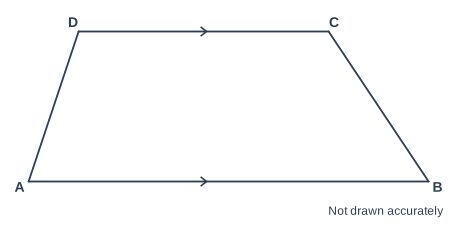
The diagram shows quadrilateral ABCD. The arrows show which sides are parallel.

Which two sides are parallel? What is the special name of quadrilateral ABCD?

Geometry diagram, marked "Not drawn accurately". Quadrilateral ABCD. AB and DC are each marked with an arrowhead (parallel lines).

Model answer

AB is parallel to DC.
ABCD is a trapezium.

Explanation

Matching arrows on two sides show that those sides are parallel. Here only AB and DC have arrows, so there is exactly one pair of parallel sides, which makes ABCD a trapezium. A common mistake is to call it a parallelogram, but that needs two pairs of parallel sides.

Mark scheme
  1. 1 mark

    AB and DC

    Accept BA, CD in any order or form, e.g. 'AB is parallel to DC'.

  2. 1 mark

    Trapezium

    Do not accept parallelogram, kite or rhombus. Accept 'trapezoid'.

Question 4

4 marks

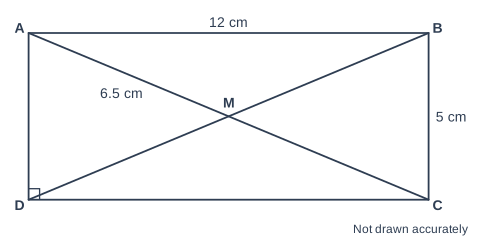
ABCD is a rectangle. Its diagonals AC and BD cross at M.

AB = 12 cm, BC = 5 cm and AM = 6.5 cm.

Work out the perimeter of triangle ABM.

Geometry diagram, marked "Not drawn accurately". Rectangle ABCD. Line segments AC and BD are drawn. M lies on AC and BD. Side AB is labelled 12 cm. Side BC is labelled 5 cm. AM is labelled 6.5 cm. Angle CDA is marked as a right angle (90°).

Model answer

AC = 2 × 6.5 = 13 cm
The diagonals of a rectangle are equal, so BD = 13 cm.
They cut each other in half, so BM = 13 ÷ 2 = 6.5 cm.
Perimeter of ABM = 6.5 + 6.5 + 12 = 25 cm

Explanation

Use two properties of a rectangle's diagonals: they are the same length, and they cut each other in half. So M is halfway along both diagonals, which makes BM the same as AM, 6.5 cm. Then add the three sides of triangle ABM: 6.5 + 6.5 + 12 = 25 cm. BC = 5 cm is not needed: a common mistake is to use it as a side of the triangle.

Mark scheme
  1. 1 mark

    AC = 13 cm (\(2 \times 6.5\)) or BD = 13 cm; or the correct answer 25 cm with no working

    Award for 13 seen as the length of a diagonal.

  2. 1 mark

    BM = 6.5 cm, because the diagonals of a rectangle are equal and cut each other in half

    BM = 6.5 seen or used is enough for this mark.

  3. 1 mark

    6.5 + 6.5 + 12

    Follow through from their BM.

  4. 1 mark

    25 (cm)

    Units not needed. Do not accept 23.5 (using BC instead of AB) or 30.5. A correct answer with no working scores full marks.

Ready to try the rest? Tap or type your answers and see straight away how you did.

Topic notes

Geometric notation and properties of 2D shapes

The big idea

Mathematicians use letters and small marks on diagrams so that everyone reads them the same way. Once you can read them, you can sort 2D (flat) shapes by their properties: their sides, angles, diagonals and symmetry.

Points, lines and angles

  • A point is labelled with a capital letter, such as A.
  • A line goes on for ever in both directions. A line segment is the part between two points: segment AB has a length.
  • An angle is named with three letters. Angle ABC (or ∠ABC) is the angle at B, between BA and BC. The middle letter is always the corner. In triangle ABC, the side opposite angle A is BC.
  • Parallel lines never meet; they stay the same distance apart. Matching arrows show them.
  • Perpendicular lines meet at a right angle (90°), shown by a small square.
  • Matching dashes show sides of equal length.
Geometry diagram, drawn accurately to scale. Trapezium ABCD. Angle DAB is marked as a right angle (90°). Angle ADC is marked as a right angle (90°). Angle ABC is marked 45°. AD and DC are each marked with one short dash (equal lengths). AB and DC are each marked with an arrowhead (parallel lines).
Shape ABCD: the arrows show AB is parallel to DC, the squares show right angles at A and D, the dashes show AD = DC, and angle ABC = 45°.

Triangles

TriangleSidesAnglesLines of symmetry
Equilateral3 equal sides3 equal angles3
Isosceles2 equal sides2 equal angles1
Scaleneno equal sidesno equal angles0
Right-angledcan be isosceles or scaleneone angle is 90°1 or 0

Quadrilaterals

A quadrilateral has 4 straight sides. A diagonal joins two opposite corners.

ShapeSidesAnglesDiagonalsLines of symmetryRotational symmetry
Square4 equal; opposite sides parallelall 90°equal, cross at right angles4order 4
Rectangleopposite sides equal and parallelall 90°equal2order 2
Rhombus4 equal; opposite sides parallelopposite angles equalcross at right angles2order 2
Parallelogramopposite sides equal and parallelopposite angles equalcut each other in half0order 2
Trapeziumone pair of parallel sides––usually 0order 1
Kitetwo pairs of equal sides next to each otherone pair of equal anglescross at right angles1order 1

A square is a special rectangle and also a special rhombus.

Polygons and symmetry

A polygon is a flat shape with straight sides. A pentagon has 5 sides, a hexagon 6, a heptagon 7, an octagon 8, a nonagon 9 and a decagon 10. A regular polygon has all its sides equal and all its angles equal.

  • A line of symmetry splits a shape into two halves that match exactly when folded.
  • The order of rotational symmetry is how many times a shape fits onto itself in one full turn. Order 1 means it has no rotational symmetry.
  • A regular polygon with \(n\) sides has \(n\) lines of symmetry and rotational symmetry of order \(n\).

Find the symmetry of the letters H, N and A

H: it folds onto itself along a line going down the middle and along a line going across the middle, so 2 lines of symmetry. Upside down it still looks like H, so it has rotational symmetry of order 2.

N: no fold works, so 0 lines of symmetry. A half turn gives N again, so it has order 2.

A: 1 line of symmetry, down the middle. Only a full turn brings it back, so it has order 1.

Join two triangles to make a quadrilateral

Two identical isosceles triangles have sides 5 cm, 5 cm and 8 cm. They are joined along their 8 cm sides, one pointing up and one pointing down. Name the new shape and work out its perimeter.

The 8 cm sides are now inside the shape. The outside is made of the four 5 cm sides, so all 4 sides are equal. Four equal sides make a rhombus (it has no right angles, so it is not a square).

Perimeter: \(4 \times 5 = 20\) cm.

Parts of a circle

Geometry diagram, drawn accurately to scale. A circle with centre O. A sloping line with no labelled ends is drawn. A line is drawn from O going upwards. O lies on an unlabelled line going to the right. An unlabelled line going to the right is labelled diameter. The line going upwards from O is labelled radius. The arc from an unlabelled point to an unlabelled point is labelled circumference.
O is the centre. The diameter is twice as long as the radius.
  • The radius goes from the centre to the edge.
  • The diameter goes all the way across, through the centre. Diameter = 2 × radius.
  • The circumference is the distance all the way round the circle: its perimeter.

Common mistakes

  • Naming an angle with the corner letter first or last: in angle ABC the corner is B.
  • Thinking equal sides make a shape regular: its angles must be equal too, so a rhombus is not regular.
  • Saying a parallelogram has 2 lines of symmetry: folding along a diagonal does not make the halves match.
  • Mixing up isosceles (2 equal sides) and scalene (no equal sides).
  • Halving the radius to get the diameter instead of doubling it.

Top tip

To check a line of symmetry, imagine folding along it. To find the order of rotational symmetry, imagine tracing the shape and counting how many times the tracing fits as you turn it once round.

Study Helper Hints first, answers after you try

Stuck on this one? Ask for a hint and I’ll point you in the right direction, without giving the answer away. Once you’ve checked your answer, I’ll show you how the marks are awarded.