Level:
Correct: 0
Incorrect: 0
Marks: 0/0
Practice
Course:
Topics:
Year 7 Maths Smart practice A mixed round aimed at your weak spots
Unit 1
Place value and the number system
Unit 2
Calculating
Unit 3
Factors, multiples and powers
Unit 4
Fractions
Unit 5
Fractions, decimals and percentages
Unit 6
Algebraic expressions
Unit 7
Equations and inequalities
Unit 8
Sequences and graphs
Unit 9
Ratio and proportion
Ratio, proportion and rates of change
Writing and simplifying ratios
Quick practice5 skills
Sharing in a ratio
Quick practice5 skills
Proportion and best buys
Quick practice5 skills
Scale drawings and maps
Quick practice4 skills
Unit 10
Measures, perimeter, area and volume
Unit 11
Angles and shapes
Unit 12
Probability
Unit 13
Statistics
Avg
score:
–
Topics
done:
0/63

Coordinates in four quadrants

Practise 24 questions on Coordinates in four quadrants for Year 7 Maths. Tap or type your answer and find out straight away if you are right, with the Study Helper on hand if you get stuck.

  • 24 questions
  • 1–5 marks each
  • Instant marking
  • No sign-up needed
20 questions, marked as you go

Sample questions with model answers

Here are 4 of the questions in this topic, each with a model answer, an explanation of why it earns the marks and the mark scheme.

Question 1

1 mark

What are the coordinates of the origin?

Model answer

The origin is where the axes cross.
It is \((0, 0)\).

Explanation

The origin is the point where the x-axis and the y-axis cross. It is 0 across and 0 up, so its coordinates are \((0, 0)\). It is often marked with the letter O on a grid. All other points are measured from here.

Mark scheme
  1. 1 mark

    \((0, 0)\)

    Accept 0, 0 without brackets. Do not accept O or 0 on its own.

Question 2

2 marks

P is the point \((4, -5)\) and Q is the point \((4, 3)\).

Work out the coordinates of the midpoint of the line segment PQ.

Model answer

PQ is vertical, so the midpoint has x-coordinate 4.
From \(-5\) up to 3 is 8 units. Half of 8 is 4.
\(-5 + 4 = -1\)
The midpoint is \((4, -1)\).

Explanation

P and Q have the same x-coordinate, so PQ is a vertical line and the midpoint is also at x = 4. Going up from \(-5\) to 3 is 8 units, so the midpoint is 4 units up from P: \(-5 + 4 = -1\). A common mistake is to work out \(5 + 3 = 8\), halve it and get 4 or 1, forgetting that \(-5\) is below zero.

Mark scheme
  1. 1 mark

    A correct method for the y-coordinate, e.g. the distance from \(-5\) to 3 is 8 and half of 8 is 4, so \(-5 + 4\) / \((-5 + 3) \div 2\); or the correct answer \((4, -1)\) with no working

    Also award for the x-coordinate 4 given correctly in a coordinate pair.

  2. 1 mark

    \((4, -1)\)

    Do not accept (4, 1), (4, 4) or (-1, 4). A correct answer with no working scores full marks.

Question 3

2 marks

M is the midpoint of the line segment AB.

A is the point \((2, -7)\) and M is the point \((2, -1)\).

Work out the coordinates of B.

Model answer

AB is vertical (both x-coordinates are 2).
From A \((2, -7)\) up to M \((2, -1)\) is 6 units.
B is another 6 units up from M: \(-1 + 6 = 5\).
B is \((2, 5)\).

Explanation

The midpoint is halfway, so the distance from A to M is the same as from M to B. A to M goes up 6 units (from \(-7\) to \(-1\)), so go up another 6 from M to reach B at y = 5. The x-coordinate stays 2 because the line is vertical. A common mistake is to find the point halfway between A and M instead.

Mark scheme
  1. 1 mark

    A correct method, e.g. A to M is 6 units up, so B is 6 units up from M / \(-1 + 6\); or the correct answer \((2, 5)\) with no working

  2. 1 mark

    \((2, 5)\)

    Do not accept (2, -4) (the midpoint of A and M) or (2, 6). A correct answer with no working scores full marks.

Question 4

4 marks

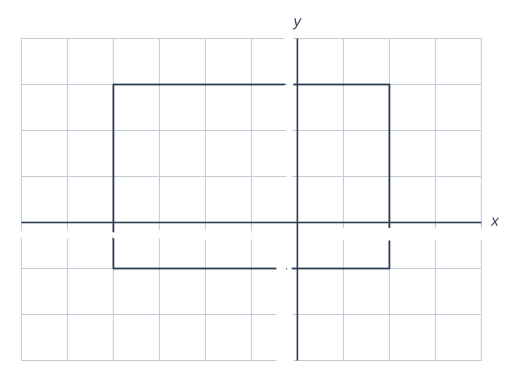
The grid shows a rectangle ABCD.

M is the midpoint of the diagonal AC.

Work out the coordinates of M.

A coordinate grid with x from −6 to 4 and y from −3 to 4; each grid square is 1 unit across, and the axes cross at the origin O. Quadrilateral ABCD (unshaded) is drawn; its vertices can be read from the grid.

Model answer

A is \((-4, 3)\) and C is \((2, -1)\).
x: \((-4 + 2) \div 2 = -2 \div 2 = -1\)
y: \((3 + (-1)) \div 2 = 2 \div 2 = 1\)
M is \((-1, 1)\).

Explanation

First read A and C from the grid. The midpoint of AC is halfway across and halfway up or down between them. From \(-4\) to 2 is 6 units across, so go 3 from A to reach x = \(-1\). From 3 down to \(-1\) is 4 units, so go down 2 from A to reach y = 1. M is also the centre of the rectangle. A common mistake is to give the half-distances, (3, 2), instead of the coordinates of the point.

Mark scheme
  1. 1 mark

    Reads the coordinates of A \((-4, 3)\) and C \((2, -1)\) correctly; or the correct answer \((-1, 1)\) with no working

  2. 1 mark

    A correct method for either coordinate of M, e.g. \((-4 + 2) \div 2\) / \((3 + -1) \div 2\) / halfway across the 6 units from \(-4\) to 2 / halfway down the 4 units from 3 to \(-1\)

    Follow through their coordinates of A and C.

  3. 1 mark

    x-coordinate \(-1\)

  4. 1 mark

    y-coordinate 1

    The answer must be a coordinate pair, (-1, 1). Do not accept (3, 2) (half the distances across and down). A correct answer with no working scores full marks.

Ready to try the rest? Tap or type your answers and see straight away how you did.

Topic notes

Coordinates in four quadrants

The big idea

Coordinates give the exact position of a point on a grid. The grid has two number lines: the x-axis goes across and the y-axis goes up. They cross at the origin, the point \((0, 0)\). Both axes carry on into negative numbers, which splits the grid into four parts called quadrants.

Reading and plotting points

Coordinates are written in brackets, \((x, y)\). The x-coordinate comes first and says how far to go across: right if it is positive, left if it is negative. The y-coordinate comes second and says how far to go up (positive) or down (negative).

A coordinate grid with x from −5 to 5 and y from −5 to 5; each grid square is 1 unit across, and the axes cross at the origin O. Point A is marked with a dot at (4, 1), labelled "A(4, 1)". Point B is marked with a dot at (−2, 3), labelled "B(−2, 3)". Point C is marked with a dot at (−5, −2), labelled "C(−5, −2)". Point D is marked with a dot at (3, −4), labelled "D(3, −4)". Point E is marked with a dot at (0, 2), labelled "E(0, 2)". Point F is marked with a dot at (−3, 0), labelled "F(−3, 0)".
One point in each quadrant, plus E on the y-axis and F on the x-axis. To reach C, go 5 to the left, then 2 down.
  • A point on the x-axis has y-coordinate 0, like F at \((-3, 0)\).
  • A point on the y-axis has x-coordinate 0, like E at \((0, 2)\).

Points on a horizontal or vertical line

All the points on a vertical line (straight up and down) have the same x-coordinate. All the points on a horizontal line (straight across) have the same y-coordinate.

A vertical line passes through \((-3, 4)\). Write down three more points on the line, including the point where it crosses the x-axis.

Every point on the line has x-coordinate \(-3\). Only the y-coordinate changes.

For example: \((-3, 1)\), \((-3, -5)\) and \((-3, 0)\). The point on the x-axis has y-coordinate 0, so it is \((-3, 0)\).

Missing corners of shapes

Sketch the shape on a grid. Opposite sides of a rectangle, square or parallelogram are equal and parallel (they point the same way), so the same move takes you along both of them.

\(A(-3, 2)\) is the top left corner of a rectangle ABCD that is 5 units wide and 4 units tall. Find the other three corners.

B is 5 units to the right of A: \(-3 + 5 = 2\), so B is \((2, 2)\).

C is 4 units below B: \(2 - 4 = -2\), so C is \((2, -2)\).

D is 4 units below A, so D is \((-3, -2)\).

A coordinate grid with x from −5 to 4 and y from −4 to 4; each grid square is 1 unit across, and the axes cross at the origin O. A shaded quadrilateral with vertices (−3, 2), (2, 2), (2, −2) and (−3, −2). (Rectangle; area 20 square units.) Point A is marked with a dot at (−3, 2), labelled "A(−3, 2)". Point B is marked with a dot at (2, 2), labelled "B(2, 2)". Point C is marked with a dot at (2, −2), labelled "C(2, −2)". Point D is marked with a dot at (−3, −2), labelled "D(−3, −2)".
Rectangle ABCD is 5 units wide and 4 units tall.

Midpoints

The midpoint of a line segment (a straight line between two points) is the point exactly halfway along it. On a horizontal line only the x-coordinate changes, so find the number halfway between the two x-coordinates. On a vertical line, do the same with the y-coordinates.

On a map, the bus stop is at \((-5, -1)\) and the school is at \((3, -1)\). A crossing is exactly halfway between them. What are its coordinates?

Both points have y-coordinate \(-1\), so the crossing does too.

From \(-5\) to 3 is 8 units (5 units up to 0, then 3 more). Half of 8 is 4.

\(-5 + 4 = -1\), so the crossing is at \((-1, -1)\).

Stretch: the midpoint of any line segment

Add the two x-coordinates and halve, then add the two y-coordinates and halve. For \((-4, 5)\) and \((2, -1)\): \((-4 + 2) \div 2 = -1\) and \((5 + (-1)) \div 2 = 2\), so the midpoint is \((-1, 2)\).

Remember

  • \((x, y)\): go across first, then up or down.
  • Left of the y-axis, x is negative. Below the x-axis, y is negative.
  • Points with the same x-coordinate are on a vertical line; the same y-coordinate, a horizontal line.

Common mistakes

  • Swapping the coordinates: \((2, -3)\) and \((-3, 2)\) are different points.
  • Losing a minus sign for a point to the left of or below the origin.
  • Mixing up \((0, -5)\), which is on the y-axis, with \((-5, 0)\), which is on the x-axis.
  • Working out the distance from \(-2\) to 5 as 3. Crossing zero, it is \(2 + 5 = 7\).
  • Giving the half-distance as the midpoint: halfway from \(-5\) to 3 is 4 units along, so the midpoint is at \(-1\), not 4.

Top tip

Remember "along the corridor, then up or down the stairs": x first, then y. If a question has no picture, sketch a quick grid and mark the points.

Study Helper Hints first, answers after you try

Stuck on this one? Ask for a hint and I’ll point you in the right direction, without giving the answer away. Once you’ve checked your answer, I’ll show you how the marks are awarded.