The big idea
Two amounts are in direct proportion when they grow at the same rate: buy twice as many and you pay twice as much; buy none and you pay nothing. Proportion helps you scale recipes, change pounds into other money and find the best value in a shop.
The unitary method
The unitary method means finding the value of one first, then multiplying to get the amount you want.
6 tennis balls cost £4.50. How much do 10 tennis balls cost?
One ball: \(4.50 \div 6 = 0.75\), so one ball costs 75p.
10 balls: \(10 \times 75 = 750\)p, which is £7.50.
Scaling recipes
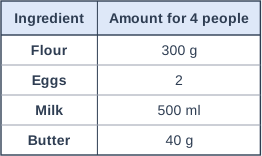
To scale a recipe, multiply every ingredient by the same number. Find that number by dividing the new number of people by the old one (or work out the recipe for one person first).
A smoothie for 4 people uses 300 g of strawberries, 2 bananas and 500 ml of yoghurt. How much of each is needed for 6 people?
\(6 \div 4 = 1.5\), so multiply everything by 1.5:
- Strawberries: \(300 \times 1.5 = 450\) g
- Bananas: \(2 \times 1.5 = 3\)
- Yoghurt: \(500 \times 1.5 = 750\) ml
Best buys
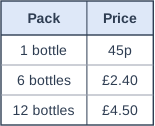
To find the best buy (the best value for money), compare the same amount of each offer. Either work out the unit price (the cost of one item, or of 100 g), or scale both offers up to the same amount.
Tea bags come in a box of 80 for £2.40 or a box of 200 for £5.50. Which box is better value?
Method 1, the cost of one tea bag:
- Box of 80: \(240 \div 80 = 3\)p each
- Box of 200: \(550 \div 200 = 2.75\)p each
Method 2, the cost of 400 tea bags:
- 5 boxes of 80: \(5 \times 2.40 = 12\), so £12
- 2 boxes of 200: \(2 \times 5.50 = 11\), so £11
Both methods show that the box of 200 is better value.
Exchange rates
An exchange rate tells you what one currency (a country's money) is worth in another. Pounds and US dollars are in direct proportion, so an exchange rate works just like a unit price.
The exchange rate is £1 = 1.30 US dollars. Change £60 into dollars, and 52 dollars into pounds.
Pounds into dollars, multiply: \(60 \times 1.30 = 78\) dollars.
Dollars into pounds, divide: \(52 \div 1.30 = 40\), so £40.
Check: £1 is worth more than 1 dollar, so you should get more dollars than pounds, and fewer pounds than dollars.
Is it direct proportion?
Divide one amount by the other for each pair. If you always get the same answer, they are in direct proportion.
| Cinema tickets | 2 | 3 | 5 |
|---|
| Cost | £14 | £21 | £35 |
\(14 \div 2 = 7\), \(21 \div 3 = 7\) and \(35 \div 5 = 7\), so yes: every ticket costs £7. A bike hire shop that charges £3 to start plus £2 an hour is not in direct proportion: 1 hour costs £5, but 2 hours cost £7, not £10.
Remember
- Direct proportion: double one amount and the other doubles too.
- Unitary method: find the value of one, then multiply.
- Best buy: compare the cost of the same amount.
- Pounds into another currency: multiply by the rate. Back into pounds: divide.
Common mistakes
- Adding instead of multiplying: to change a recipe for 4 into a recipe for 6, multiply by 1.5. Do not add 2 of everything.
- Choosing the cheapest pack without comparing the same amount of each.
- Multiplying by the exchange rate when changing back into pounds. Going back, divide.
- Saying two amounts are in proportion just because both go up. They must go up at the same rate.
- Mixing pence and pounds: 750p is £7.50, not £750.
Top tip
Write the two amounts in two columns with labels ("balls" and "cost"). Whatever you do to one column, do to the other: ÷ 6 to get one ball, then × 10.