Level:
Correct: 0
Incorrect: 0
Marks: 0/0
Practice
Course:
Topics:
Year 7 Maths Smart practice A mixed round aimed at your weak spots
Unit 1
Place value and the number system
Unit 2
Calculating
Unit 3
Factors, multiples and powers
Unit 4
Fractions
Unit 5
Fractions, decimals and percentages
Unit 6
Algebraic expressions
Unit 7
Equations and inequalities
Unit 8
Sequences and graphs
Unit 9
Ratio and proportion
Ratio, proportion and rates of change
Writing and simplifying ratios
Quick practice5 skills
Sharing in a ratio
Quick practice5 skills
Proportion and best buys
Quick practice5 skills
Scale drawings and maps
Quick practice4 skills
Unit 10
Measures, perimeter, area and volume
Unit 11
Angles and shapes
Unit 12
Probability
Unit 13
Statistics
Avg
score:
–
Topics
done:
0/63

Volume of cubes and cuboids

Practise 25 questions on Volume of cubes and cuboids for Year 7 Maths. Tap or type your answer and find out straight away if you are right, with the Study Helper on hand if you get stuck.

  • 25 questions
  • 1–5 marks each
  • Instant marking
  • No sign-up needed
20 questions, marked as you go

Sample questions with model answers

Here are 4 of the questions in this topic, each with a model answer, an explanation of why it earns the marks and the mark scheme.

Question 1

1 mark

A cuboid is 5 cm long, 4 cm wide and 2 cm high.

Work out the volume of the cuboid in cm³.

Model answer

Volume = length × width × height
\(5 \times 4 \times 2 = 40\)
Volume = 40 cm³

Explanation

The volume of a cuboid is length × width × height. Here \(5 \times 4 = 20\) cubes would cover the base, and there are 2 layers, so \(20 \times 2 = 40\) cm³. A common mistake is to add the three lengths instead of multiplying them.

Mark scheme
  1. 1 mark

    40 (cm³)

    \(5 \times 4 \times 2 = 40\). The unit is given in the question, so 40 on its own scores the mark. Do not accept 11 (adding the lengths) or 76 (the surface area).

Question 2

2 marks

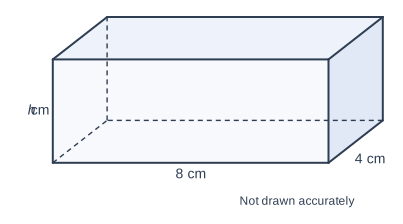
The diagram shows a cuboid. Its volume is 96 cm³.

Work out the height, h.

A cuboid drawn in 3D with hidden edges shown as dashed lines. The length is labelled 8 cm (along the front bottom edge). The width (the edge going back) is labelled 4 cm (along the bottom edge going back on the right). The height is labelled h cm (along the front left vertical edge). The diagram is labelled "Not drawn accurately".

Model answer

Area of base = \(8 \times 4 = 32\) cm²
\(h = 96 \div 32 = 3\)
h = 3 cm

Explanation

Volume = length × width × height, so \(8 \times 4 \times h = 96\). The base has an area of 32 cm², so you need to know how many 32s make 96: \(96 \div 32 = 3\). Check: \(8 \times 4 \times 3 = 96\). A common mistake is to subtract the lengths from 96 instead of dividing.

Mark scheme
  1. 1 mark

    \(8 \times 4 = 32\) and \(96 \div 32\) seen or used; or the correct answer 3 with no working

    Also award for \(96 \div 8 = 12\) then \(12 \div 4\), or for a correct trial such as \(8 \times 4 \times 3 = 96\).

  2. 1 mark

    3 (cm)

    Accept h = 3. Units not needed. A correct answer with no working scores full marks.

Question 3

3 marks

Box A is a cuboid 6 cm long, 4 cm wide and 5 cm high.
Box B is a cuboid 8 cm long, 3 cm wide and 5 cm high.

Raj says, "Box B has a bigger volume than box A, because box B is longer."

What is the volume of each box? Is Raj right?

Model answer

Box A: \(6 \times 4 \times 5 = 120\) cm³
Box B: \(8 \times 3 \times 5 = 120\) cm³
No, Raj is wrong. Both boxes have the same volume, 120 cm³.

Explanation

To compare volumes you must work them out, not just look at one length. Box B is longer, but it is also narrower, and both come to 120 cm³. A common mistake is to judge which box is bigger from one measurement only.

Mark scheme
  1. 1 mark

    Volume of A = \(6 \times 4 \times 5 = 120\) (cm³)

    The value 120 for box A is enough.

  2. 1 mark

    Volume of B = \(8 \times 3 \times 5 = 120\) (cm³)

    The value 120 for box B is enough.

  3. 1 mark

    No, Raj is wrong: the boxes have the same volume (both 120 cm³)

    Needs both volumes correct. 'No' alone, or 'No, B is not longer', scores 0 for this mark.

Question 4

4 marks

A box is a cuboid 20 cm long, 15 cm wide and 12 cm high.

Mia wants to pack cubes with edges 4 cm long into the box.

Mia says, "The box has a volume of 3600 cm³ and each cube has a volume of 64 cm³. \(3600 \div 64 = 56.25\), so 56 cubes will fit."

Is Mia right? How do you know? How many cubes will really fit?

Model answer

Mia is not right. The width is 15 cm and 4 does not go exactly into 15, so the cubes leave gaps.
Along 20 cm: \(20 \div 4 = 5\) cubes
Along 15 cm: only 3 cubes (12 cm), with a 3 cm gap
Up 12 cm: \(12 \div 4 = 3\) cubes
\(5 \times 3 \times 3 = 45\) cubes

Explanation

Dividing volumes only works when the small cubes fit exactly along every edge. Here 4 cm cubes leave a 3 cm gap across the 15 cm width, and that space cannot be filled with whole cubes. Count how many fit along each edge instead: 5, 3 and 3, so 45 cubes fit. This is a common trap, so always check the edges first.

Mark scheme
  1. 1 mark

    Explains that Mia is wrong because 4 does not go exactly into 15 (the width), so there would be gaps / cubes cannot be cut to fill the space

    Accept 'only 3 cubes fit across the 15 cm side, leaving a 3 cm gap', or 'No' together with working that shows only 3 cubes fit along the 15 cm edge. 'No' alone, or 'No, because 56.25 is not a whole number', scores 0.

  2. 1 mark

    Finds 5, 3 and 3 cubes along the edges (\(20 \div 4 = 5\), 15 cm takes 3 cubes, \(12 \div 4 = 3\))

    All three numbers needed.

  3. 1 mark

    \(5 \times 3 \times 3\)

    Follow through from their numbers along the edges, if they are whole numbers.

  4. 1 mark

    45 cubes

    A correct answer of 45 with no working scores the last three marks but not the explanation mark.

Ready to try the rest? Tap or type your answers and see straight away how you did.

Topic notes

Volume of cubes and cuboids

The big idea

Volume is the amount of space a 3D shape takes up. You measure it by counting how many small cubes would fill it. Capacity is how much a container can hold, often measured in millilitres (ml) or litres.

Counting cubes

A centimetre cube has edges 1 cm long. Its volume is 1 cubic centimetre, written 1 cm³. The volume of a solid made from centimetre cubes is the number of cubes, including any you cannot see.

A solid made from cubes, drawn on isometric paper: 4 cubes wide, 3 deep and up to 2 high, standing on a flat base (every stack goes down to the base). Cubes in each stack, as seen from above (back row first, each row left to right): [2, 2, 2, 2], [2, 2, 2, 2], [2, 2, 2, 2]. Total 24 cubes. Volume: 24 cube units. Surface area: 52 square faces of a cube (including the base).
A cuboid 4 cubes long, 3 cubes wide and 2 cubes high. Each layer has 4 × 3 = 12 cubes, and there are 2 layers, so it is made of 24 cubes.

Counting in layers is quicker than counting one cube at a time: find the number of cubes in one layer, then multiply by the number of layers.

The formula

Counting layers leads to the rule for any cuboid (a box shape with six rectangular faces):

\[ \text{volume} = \text{length} \times \text{width} \times \text{height} \]
A cuboid drawn in 3D with hidden edges shown as dashed lines. The length is labelled length (along the front bottom edge). The width (the edge going back) is labelled width (along the bottom edge going back on the right). The height is labelled height (along the front left vertical edge). The diagram is labelled "Diagram NOT accurately drawn".
The three measurements of a cuboid. Multiply them together to find the volume.

A cube has all its edges the same length, so its volume is edge × edge × edge.

Units of volume and capacity

  • Lengths in cm give a volume in cm³. Lengths in m give m³ (cubic metres), for big things such as rooms and skips.
  • All three lengths must be in the same unit before you multiply.
  • 1 cm³ = 1 ml, and 1000 ml = 1 litre, so 1000 cm³ = 1 litre.

How many plant pots does one bag of compost fill?

The inside of each pot is a cube with edges 20 cm long. Compost is sold in 50-litre bags. How many pots can one bag fill completely?

Volume of a pot: \(20 \times 20 \times 20 = 400 \times 20 = 8000\) cm³

1 cm³ = 1 ml, so this is 8000 ml, and 1000 ml = 1 litre, so each pot holds \(8000 \div 1000 = 8\) litres.

8 goes into 50 six times (\(6 \times 8 = 48\)), so one bag fills 6 pots, with 2 litres left over.

Finding a missing length

Length × width gives the area of the base, and the volume is base area × height. So if you know the volume, divide it by the base area to find the height.

How deep is the water in the tank?

A fish tank has a rectangular base 50 cm by 40 cm. Ola pours in 30 litres of water. How deep is the water?

Change litres into cm³: \(30 \times 1000 = 30\,000\) cm³.

Base area: \(50 \times 40 = 2000\) cm².

Depth: \(30\,000 \div 2000 = 15\) cm.

Check: \(50 \times 40 \times 15 = 30\,000\) cm³, which is 30 litres.

How many boxes fit?

To find how many small boxes fit inside a big box, work out how many fit along each edge, then multiply. Only whole boxes fit, so round each answer down. Dividing one volume by the other only works when the small boxes fit exactly along every edge.

How many matchboxes fit in the carton?

A carton is 20 cm long, 16 cm wide and 10 cm high. Matchboxes 5 cm long, 3 cm wide and 2 cm high are packed in rows, all the same way up. How many fit?

Along the length: \(20 \div 5 = 4\)

Across the width: 3 goes into 16 five times with 1 left over, so 5 fit and a 1 cm gap is left.

Up the height: \(10 \div 2 = 5\)

Number of matchboxes: \(4 \times 5 \times 5 = 100\)

Dividing the volumes, \(3200 \div 30 = 106.7\) (to 1 decimal place), gives too many: no matchbox fits in the 1 cm gap.

Stretch: surface area

The surface area of a cuboid is the total area of its 6 faces, in cm² or m². The faces come in 3 matching pairs, so find 3 different faces and double the total.

How much card makes an open box?

A box with no lid is 10 cm long, 5 cm wide and 4 cm high. How much card is needed to make it?

There is no lid, so count 5 faces, not 6.

Bottom: \(10 \times 5 = 50\) cm²

Front and back: \(10 \times 4 = 40\) cm² each, so 80 cm²

Two ends: \(5 \times 4 = 20\) cm² each, so 40 cm²

Card needed: \(50 + 80 + 40 = 170\) cm²

Common mistakes

  • Adding the three lengths instead of multiplying them.
  • Using cm² for a volume. Volume is in cubic units (cm³, m³); area is in square units.
  • Counting only the cubes you can see in a drawing.
  • Multiplying lengths in different units, such as metres and centimetres.
  • Dividing volumes to find how many boxes fit when they do not fit exactly.

Top tip

Write the unit at every step: lengths in cm, areas in cm², volumes in cm³. If a question asks for litres, find the volume in cm³ first, then divide by 1000.

Study Helper Hints first, answers after you try

Stuck on this one? Ask for a hint and I’ll point you in the right direction, without giving the answer away. Once you’ve checked your answer, I’ll show you how the marks are awarded.