Level:
Correct: 0
Incorrect: 0
Marks: 0/0
Practice
Course:
Topics:
Year 7 Maths Smart practice A mixed round aimed at your weak spots
Unit 1
Place value and the number system
Unit 2
Calculating
Unit 3
Factors, multiples and powers
Unit 4
Fractions
Unit 5
Fractions, decimals and percentages
Unit 6
Algebraic expressions
Unit 7
Equations and inequalities
Unit 8
Sequences and graphs
Unit 9
Ratio and proportion
Ratio, proportion and rates of change
Writing and simplifying ratios
Quick practice5 skills
Sharing in a ratio
Quick practice5 skills
Proportion and best buys
Quick practice5 skills
Scale drawings and maps
Quick practice4 skills
Unit 10
Measures, perimeter, area and volume
Unit 11
Angles and shapes
Unit 12
Probability
Unit 13
Statistics
Avg
score:
–
Topics
done:
0/63

Converting fractions, decimals and percentages

Practise 30 questions on Converting fractions, decimals and percentages for Year 7 Maths. Tap or type your answer and find out straight away if you are right, with the Study Helper on hand if you get stuck.

  • 30 questions
  • 1–5 marks each
  • Instant marking
  • No sign-up needed
20 questions, marked as you go

Sample questions with model answers

Here are 4 of the questions in this topic, each with a model answer, an explanation of why it earns the marks and the mark scheme.

Question 1

1 mark

What is \(\dfrac{3}{4}\) as a decimal?

Model answer

\(\dfrac{3}{4} = \dfrac{75}{100} = 0.75\)

Explanation

\(\dfrac{1}{4}\) is 0.25, so \(\dfrac{3}{4}\) is three lots of 0.25, which is 0.75. You can also multiply the top and bottom by 25 to get \(\dfrac{75}{100}\). A common mistake is to use the digits of the fraction and write 0.34.

Mark scheme
  1. 1 mark

    0.75

    Accept .75. 3.4, 0.34 or 0.3 scores 0. 75% is not a decimal and scores 0.

Question 2

2 marks

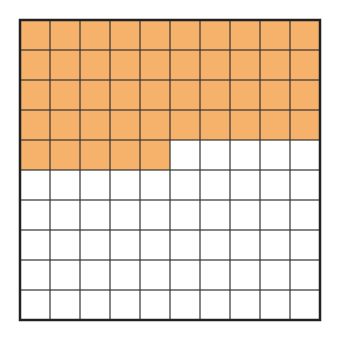
The hundred square is split into 100 equal small squares. Some of the squares are shaded.

What fraction of the hundred square is not shaded? Give your answer in its simplest form.

A hundred square: a 10 by 10 grid of 100 equal small squares. The top four rows are completely shaded, and the first 5 squares on the left of the fifth row are shaded. The rest of the grid is white.

Model answer

Shaded: \(40 + 5 = 45\) squares
Not shaded: \(100 - 45 = 55\) squares
\(\dfrac{55}{100} = \dfrac{11}{20}\)

Explanation

45 squares are shaded, so 55 of the 100 squares are not shaded: \(\dfrac{55}{100}\). The highest common factor of 55 and 100 is 5, so divide the top and bottom by 5 to get \(\dfrac{11}{20}\). A common mistake is to give the shaded fraction instead of the part that is not shaded.

Mark scheme
  1. 1 mark

    \(\dfrac{55}{100}\) (55 squares are not shaded) or an equivalent fraction; or the correct answer \(\dfrac{11}{20}\) with no working

  2. 1 mark

    \(\dfrac{11}{20}\)

    Only 11/20 scores this mark. 45/100 or 9/20 (the shaded part) scores 0. 0.55 or 55% is not a fraction and does not score this mark. A correct answer with no working scores full marks.

Question 3

2 marks

Which is larger, 0.7 or \(\dfrac{2}{3}\)?

Show how you decide: what is \(\dfrac{2}{3}\) as a decimal?

Model answer

\(\dfrac{2}{3}\) = 0.666...
0.7 = 0.700
0.700 is bigger than 0.666..., so 0.7 is larger.

Explanation

Write both numbers as decimals. \(\dfrac{1}{3}\) is 0.333..., so \(\dfrac{2}{3}\) is 0.666..., and 0.7 is 0.700. Comparing the tenths, 7 tenths is more than 6 tenths, so 0.7 is larger. A common mistake is to use the digits of the fraction and think \(\dfrac{2}{3}\) is 0.23.

Mark scheme
  1. 1 mark

    \(\dfrac{2}{3}\) = 0.666... (or 66.7%), or both numbers written as fractions with a common denominator, e.g. \(\dfrac{21}{30}\) and \(\dfrac{20}{30}\)

    Accept 2/3 = 0.67 or 0.66 (rounded or cut short).

  2. 1 mark

    0.7, with a correct comparison

    Needs the previous mark. '0.7' with no working scores 0, because the question asks you to show how you decide.

Question 4

4 marks

Every pupil in Year 7 chose one club. \(\dfrac{2}{5}\) of the pupils chose football, 0.35 of the pupils chose drama and 9% of the pupils chose chess. The rest chose art.

What fraction of the pupils chose art? Give your answer in its simplest form.

Model answer

Football: \(\dfrac{2}{5}\) = 40%
Drama: 0.35 = 35%
Chess: 9%
Together: \(40 + 35 + 9 = 84\), so 84%
Art: \(100 - 84 = 16\), so 16%
16% = \(\dfrac{16}{100} = \dfrac{4}{25}\)

Explanation

Put all three amounts into the same form, such as percentages: 40%, 35% and 9%, which add up to 84%. All the pupils make 100%, so 16% chose art. Then write 16% as \(\dfrac{16}{100}\) and divide the top and bottom by 4 to get \(\dfrac{4}{25}\). A common mistake is to stop at \(\dfrac{16}{100}\), which is not in its simplest form.

Mark scheme
  1. 1 mark

    \(\dfrac{2}{5}\) = 40% (or 0.4), or 0.35 = 35%; or the correct answer \(\dfrac{4}{25}\) with no working

    Any common form is fine (all percentages, all decimals or all hundredths).

  2. 1 mark

    84% (or 0.84 or \(\dfrac{84}{100}\)) chose football, drama or chess

  3. 1 mark

    16% (or 0.16 or \(\dfrac{16}{100}\)) chose art

  4. 1 mark

    \(\dfrac{4}{25}\)

    Only 4/25 scores this mark. 16/100, 8/50, 16% or 0.16 on its own scores the first three marks. A correct answer with no working scores full marks.

Ready to try the rest? Tap or type your answers and see straight away how you did.

Topic notes

Converting fractions, decimals and percentages

The big idea

Fractions, decimals and percentages are three ways of writing the same amount. Half a pizza is \(\dfrac{1}{2}\), 0.5 or 50% of the pizza. Changing from one form to another helps you compare amounts.

What a percentage means

Per cent means "out of 100". A percentage is a number of parts per hundred, so 30% means 30 parts out of every 100. On a hundred square (a grid of 100 equal small squares), each small square is 1% and the whole grid is 100%.

100% is one whole, so a percentage bigger than 100% means more than one whole: 250% is two and a half wholes.

The key facts to learn

FractionDecimalPercentage
\(\dfrac{1}{2}\)0.550%
\(\dfrac{1}{4}\)0.2525%
\(\dfrac{3}{4}\)0.7575%
\(\dfrac{1}{5}\)0.220%
\(\dfrac{1}{8}\)0.12512.5%
\(\dfrac{1}{10}\)0.110%
\(\dfrac{1}{100}\)0.011%
\(\dfrac{1}{3}\)0.333...about 33.3%

The dots in 0.333... mean that the 3s go on for ever, so \(\dfrac{1}{3}\) is not exactly 0.3. You can build other facts from these: \(\dfrac{3}{5}\) is three lots of \(\dfrac{1}{5}\), so it is 0.6 or 60%.

A horizontal scale from 0 to 1, divided into 4 equal parts by long marks, each split into 5 small divisions by short marks. Every long mark is numbered (0, ¼, ½, ¾ and 1). Long marks are every ¼ and each small division is 0.05. Words under the scale: "0 = 0%" at 0, "0.25 = 25%" at ¼, "0.5 = 50%" at ½, "0.75 = 75%" at ¾ and "1 = 100%" at 1.
A number line from 0 to 1, marked in quarters. Under each fraction is the same amount as a decimal and as a percentage. Each small step is 0.05, or 5%.

Percentages and decimals

A percentage is a number of hundredths. In a decimal, the second digit after the point shows hundredths.

  • Percentage to decimal: divide by 100. So 64% = 0.64 and 8% = 0.08
  • Decimal to percentage: multiply by 100. So 0.29 = 29% and 2.05 = 205%

Fractions to decimals and percentages

The numerator is the top number of a fraction and the denominator is the bottom number.

Method 1: equivalent fractions (fractions that are worth the same). Multiply the top and the bottom by the same number to make the denominator 10, 100 or 1,000. Then read off the decimal.

A survey finds that \(\dfrac{7}{25}\) of the pupils in a school walk to school. Write this as a decimal and as a percentage.

\(25 \times 4 = 100\), so multiply the top and the bottom by 4: \(\dfrac{7}{25} = \dfrac{28}{100}\)

28 hundredths is 0.28 as a decimal, and 28 out of 100 is 28%.

Method 2: short division. A fraction is a division: \(\dfrac{3}{5}\) means \(3 \div 5\). This works even when the denominator does not go into 10, 100 or 1,000.

Use short division to write \(\dfrac{1}{3}\) as a decimal.

\(\dfrac{1}{3}\) means \(1 \div 3\). Write 1 as 1.000.

3 into 1 goes 0 times, remainder 1. Then 3 into 10 goes 3 times, remainder 1, again and again.

The remainder is always 1, so the 3s never stop: \(\dfrac{1}{3} = 0.333...\)

Decimals and percentages to fractions

Write the amount as tenths, hundredths or thousandths. Then simplify: divide the top and the bottom by the same number until you cannot go any further. For example, 0.65 is 65 hundredths, and \(\dfrac{65}{100} = \dfrac{13}{20}\) (divide both by 5).

A phone battery shows 85%. What fraction of a full charge is that? Give the fraction in its simplest form.

85% means 85 out of 100: \(\dfrac{85}{100}\)

85 and 100 are both in the 5 times table, so divide the top and the bottom by 5: \(\dfrac{17}{20}\)

No whole number bigger than 1 divides into both 17 and 20, so \(\dfrac{17}{20}\) is in its simplest form.

Ordering a mixture

To compare amounts, change them all into the same form first.

Write these in order of size, largest first: \(\dfrac{1}{3}\), 0.03, 33%, \(\dfrac{3}{10}\)

As percentages: \(\dfrac{1}{3}\) is about 33.3%, 0.03 is 3%, 33% stays the same, and \(\dfrac{3}{10}\) is 30%.

Largest first: 33.3%, 33%, 30%, 3%

So the order is \(\dfrac{1}{3}\), 33%, \(\dfrac{3}{10}\), 0.03

Remember

  • Per cent means "out of 100".
  • Percentage to decimal: divide by 100. Decimal to percentage: multiply by 100.
  • 100% is one whole.

Common mistakes

  • Writing 0.6 as 6%. 0.6 is 6 tenths, which is 60 hundredths, so it is 60%.
  • Using the digits of a fraction as a decimal: \(\dfrac{2}{5}\) is not 0.25. It is \(2 \div 5 = 0.4\).
  • Dividing the wrong way round: \(\dfrac{3}{5}\) is \(3 \div 5\), not \(5 \div 3\). A fraction less than 1 gives a decimal less than 1.
  • Forgetting the whole one: 1.45 is 145%, not 45%.

Top tip

To compare or order numbers, change them all into the same form (percentages are often easiest). Then write your answer using the numbers exactly as the question gave them.

Study Helper Hints first, answers after you try

Stuck on this one? Ask for a hint and I’ll point you in the right direction, without giving the answer away. Once you’ve checked your answer, I’ll show you how the marks are awarded.